Winterton Prayer
PRAYER FOR THE AUTHOR AND OTHER
WINTERTONS WHO GROW OLDER DAY BY DAY
Lord, thou knowest better
than I know myself that I am growing older and will some day be old. Keep me from the fatal habit of thinking I must say something on every
subject- and on every occasion. Release
me from craving to try to straighten out every Winterton’s affairs.
Lord, make me thoughtful
but not moody; helpful but not bossy. With my vast store of wisdom, it seems a
pity not to use it all--but thou knowest,
Lord, that I want a few friends at the end.
Lord, keep my mind free
from the recital of endless details.. . Give me wings to get to the point. Seal
my lips on my aches and pains. They are increasing and love of rehearsing them
is becoming sweeter as the years go by...
I dare not ask for grace enough to enjoy the tales of other Winterton
pains but help me to endure them with patience.
Lord, I dare not ask for
improved memory, but allow me a growing humility and a lessening cocksureness
when my memory seems to clash with the memories of other Wintertons. Teach me
the glorious lesson that occasionally I may be mistaken.
Lord, keep me reasonably
sweet; I do not want to be a saint--some of them are so hard to live with- -but
a sour old per son is one of the crowning works of the devil. Give me the
ability to see good things in unexpected places and
talents in ordinary people.
Give me the grace to tell them so.
Amen
The Winterton Family Reunion
The Winterton Family
Reunion is a regularly scheduled annual event at the Charleston, Wasatch County,
Utah Memorial Park. On the first Saturday of August each year the descendants of Utah’s Pioneer
William Hubbard Winterton bring their picnic lunches at noon and renew acquaintances
as they break bread.
This picturesque location
on the northern shores of the Deer Creek (Reservoir) Lake with its superb view
of the eastern slopes of majestic Mount Timpanogos is the scene, several hours later,
of a vocal and instrumental family talent program. Before each group separates
to return
home, anecdotes and reminiscences
of the lives of progenitors are exchanged and the names of brand new cousins
are added to family records.
It was my privilege to
attend the Winterton Family Reunion on Saturday, 3 August 1963, which noted the 100th anniversary of the
emigration of William Hubbard Winterton 1816-1890 and his two sons John
Marriott Winterton 1844-1910 and William Winterton 1846-1929 from Nottingham, England
to Great Salt Lake City, Utah. They were
reported to have been tramping in the dust of a covered wagon train in
company with several hundred other Saints facing westward beside the banks of
the Platte River somewhere in Nebraska at exactly this same hour, day, week and
month in 1863--100 years ago.
Honored as the Senior
Winterton citizen in attendance was Hyrum Shurtliff Winterton born 16 August
1878 at Charleston, Utah son of William and Ellen Widdison Winterton. The only other
grandchild of William Hubbard and Sarah Marriott Winterton present .at this
reunion was Carrie Winterton Davis born 5 May 1893 daughter of William and Jane
Steadman Winterton. A score or more of William’s grandchildren; Mrs. Bessie (Gill)
Wahlen, Ann’s granddaughter; Mrs. Viola (Coleman) Coleman, John’s granddaughter;
and William Hubbard Winterton’ s great grandchildren were also present as were
numerous fifth and sixth generation Winterton descendants from many parts of
the state.
The committee responsible
for making arrangements for the 1964 Winterton Family - Reunion is headed by Mr.
Sherron J. Winterton, son
of Valeo James Winterton, grandson of William Winterton and great grandson of
Pioneer William Hubbard Winterton. A capacity attendance will be
welcomed.
Winterton Family Reunion 2005
|
Please RSVP to Jack Simmons at 989-642-8850 or cell at
989-928-1084 or 989 928 1072 or you may reply to Jack Simmons by email:
jacksimmons@speednetllc.com
The Wasatch County chapter
of the Daughters of Utah Pioneers has this year of 1963 published a 1200 page
centennial history of Wasatch County. Section six of this ten section volume
contains Charleston’s history and biographies of several Wintertons and many
other pioneers of that community. See its pages 991 to 1045. The name of the book
is “How Beautiful upon the Mountains.” It
was printed by the Desert News Press of Salt Lake City, Utah.
What They Say
“Every man is his own ancestor and every man his own
heir. He devises his own future, and he inherits his own past.”
--Frederick Henry
Hedge
“The study of history is lifeless without genealogy.”
--John Fiske
““Those who do not treasure up the memory of their
ancestors do not deserve to be remembered by posterity.”
--Sir Edmund Burke
“He who cares not whence he came, cares not whither he
goes.”
--Ben Johnson
“These were their dwelling places and their genealogical
enrollments.”
I Chronicles Chapter 4
Verse 33
“So all Israel were reckoned by genealogies and their
names were written in the book.”
I Chronicles Chapter 9
Verse 1
“For a book of remembrance we have written among us,
according to the pattern given by the finger of God, and it is given in our own
language.”
Pearl of Great Price
Moses 6:46
“Consider the
years back from generationto generation, ask your father and he can
tell you.”
Deuteronomy 32:7
“… my God put it into my heart that I should collect the people (by name) to
get them enrolled genealogically. . . “
Nehemiah 7: 5
33 Winterton Grandchildren
WILLIAM HUBBARD AND SARAH
MARRIOTT WINTERTON’S
33 GRANDCHILDREN IN CHRONOLOGICAL
ORDER OF BIRTH
Name Born
1.
Sarah Ellen Winterton 10 Dec 1870
2.
John Eugene Winter ton 18 Jan 1871
3.
Sarah Ann Noakes 9 May 1871
4.
Eliza Ann Winterton 9 Oct 1872
5.
Sarah Sophia Winterton 11 Nov 1872
6.
Rosetta Noakes 23
April 1873
7.
Eliza Ann Winterton 9 June 1874
8.
William Heber Winterton 4 Oct 1874
9.
Anne Noakes 1
Feb 1875
10.
John Joseph Winterton 31 Aug 1876
11.
Emma Winterton 2 Dec
1876
12.
Twin Parker 8
Feb 1878
13.
John William Parker 8 Feb 1878
14.
George William Winterton 5 July 1878
15.
Hyrum Shurtliff
Winterton 16 Aug
1878
16.
Eliza Ann Parker 30 Dec
1879
17.
Ralph Stafford Winterton 27 Sept 1880
18.
Joseph Winterton 4
Dec 1880
19.
Moroni Winterton 28 Sept
1882
20.
Hyrum Winterton 6 Feb 1883
21.
Baby Winterton 26 Oct
1884
22.
Frederick Parker 3 Nov
1884
23.
David Winterton 5 Oct
1885
24.
Thomas Frederick
Winterton 14 Aug 1886
25.
Rose Anna Winterton 29 May 1887
26.
Alice Malissa Winterton 31 July 1888
27.
Henry Winterton 2 Dec
1889
28.
Robert F Winterton 10 Feb 1891
29.
Isabella Winterton 17 Feb
1893
30.
Carrie Elizabeth Winterton 5 May 1893
31.
Nettie Rachel Winterton 7 May 1895
32.
Edward Marriott
Winterton 16 Sept
1897
33.
Valeo “Leo” James Winterton 10 Oct 1900
Table of Contents
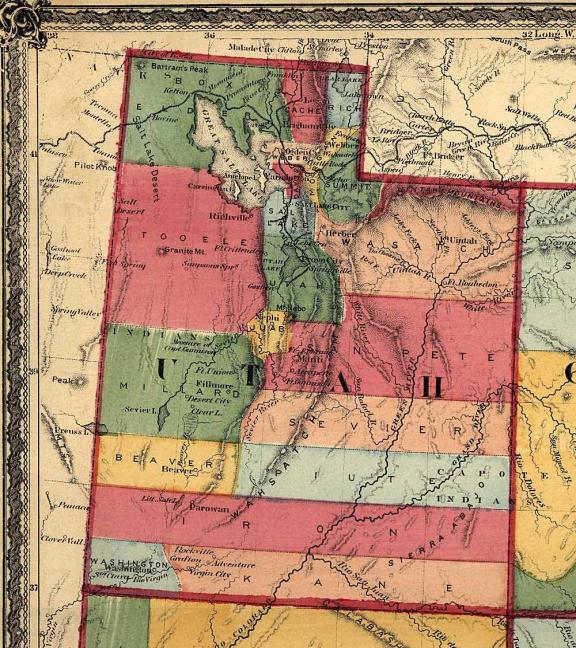
Utah Territory and its counties
around 1874
4000-2370 B.C. - Antediluvian
Ancestors
2369-2000 B.C. - Post Flood
Ancestors
2000 B.C. - 500 B.C. -
Pre-Historical Period
500 B.C. to 1000 A.D. - Ancient
Times
500 - 600 A.D. - What’s in a Name
1000 to 1700 A.D. - Medieval
Chronology
1700 A.D. to Present - Modern
Chronology
Biography of William Hubbard
Winterton
Journal Entries of William Hubbard
Winterton
Sarah Sophia Winterton Simmons
Alice Malissa Winterton Thomson
Carrie Elizabeth Winterton Davis
The George & Sophia Noakes
Family
Foreword
For the past several years
it has been my pleasure to participate in the preparation of family histories
for Viola’s paternal ancestors. During
this time certain of her
maternal ancestors families’ names and genealogical data has come into my
possession.
Because this is the one
hundredth anniversary of *e emigration of William Hubbard Winterton from
England to Utah, it seemed particularly fitting that a record of his posterity be
compiled together with biographical and historical data to commemorate that
event.
The Winterton family have
been Christian believers as far back as we have records concerning them so it
was felt proper to proceed on the basis of the 6, 000 year old Bible chronology
for our progenitors history.
Evolutionists and pseudo –anthropologists
who would make of our Winterton ancestor s some subhuman type of creature
emerging from the mire of many millions of years ago, are welcome to prepare
their own genealogies of our first earthly parents if they care to do so; but I
prefer the Christian belief.
My first view of Charleston
and Wasatch County came about the middle
of the 1930 decade some 30 years ago. This was before the Deer Creek Dam had
been constructed and before the backed-up waters of Provo River covered the
land that furnished sustenance to members of the Winterton family.
I hope you will find “Winterton
Pioneers of Utah” a suitable memorial to the family, which with some 80,000
other Utah pioneers endured so much to emigrate from their homelands. The establishment of homes in Zion where they
could worship according to their religious convictions was the accomplishment
of William Hubbard, John, William, Ann, Tom and Sarah Winterton.
As a family historian my
efforts are strictly amateurish. Perhaps it is because I recognized my own shortcomings that I felt
impelled to prepare this incomplete record. May all the future Wintertons add to what is presently known of
the family.
Arthur D. Coleman
4014 S. 565 E. St.
Salt Lake City, Utah
1 February 1964
Since most of the Winterton
progeny are so closely associated with Utah agriculture- - - raising live stock
and producing hay, grain and foodstuffs the following poem (adapted) seemed a
most appropriate tribute.
Wintertons Feed Them All
The politician talks
and talks,
The actor plays his
part;
The soldier glitters
on parade,
The goldsmith plies
his art.
The sailor navigates
his ship,
O’er this terrestrial ball,
The scientist pursues
his germ
And Wintertons feed
them all.
The preacher pounds
his pulpit desk,
Brokers read their
tape;
The tailor cuts and
sews his cloth
To fit the human shape.
The dame of fashion,
dressed in silks,
Goes forth to dine or
call,
Or drive, or dance, or
promenade,
But Wintertons feed
them all.
The workman wields his
shiny tools,
The merchant shows his
wares;
The astronaut above
the clouds
A dizzy journey dares.
But art and science soon would fade,
And commerce dead
would fall,
If the farmer ceased
to reap and sow,
For Wintertons feed
them all.
Acknowledgments
This book would not have
been possible if our unknown Winterton ancestors of the 12th-16th
centuries had heeded the spurious advice of the Arab philosopher Abu ala Al-Ma’
Arri of the eleventh Century who wrote:
“If ye unto your sons would
prove
By act how dearly them you
love
Then every voice of wisdom
joins
To bid you leave them in your loins.”
Thank goodness our
Winterton progenitors were Christian Englishmen and women who did not heed, and
probably never heard of, the Arabian writer.
I particularly want to
express my thanks and appreciation to the Salt Lake Genealogical Association
for their generous and gratuitous permission to use library and archive
facilities. for research basic
to this book. Many of the Winterton pioneer s and their de scendants have deposited
with the above organization their immediate family data.
I am indebted to them and
to contemporary cousins and other Winterton relative s for the names and birth
dates of 3rd, 4th and 5th cousins. Most of these names were supplied in response
to letters, phone calls and personal contacts.
Pictures of our Winterton
ancestors have been preserved by various descendants and family lines who sent
the photos of the Winterton Pioneers which are presented here. Likewise much of
the biographical material came from Winterton Family Memory books.
The name s of the
descendants of the Winterton pioneers who
have been most responsible for helping bring this book to completion by
their encouragement, verbal and financial, are shown here in alphabetical order
not only as an acknowledgment of their subscription but also as an accolade to
their family kinsmanship.
Mr. & Mrs. Farrell Abplanalp
Mr. & Mrs. Harris Bethers
Mrs. Velda Winterton Carlson
Mr. & Mrs. Duane
Galli
Mr. & Mrs. Alfred Allen Giles
Mr. &.Mrs. Roy Giles
Mr. & Mrs. Kenneth O. Gotberg
Mr. & Mrs. Grant Davis Gray
Mr. & Mrs. Hy Hainsworth
Mrs. Mervel G. W. Hall
Mr. & Mrs. John I. Hallmark
Mr. & Mrs. King Hendricks
Mrs. Florence G. Johnson
Mrs. Lillie G. Johnson
Mr. & Mrs. Ralph Kubni
Mr. & Mr S. Glade Kuhni
Ms. & Mr S. Melvin Kuhni
Mr. & Mrs. Arlin Kuhni
Mr. & Mrs. Theron Kuhni
Mr. . & Mrs. s. Ned LeSueur
Mr. & Mr s. Manuel Monis
Mr. & Mrs. Boyd A. Murray
Mr. & Mrs. Kenneth M. Nave
Mrs. Zella B. Nelson
M & Mrs. Arnold Paxman
Mr. & Mrs. Melvin Peterson
Mr. & Mrs. Buel B. Phillips
Mr. & Mrs. Richard Pinell
Mr. & Mrs. Lloyd Provost
Mr. & Mrs. Bert Simmons
Mr. & Mrs. William E. Slade
Mr. & Mrs. Joaquim Soto
Mr. & Mrs. J. Weston Thacker
Mr. & Mrs. George Thomson
Mr. & Mrs. Leland G. Waldron
Mr. & Mrs. Calvin T. Webb
Mr. & Mrs. Russell West
Mr. & Mrs. Bert Winterton
Mr. & Mrs. Boyd W. Winterton
Mr. & Mrs. Darwin Winterton
Mr. & Mrs. Dick Winterton
Mr. & Mrs. Grant Winterton
Mr. & Mrs. Hyrum S. Winterton
Mr. & Mrs. James R. Winterton
Mr. & Mrs. Neil F. Winterton
Mr. & Mrs. Ornni 0. Winterton
Mr. & Mrs. Robert F. Winterton
Mrs, Sheila Winterton
Mr. & Mrs. Stafford Winterton
Mr. & Mrs. V. J. “Leo” Winterton
Mr. & Mrs. Dean H. Wright
Mr. & Mrs. Lorin A. Wright
Mr. & Mrs. R. B. Anderson
Mr. & Mrs. Vern Huff
Mr. & Mrs. Fay E Thacker
“We go about our dignified
proceedings, solemnly addressing each other by the names of birds and beasts
and trees and kitchen implements. . . and the most important list of honored personages
contains nicknames graceless enough to keep us laughing for a month.”
“Surnames” by E.
Weekley
a professor at the
Nottingham
University in England
Published by Dutton
& Co. in 1916
A recent
newspaper article will be of interest to most readers of this Winterton family book:
THE SUMMIT COUNTY BEE
Thursday, October 3, 1963 No, 40 Coalville
WINTERTON HEREFORDS
WIN
KAMAS- -
Winterton Brothers of Kamas
won more total ribbons in the Hereford division at the Utah State Fair than any
other breeder, it was pointed out this week.
The honors for the Summit
County ranch were especially outstanding because this year ‘s Hereford show was
the largest ever held in Utah, and the judge stated “the quality of cattle
exhibited in the Hereford division exceeds that of most of the national shows,”
Hereford cattle were
exhibited from Montana, Idaho, Wyoming, Nevada and Utah.
Winterton Brothers won the following first places:
Champion bull.
Reserve champion
female.
Summer yearling bull.
Winter heifer calf.
Winterington and Winteringham
Lincolnshire, England
The river Humber empties
into the North Sea on the east coast of England at Greenwich 0 degrees
longitude and about 53 ½ degrees north latitude. Upstream some twenty
or thirty miles on the south bank between the city of Barton-on-the-Hurnber and
the mouth of the River Trent and north of the Lincoln Wolds we find the
communities known as Winterington (or Winterton) and Winteringham.
This area is some 60 or
70 miles from Che ster and Carlton (or Derby and Nottingham) where we find the
f i r st known ancestors of William Hubbard Winterton, our Pioneer Utah
progenitor, Being more than a little curious about the possibility that our
progenitors may have originated in this area and taken the localities’ name as
their own surname, I wrote to the Librarian at Lincoln, England and was
furnished with the information which follows.
Much of this data was found
in a book written by William Andrew of Winterton and printed by A. D. English, Silver -Street,
Hull in 1836 A. D. The book is titled The History of Winterton and Adjoining
Villages with a Notice of Their Antiquities. It was subscribed to by over 300
citizens of that area and dedicated to Lady Boynton who particularly encouraged
the literary effort.
Various ancient and rare
English records were examined to verify the authenticity of the historical
background of the Winterton Village account. Re searched according to Mr.
Andrews were the Doomsday Book, the Parliamentary W r i t s , the Charter Rolls
in the Tower and other valuable
and rare surveys. Every effort has been made to preserve the accuracy of
quotations from old sources, but it should be kept in mind that the compiler of
Winterton Pioneers of Utah did not have access to original documents and
has had to rely on secondary sources for much of this portion of the book.
“Agriculture was the
principal industry in Great Britain since about 1800 B.C. when the Britons began clearing the land for
growing of subsistence Crops” states the American Peoples Encyclopedia. By
about 1400 B.C.
the Neolithic islanders had domesticated cattle and horses, were
growing crops, mining tin and copper for
implements, and weaving woolen clothing. By 400 B.C. the Celts had invaded the
Islands, by 300 B. C. the Greeks had visited the islands and conducted some trading,
by 55 B. C. the Romans had invaded and conquered the southern portion of
England. About 450 A. D. the Saxons, Angles and Jutes came to the
British Isles from the Teutonic coasts of the north of Europe. At first they
made only temporary forays on the island returning to the shelter of their
homeland for the winter months. They gradually discovered that the relatively
mild weather along the coast and up the Abus, now the Humber River, to the
confluence with the Trent would permit outdoor grazing for their livestock almost
every winter day, hence they wintered there in ever growing numbers.
By 800 A.D. the Danes had begun to invade this
part of England. They sailed into the Humber and laid waste to large portions
of the adjacent English countryside. When a large Danish fleet was destroyed by
storm in the Humber in 838 A.D.
the barbaric invaders became so enraged that they indiscriminately killed the
Christian English women and children along with the male fighting forces of the
Saxons. The Danes took away much plunder to Denmark and continued pillaging the
countryside for several centuries. They, too, took up winter residence at a
number of towns in the Winterton area and forced the natives to pay fealty to
them as sovereign rulers.
Winterington and
Winteringham were included in the 33
lordships given to Norman d’Arcy or Darcey by William the Conqueror
after the Battle of Hastings and the conquest of England by the Normans in lo66
A. D. During the next three hundred years Winterton, as it now came to be called,
was owned and inherited by a successive line of Darcey Barons, i.e. Robert, Thomas
I, Thomas II, Norman I, Norman II, Phillip I, Norman III 1264-1296
who endowed the Winterton church with 2 pounds 13 shillings 4 pence annually for
“serving God.” Then came Phillip II, in the 24th year of the
reign of Edward I of England, and Norman (the fourth of that name) who died
without children in 1340 while fighting in Flanders.
Since then Winterton ‘demesne
lands’ have never been held by one person but have been divided among several feudal lords and men of family
and property. The Darcey Castle very likely stood to the west of town on the
road now called “Yerles Gate” which is probably an abbreviation of the Earls
Gate. Disappointingly though, no record was found of the name Winterton being used
as a surname in this area at the above
period of history.
An interesting document
signed and sealed 10th August 1456 has been preserved which reads:
“This endenture made between The Prior and Convent
of Malton and the Parson and Kirk of Winterton on the one part and the
parishioners of the same town of Winterton on the other part; Beareth Witness,
that whereas the said parishioners claim to have of the Prior and Convent yearly,
a deacon, founded in the said Church of Winterton, sufficiently learned in
reading and singing to the Maintenance of Gods service in the same place. Also
the said parishioners claim to have, in the Ember days before Christmas, one quarter
of wheat meal, two oxen, 5 pairs
of shoes, and 105 shillings to be given to the poor people of the same parish; Beareth
Witness that it is agreed the Prior and Convent of Malton and their
successors shall have certain swapes of meadows, (swapes appears to mean sweeps
of the hand scythe sometimes written as swarthes or swaths) called
Friar-Crofts, Typpete and Shackhole for all the grass there growing according
to the custom then used … the parishioners of Winterton have agreed to abide
the rule of Roger Fawconberg, Esquire of all the premises and all matters
between them from the beginning of the world to the day of making this
indenture … the Convent of Malton shall at their own cost repair a dyke lying in Winterton, between
Friar-Crofts and Brawater as often as it needs to be repaired.”
An absolution granted to a
person of opulence at the Winterton Lincolnshire England church in 1511 A.D. is curiously interesting as an
example of Christian ceremony of that time possibly some of our Winterton
ancestors owed feudal allegiance to such leaders of the community life. It was granted some years before the Winterton
Kirk in the late Sixteenth Century “… suffered
much damage from the bigatry and infidelity abounding. in these troubled times
… and had seriously gone to decay that for some time there was neither glass
for the windows nor covering for the body of the building … the congregation being
exposed to the weather … until Mr. Place at his own disadvantage, liberally
supplied the deficiencies … new floors, new oak pews, walls cleaned, bells
recast, yard levelled, glass installed …” (and of course a new roof).
“To our most dearly beloved in
Christ George Blank and Elizabeth his wife; Chief Guardian of the Friars’
Minors at Lincoln: Health and the attainment of the Kingdom of Heaven, through
the intercession of Holy Orders! So soon as I heard of the sincere devotion
which you bear us for the reverence of Christ, giving diligent heed, and lovingly
accepting those things, quite conducive to the salvation of souls,. I was
desirous so far as I am able under God, to confer some spiritual blessing upon
you in return to which end I grant unto you a perpetual participation both in life
and after death of all indulgences masses,
prayers, fastings, severities, watchings, preachings, and all other,
good works which our merciful Saviour shall graciously vouchsafe to perform by the
brethren placed under my care by these presents. Adding moreover of special
favor, that whensoever the memorial of your death shall be rehearsed in our
chapel, the same shall be done for you in all and every point that is used to
be done for the deceased brethren and friends of our order then commemorated. Farewell heartily, under the banner of the
Great King, the poor, the Crucified Saviour, and buckler of his dearest Mother,
The Virgin.”
Probably the most
celebrated remnant of antiquity, to be seen in present times, at Winterton are
the various tessellated Roman pavements which have been described in an
encyclopedia as:
“… chequered pavements consist of
cubical stones commonly about ½ inch in length whereof some are natural stones
wrought into that form and others artificially made like brick; these are of
several colours as white, black, blue, green, red, and yellow and are closely
pitched together in a floor of fine plaster, so disposed of by the artist with
respect to colour, as to exhibit figures to shew beasts, birds, trees, etc.”
The community of Winterton
is described by Mr. Andrews (ibid) as”…
bounded on the east side by the old Roman road or as it is called Herman or Old
Street; about a mile from Appleby this Roman way passes through the Roxby
pasture, the property of Mr. Elwes, runs across the Horkstow Road, from Winterton,
and by the East Field farm into the Winteringham lordship; the direct line it
formerly took through the latter town to the Humber lies now nearly a mile to
the east of that place and is destroyed by inclosures. It (Winterton) is
bounded again on the west by the Cliff hills and is eight miles west by south
of Barton. Winterton once of so much importance to the Romans is still (1836) a
flourishing town and contains twelve or thirteen hundred inhabitants …”
The site of old
Winteringham was almost enclosed by water and is properly described as a small
peninsula between the Ankham and Humber rivers. There was a spring of fresh
water on it which is a rarity arising so near an arm of the sea. Winteringham has been described (in 1836) as
a long straggling place about seven
miles westward from Barton containing 159 houses and 745 inhabitants and the
site of the Roman fort and town Ad Abum.
This was also a favorite
wintering place for many peoples in the 1000 B. C. to 1000 A.D. period of time Celts, Romans, Saxons,
and Danes in particular enjoyed the green winter-time pastures for their
livestock. History records the Danes were here on November 12, 1012 A.D. and that a terrible massacre took
place that might be in retribution for previous sufferings of the Britons.
The very ancient record
Doomsday Book mentions this community of Winteringham in the following manner “…
in Wintringeham Ulf had twelve carueates of land to be taxed, land to as many
ploughs. Robert a vassal of Gilberts has there four ploughs …” even back there
900 years or so ago the Wintertons were farmers! They were servants or subject at that time to Gilbert de Gant a
nephew of William the Conqueror who had among other holdings the lordship of Winteringham.
It included one ferry of thirteen shillings, the bed of a fishery, value ten
pounds, three mills of 37 shillings and four pence as well as a priest and a
church.
Robert Lord Marmion in the
year 1166 held in Winteringham twelve knights fees by descent and three by
purchase. The Marmion family were hereditary champions of the English kings for
several centuries and are to be remembered as the subject of Sir Walter Scott’s
imperishable saga of early English literature of which one couplet reads:
“We fain of thee would
search to know
What warrior form lies cold
below!”
As at Winterington so it is
at Winteringham in neither town nor hamlet have the names of early Winterton
progenitors of the William Hubbard Winterton family been preserved for their
posterities view. We do not know which Winterton males served Darcey and
Marmion or fought the advances of William the Conqueror. We do not know the
names of the Wintertons that worshipped at the Kirk, Convent or Parish-house.
We do not know the names of Wintertons who may have violated some byelaw rule or
ordinance and hastily moved to the adjoining shire of Derby or Nottingham during
Medieval Centuries to avoid punishment.
An old Winteringham Parish “lack-kount”
book has recorded in it, by the Churchwarden of the Seventeenth Century, such
byelaws as these:
“… none shall burne or
bake at any unlawful time of nighte on paine of three shillings and four pence”
“… none shall dry any hempe or flax by the fire upon paine of three shillings
and four pence.” “… none shall smoke tobacco on the streets upon paine of
two shillings for every default.”
May I complete this presentation of the Winterington
and Winteringham areas of Lincolnshire England which undoubtedly are the
origination of our Winterton family surname by quoting from a letter written by
Henry Kirke White in August 1804 when he was in residence at the Winteringham
rectory house though later he studied at Cambridge. He wrote:
‘Winteringham is
indeed now a delightful place, the trees
are in full verdure, the crops are browning in the fields, and my former walks
are becoming dry underfoot … the opening vista from our churchyard over the Humber
to the hills and receding vales of Yorkshire assume a thousand new aspects. I sometimes
watch it in the evening when the sun is just gilding the summits of the hills,
and the lowlands are beginning to take a browner line. The showers partially
falling in the distance, while all is serene above me the swelling sail rapidly falling down the river and not least of
all the villages woods and
villas on the opposite bank sometimes render this scene quite enchanting to me.”
Introduction
This is the story of the
William Hubbard and Sarah Marriott Winterton fami1y. William Hubbard born 26
June 1816 and Sarah 14 Feb 1825 were married at Nottingham, Nottinghamshire,
England, where they had lived their 26 and 17 years respectively, on the 24th
of October 1842.
Early in their married life
they heard the gospel story told by the missionaries sent to England by the
recently organized Church of Jesus Christ of Latter-day Saints in North America.
They believed and were baptised, Wil1iam on the 6th of January 1850 and Sarah on
the 3rd of June of that same year.
Some
thirteen years later enough money had been
saved to buy passage for three of the family to come to Zion in the Utah valleys
of North America. William
Hubbard Winterton and his two oldest sons John Marriott and William ages 19 and
17 were the ones who boarded the sailing vessel “John J. Boyd” on that fateful day in 1863.
Little did William and
Sarah realize that day they would never see each other again! Tearful and
sorrowful as the 1863 parting was, Sarah believed, I am sure, that she would
soon take the other children to Utah to join her husband in Zion and see the “Tops
of the Mountains” where the Saints worshipped with freedom of conscience, where
the Temple was being built and where President Brigham Young personally and inspirationally
preached the revealed Gospel.
The three pioneer
Wintertons reached America and were in the John R. Murdock Company as they
started across the Plains. They overtook a Wells-Fargo wagon train company on the
Sweetwater River near the Black Hills in charge of a Captain Creighton. Several
of the Freightwagon drivers had quit and the Mormon immigrants were solicited
for new employees.
This was the first
opportunity the Winterton boys had for employment in America and they accepted
the jobs at once. They soon learned to drive the three yoke of oxen hitched to
the heavily loaded wagons of freight destined for California. After their
return from the Pacific Coast, they drifted about from Salt Lake to Provo and
other places finally settling in Wasatch County in 1865.
William Hubbard Winterton
after arriving in Salt Lake City soon found employment as “Toll Gate Keeper” in
Parley’s Canyon, a position he held for many years.
Two more of the Winterton
family came to Utah in 1869, Ann and Thomas aged 20 and 18 years respectively.
They arrived in Salt Lake City and met their father after crossing the Plains as
passengers of the new transcontinental railroad just six years after his
journey with their brothers. Sarah
Winterton who had married and divorced Arthur Parker in England came to Utah
about 1896. Her two children Eliza Ann
and Fred Parker had
journeyed to Carleston,
Utah a year or so earlier.
Sarah Marriott Winterton, the wife and mother who had worked so
hard and sacrificed so much to save the money for her loved ones journey to
Utah, died at Nottingham, England in 1902 surviving her husband by almost
twelve years. Neither she nor three of
her children who died as infants left England.
John Winterton and his
sister Ann Winterton married Emma Inkpen Noakes and George Washington Noakes
daughter and son of George and Sophia Crowfoot Noakes, another early pioneer
Mormon family that had settled at Charleston on land that is now inundated by
the waters of Deer Creek Reservoir.
The Winterton Pioneers and
many of their descendants farmed the irrigated Wasatch County lands and grazed
their cattle or sheep on nearby mountainsides and in adjoining valleys
particularly on the range that is now known as Strawberry Valley. They have
contributed their full share to the growth and development of the Utah
community.
On 3 August 1963, when
Viola and I went to Charleston to attend the Winterton Family Reunion, we also
drove past the fields where Grandfather
John Marriott Winterton and
Great Uncle William Winterton first cut hay with hand scythes. The farms they
homesteaded are now irrigated fields of alfalfa hay, for the most part, the
first cutting of which had been neatly stored in barns and the second crop was
about ready to cut. Fat dairy cows belonging to Winterton descendants enjoyed
green pastures.
Our grandparents’ home is
no longer standing, having been dismantled several years ago when it ceased to
be habitable. The backed-up waters of Deer Creek Reservoir cover the land where
grandmother Emma I. and great Uncle George W. Noakes lived as children and
young adults. Much of the area just south of Charleston so familiar to John and
Emma, William and Ellen, Ann and George during their courting days of 1869 and
1870 are covered by water.
If the level of Deer Creek
Reservoir should be raised to provide more storage space for the winter runoff
waters of the Upper Provo River, as some water engineers suggest as the best solution
for arid acres below, then the pioneer Winterton farms and Charleston may
become part of the lake bottom. If that should happen, the Winterton family
surely will find another place to hold their reunion.
This book is divided into
eight parts, one part for each of the William Hubbard and Sarah Marriott
Winterton families’ children. A separate chapter is devoted to each of their
thirty-three grandchildren. In order to readily identify each of their numerous
progeny a system of coding has been devised and adapted for use in this
Winterton Pioneers of Utah book.
The letter ‘W’ will stand
for the Winterton family name
and for William Hubbard Winterton’s father. W1 then will stand for William Hubbard Winterton 18160-1890; W11 will
stand for pioneer John Marriott Winterton 1844-1910 his oldest son; W1ll will
stand for John Eugene Winterton 1871 -
1959; W1111 will stand for Jesse Richard Winterton born 7 Nov 1900; and W11111
will stand for Ernest Winterton, a fifth generation descendant of William Hubbard
Winterton.
Or as another example of
the coding system, let’ s use W125211 Julie Winterton born 14 Aug 1956, a sixth
generation descendant of William Hubbard Winterton. Her father is W12521 Eldon Willoughby
Winterton born 31 May 1933. Her grandfather is W1252 Van Delos Winterton
born 21 May 1905. Her great grandfather
is W125 Hyrum Shurtleff Winterton born 16 Aug 1878. Her second great grandfather is the pioneer W12 William Winterton
1846-1929. Her third great grandfather is the senior Winterton pioneer W1 William
Hubbard Winterton 1816-1890.
For numbering those
families in which there are more than 9 children a dash will be used to
indicate the two digits are to be read as a whole number. For example W11-12-1
Viola Mae Coleman is the first child of Isabella Winterton who was the twelfth
child of John Marriott Winterton, who in turn was the first child of William
Hubbard and Sarah Marriott Winterton.
Winterton descendants, by
familiarizing themselves with this system of family coding, can readily
determine who is their common progenitor and just what relationship they are to
each other. Numbers can be given to yet
unborn generations by simply adding a digit to the parents’ number in the
numerical sequence of their birth.
The following relationship
chart will assist in classifying your relationship to kinfolk in corrollary
lines such as “second cousin once removed” or “grand nephew” etc.
Relationship Chart
“Common or Cannon Law”
Method
|
|
0 |
1 |
2 |
3 |
4 |
5 |
6 |
7 |
|
0 |
Self |
P |
GP |
GGP |
2GGP |
3GGP |
4GGP |
5GGP |
|
1 |
S-D |
B-S |
U-A |
GU |
GGU |
2GGU |
3GGU |
4GGU |
|
2 |
GS |
N-N |
1C |
1c1r |
1c2r |
1c3r |
1c4r |
1c5r |
|
3 |
GGS |
GN |
1c1r |
2C |
2c1r |
2c2r |
2c3r |
2c4r |
|
4 |
2GGS |
GGN |
1c2r |
2c1r |
3C |
3c1r |
3c21r |
3c3r |
|
5 |
3GGS |
2GGN |
1c3r |
2c2r |
3c1r |
4C |
4c1r |
4c2r |
|
6 |
4GGS |
3GGN |
1c4r |
2c3r |
3c2r |
4c1r |
5C |
5c1r |
|
7 |
5GGS |
4GGN |
1c5r |
2c4r |
3c3r |
4c2r |
5c1r |
6C |
|
8 |
6GGS |
5GGN |
1c6r |
2c5r |
3c4r |
4c3r |
5c2r |
6c1r |
|
9 |
7GGS |
6GGN |
1c7r |
2c6r |
3c5r |
4c4r |
5c3r |
6c2r |
|
10 |
8GGS |
7GGN |
1c8r |
2c7r |
3c6r |
4c5r |
5c4r |
6c3r |
Key Instructions
B-S is Brother
or Sister Count the number of
generations both
C is Cousin persons have descended
from their common
G is Grand progenitor. Then find
the numbers on the
GG is Great
Grand outside of the chart corresponding
with the
N-N is Nephew
or Niece number of generations removed
and read
P is Parent the square that is
applicable to both lines.
r is Times
Removed
S-D is Son or
Daughter
The Seagull, Sego Lily,
Beehive are Utah’s symbols.
Utah Territory and its
counties around 1874
Winterton Chronology
4000 B.C to 1963 A.D.
“In the beginning God
created the heaven and the earth. And God created man in His own image, … male
and female he created them.”
Genesis I: 1 and 27
The foregoing Bible verses
are the record of the earliest of our Winterton ancestors. Adam and Eve, according to most Bible
students, were given life about 5963 years ago--or about 4000 B.C. If we assume
that a new generation of life is created on the average of every twenty-five
years we are the 240th generation of descendants from our original
ancestors or if as some folks claim the average time for a new generation is
more nearly twenty-three years we may be the 260th generation from
Adam and Eve.
The Bible writer Mathew, a
Jew, at his first chapter first seventeen verses gives us a very interesting
genealogy of our Savior’s ancestry back through King David and on to Abraham to
prove Jesus was the promised Messiah. His contemporary writer Luke, a Greek
Gentile, traced our Savior’s ancestry back to Adam in an apparent effort to
present him as a Universal Savior for all races of mankind. (Chapter 3:23-38)
Frankly, I have no axes
(good or bad) to grind in preparing this genealogical account of a small
segment of our ancestral line, I believe there is a lot of good in all of
us--there is good and bad in the best of us and there is good and bad in the
worst of us. The information on our Winterton relatives is presented as it was
given to us without embellishment or criticism,
In the following paragraphs
an attempt will be made to follow our ancestors and their activities down to
our present generation and the year 1963 A.D. This writing is a sort of
centennial memorial of the arrival of our Winterton ancestors in Utah in 1863.
Our Winterton ancestral line of progenitors is far from complete for there are several
thousands of years in which we do not know our ancestral progenitors names.
What an interesting area this would be for further genealogical research.
Perhaps some Winterton descendant will yet succeed in the task.
4000-2370 B.C. - Antediluvian Ancestors
Adam and Eve were created,
married and they became the parents of Cain, Abel, Enoch, Seth, and other sons
and daughters. Genesis 5:5 … Adam lived
930 years and died (about 3096 B.C.) Enoch transferred about 3039 B.C. Noah was
born about 2969 B.C. a son of Lamech, a grandson
of Methuselah, a great grandson of Enoch, and a second great grandson of Adam. Lamech dies at age 777, and Methuselah dies at age 969 prior to the Flood which
some Bible scholars date during the year
2369 B.C.
Genesis 5:32 “Noah was 500
years old and then he got three sons: Shem, Ham, and Japheth.” These three sons were probably born between
90 and 100 years before the Flood. During this 100 year period before the
Flood, Noah preached God’s righteousness and built an Ark of Gopher Wood. The only people on the earth at that time
who were not corrupt and therefore not destroyed were Noah, Japheth, Shem, Ham
and their wives. (Genesis 6th, 7th, 8th and 9th chapters)
2369-2000 B.C. - Post Flood Ancestors
Our Winterton ancestor Noah
lived after the Flood according to the Genesis account chapter 9 verse 28 and 29 for 350 years for a
total life span of 950 years. He died
about 2020 B.C.
The Winterton ancestry would appear to have descended through Noah’s
youngest son Japheth and his wife. The
10th chapter of Genesis verses 2 thru 5 adds two more generations.
“The sons of Japheth; Gomer,
and Magog, and Madai, and Javan, and Tubal, and Meschech, and Tiras. And the sons of Gomer; Ashkenaz,
and Riphath, and Togarmah. And the sons of Javan; Elishah, and Tarshish,
Kittim, and Dodanim. By these were the
isles of the Gentiles divided in their lands; every one after his tongue, after
their families, in their nations.”
2000 B.C. - 500 B.C. - Pre-Historical Period
The grandsons of Noah by
his son Japheth, in each succeeding generation, moved north and west from the
Euphrates Valley, from the land of Shinar, and away from the ruins of the Tower
of Babel. Among these families and
tribes were the remote origins of the Winterton family. Shem and Ham’s children populated Africa,
Arabia, Persia, India, Asiatic, and southern lands.
Gorner who was the father
of the Galatians (and possibly as some claim the Teutons) and Magog the father
of the Scythians first settled on the western shores of the Caspian Sea in what
is now called Southern Russia. Javan
occupied the area we know as Greece and the Balkan Peninsula. Tubal the lands South of the Black Sea or
much of what is called Asia Minor in recent Geography books. Meschech and his children squeezed in between
Tubal and Magog along the eastern and northern shores of the Black Sea. Kittim (Chittin) and Dodanim took to the
water and enjoyed the islands in the Eastern Mediterranean Sea. Tarshish went even farther west to Southern
Spain on our maps. The thirty-eighth
chapter of Ezekial sixth verse refers to Togarmah and all his bands as being in
the uttermost parts of the north. Actually
it seems they were east of the Caspian Sea and scattered in an area extending
to Mongolia and north to Siberia an area called Turkestan by recent
geographers.
The Winston Dictionary on
my library shelf to which I referred for information on the word Japhethic said it was used to designate
members of the Caucasian races of Europe to distinguish them from the Semitic
and Hamitic races of people in other parts of the world.
It is quite probable that
Japheth’s sons or grandsons reached the British Isles well before the year 2000
B.C. as they scattered abroad on the face of the earth. The ancient wanderers were not only our
ancestors but also the progenitors of the so-called aborigines found by the Keltic
(or Celtic) invaders of the 5th Century B.C.
The Kelts, whose origin was the Central European region between the
headwaters of the Rhine and Danube, are said to have brought a higher level of civilization
and culture to the islands than was known before that time. It seems likely to me that both groups had
common Japhethic ancestors some 1700-1800
years before the Keltic invasion.
It is claimed that Japheth
had a knowledge of the
British Isles which he transmitted to his posterity after the Flood with such
glowing accounts of its desirability as a place to live that they were all
trying to reach it--some going via the Mediterranean route, some via Europe and the Danube-Rhine
valleys and others north into what is now Russia and then west through the
North Sea and Scandinavian countries.
Legends or traditions claim
that Adam was the father of 33 sons
and 23 daughters, that Ireland’s
fairy stories have their origin in Enoch’s transferance; that one system or
time used in reckoning chronological events such as Adam’s birth, the flood,
etc. has these events actually take place 300 years later than the dates I have
used; these legendary sources also assert that
the British Isles were
occupied before the Big Deluge by Adam’s sons and several generations of his
grandsons who were in communication with their cousins and other relatives in
the Fertile Crescent and Euphrates Valley Areas. A few more reliable dates will
cover the intervening generations.
1300 B.C.
Israelites in Egypt
1000 - 900 B.C.
King David and King Solomon reign.
600 B.C. The
Jewish captivity in Babylon.
500 B.C. to 1000 A.D. - Ancient Times
356 - 323 B. C. Alexander the Great the fall of Egypt, Persia, India,
and the rise of Macedonia.
170 B.C. Invention of paper in
China.
55 B. C. British Isles are
invaded by Julius Ceasar’s Roman Legions. .
1-30 A.D. Approximate
lifetime of Jesus of Nazareth.
51 A.D. Caractacus
British Chieftain captured and taken to Rome.
61 A.D. Boadicea leads British revolt
against Rome.
142 A.D. Wall
built by Romans against the Caledonians from the Forth to the Clyde.
313
A.D. Constantine
embraces Christianity. Issues decree of Milan to protect Christians,
410 A.D. Britain abandoned by
Romans. As Rome withdrew her legions
from Breton, groups of Angles, Saxons and Jutes began to arrive on the Island
and soon pushed the Bretons, Kelts, Picts, and other groups to the north and the
area became known as Angleland
or England as we pronounce the word today.
432 A.D.
The commonly
accepted date that St. Patrick began his conversion of the Pagan Irish to
Christianity.
597 A.D. St.
Augustine brought Christianity to England, particularly that portion near the Southern
Coast we call Kent and from
there it spread gradually over the Island.
664 A.D. Council
of Whitby established Roman Catholic version of Christianity in England which
later suffered some spiritual lapse during the Danish invasions of the eighth
and ninth centuries and many church buildings were destroyed.
500 - 600 A.D. - What’s in a Name
The first written or
documentary evidence of our family name or one of reasonably close resemblance
that has come to my notice was made by the Anglo Saxon warrior-chief Hereward
whose exploits are dated in the sixth century. He lauds one “Winter” as his
most faithful and loyal bodyguard but we do not learn what the fates had in store
for his comrade at arms.
Perhaps you have been as
curious to learn the meaning or origination of the name Winterton as I was when
this family research project commenced. Etymologists tell us that all names are originally significant and
that many of the English surnames in particular come from their occupation or
home community or some combination of these and other factors.
An unknown writer in discus
sing family names has said, “No name is to be disliked, the evil does not
disgrace the good, neither does the good restore the evil to fair repute!” Another writer of some years ago--”Camden”—philosophized
“To finde out the true originall of surnames is fulle of difficultie.” The most cogent thought though is that
somewhat sarcastic exclamation:
“…His parents are the
Lord knows who!”
It is impossible--for me at
least--to put the name “Winterton” in a straitjacket and come up with a one
origin or meaning of our sobriquet. Neither
can I determine for certain exactly when or where the name Winterton was first
used by our progenitors as a hereditary surname.
The English records such as
Domesday Book, 100 rolls, etc. extant from the twelfth and thirteenth centuries
contain such names as John le Vinetur, Ralph le Vinetuner, William le Wyneter, and
show a Norman influence as well as an occupational adaptation. These men and others undoubtedly took the
name of their trade --that of wine merchant, grape grower, or perhaps the more specialized and closely
related early industrial activity that of putting the spiritous beverages and
liquors in containers called TUNS. A man from the community where
this work was performed being called, let us say, “William from the Wine
Tunners (or Vintners) Town,” which was soon shortened to suit the Anglo Saxon
taste “William Winterton.”
Perhaps William le Wyneter
mentioned above was an important and well-known man in his and surrounding
areas and John left that town to
go to another area, what would be more natural than to refer to him as John
from Wyneter’s Town and before long he would be signing his name John Wyntertowne
and later it would be as we see it today Winterton.
Here is an interesting
couplet, naming trades that give rise to surnames, from an early Medieval English
poem entitled “Cocke Lorrelles Boteu”:
… Woolenen, Vynterers
and Fleshmongers,
Salteras, Jewelers and
Haberdashers.
Some etymologists suggest
the names Winter, Finter or Vinter have a Cornish origin and are from that ancient
tongues words for “white water” GWYN
DOUR. The addition of town, hall,
bottom, field, etc. to the base word not changing its meaning, i.e. Winterton
means town near White Water or Winterbottom means White Water in the lowest
portion of a steep valley, field near the
White Water, etc.
Certain dictionaries define
winter in addition to a season of the year as meaning cold, unattractive, unpleasant,
disagreeable. Some claim that as
pressure was applied to our progenitors to furnish two names a surname as well
as a Christian name it often happened that when William was born in the winter
he would sign his name in after years, if he learned to write that is, as
William Winter to distinguish himself from that other William living nearby who
caught herring for a living- -and he in self protection learned to sign his
name as William Herring. The “ton” being added as someone else came to identify
themself as being from Winter’s town or from the Herring town.
Many other family names
have been formed in addition to our own Winterton name by the adding of another
word or syllable to the “‘Winter” root. Recently I examined a number of telephone directories for widely
scattered American cities on file in the Salt Lake City Telephone Office Building
lobby.
From just this one source
the following “Winter–plus” names were noted and found listed in alphabetical
order. Surely we have progenitors in
common with some of them no more
than forty or fifty generations back along the ancestral lines of ancient
England. You may recall more such names than are listed here.
Winterberg, Winterberger,
Winterbotham, Winterbottam, Winterbottom, Winterburn, Wintercorn, Winterer,
Winterfall, Winterfeld, Wintergalen, Wintergarden, Wintergood, Wintergreen, Winterhalder,
Winterhall, Winterhalter, Winterhoff, Winterholder, Winterhouse, Winterkorn,
Winterling, Winterman, Wintermantel, Wintermute, Wintermyer, Winternitz,
Winterose, Winterowd, Winters, Wintersdorff, Wintersgill, Wintersmith,
Wintersole, Winterson, Wintersport, Winterstein, Winterstellar, Winterstine,
Winterville and Winterwerp.
An Etymological Dictionary
written in 1857 by William Arthur defines our surname as follows:
“Winterton- -from the village of Winterton
in the County of Norfolk, England, so
called from its cold situation.”
The “Topography Dictionary
of England” published in 1840 lists two places called Winterton. One is a
parish in the Wapentake of Manley, County of Lincoln 8½ miles from Barton-upon-Humber containing at that time 1840 some
1295 inhabitants. It is about 55 miles
North of Nottingham and 70 miles from where our early Winterton progenitors lived
in Derbyshire. They could easily have walked
the distance in several days time.
The other Winterton is a parish
in the hundreds of West Flegg Eastern Division
of the County of Norfolk 5½
miles N by W from Caistor containing 631 inhabitants (in 1840). On a promontory called Winterton Ness are two
lighthouses (about 5 miles north on the Coastline from New Yarmouth on our 1960
maps). This is about 90 miles south west of Breadsall and Little Chester in
Derbyshire where we find early Winterton ancestors.
This is a reply to a letter
of inquiry I sent asking for information about the Winterton name.
Great Yarmouth Public
Libraries and Museums
Central Library
Dear Mr. Coleman, 11th
October, 1963.
Thank you for your enquiry
of 23rd September. Winterton is an ancient fishing village, lying in
a bay, 8 miles north of “Winterton Ness”, a dangerous headland once dreaded by
sailors as much as any part of the Coast between the Humber and the Thames. It has 912 inhabitants and contains 1,367 acres
of land, exclusive of a large extent of seabeach and warren. This Coastal
parish has almost four miles of sandy beach backed by dunes - now
an ideal site for holidaymakers.
The name “Winterton,”
derives from the Old English “tun” meaning an enclosure, a farmstead, an estate
or a village. There are many towns and villages
in England with this suffix, e.g. -Hampton, Plumpton, Allerton, etc. (there are
230 in the County of Devon alone). In
the case of Winterton, it would almost certainly denote the seasonal uses of
the farms (i.e. used in Winter). The soil is light in this area,
but very fertile, the chief crops today being wheat, oats and barley.
Winterton was originally a
township. It is mentioned in the
Domesday Book, and it can be presumed that it was once a place of much consequence as it formerly had a
market and a fair and races (now discontinued). The people of Winterton have
always been a hardy group, but due to their associations with the sea, a very
superstitious one as well.
The Church, dedicated to
the Holy Trinity and All Saints, was built about 1400. It consists of a nave, South porch, Chancel
and fine embattled tower. The latter is
120 feet high and is surmounted by four carved figures in lieu of pinnacles. It
contains five bells and its summit commands an extensive view of the ocean. New windows were inserted in the Chancel in
1859. The roof of the Nave is supported
by 18 wooden pillars, 9 on either side and the pulpit stands under the centre of
the Chancel arch. Here, is a brass to
Thomas Husband, dated 1676, and several tablets of the Knights, Lens,
Huntington and Hume families. The Rectory House was built in 1822.
Daniel Defoe, who visited
this part of the coast about 1722, wrote
of it, that the farmers and
other country people “had scarce a barn, or a shed, or a stable, nay, not the
pales of their yards and gardens….but what was built of old planks, beams,
wales and timbers –etc., the wrecks of ships and ruins of Mariners and Merchants’
fortunes.” He goes on to give a vivid picture
of a shocking disaster on this part of the coast one night about 1692, in which
were involved 200 light colliers from Yarmouth, a fleet of ships from the North
and vessels from Lynn and Wells, laden with Corn for Holland. In a sudden storm over 200 ships and a
thousand lives were lost.
On the 1st September,
1756, the Winterton folk saw the finish of a sharp sea-fight between H.M.S. Hazard
and the French privateer La Subtille, carrying twelve guns and eighty-six men. The engagement began off Lowestoft and was
continued for six hours. The prisoners
were landed at Yarmouth and lodged in the gaol; but by undermining a wall
fourteen of them escaped and only four were retaken.
An inscription in the
Church links Winterton with the nineteenth century political philosopher Joseph
Hume, who lived at the Hall. In his
young days he was a surgeon in the East India Company, and by the time he was
30 he was able to come home with all the money he needed. For 30 years he was one of our leading
politicians, and though a bad speaker in Parliament, he was a good leader for
the abolition of abuses and an ardent advocate of freedom of trade with India. Untiring in exposing extravagence, his
watchword was Peace and Reform, and it was largely due to his efforts that flogging
in the Army, the Press Gang, and the old System of imprisonment for debt were
abolished. He started the Savings Bank
movement, and his daughter, Eliza Greenhow, who has a memorial at Winterton, is
remembered for the splendid work she did in helping on National Schools.
The lighthouse built in
1617 stands on a lofty summit on the south east side of the village. It
is a hexagonal tower, nearly 70 ft. high. It is the property of Trinity House, London, and was granted in
1687 to Sir Edward Turnow, with “ld. per ton for every vessel sailing by”. There were formerly two lights on the Ness, more than a mile north of
the village, but they were removed about 1830. In 1859, a life boat was placed here by the National Life Boat
Association, and in 80 years of its history the Lifeboat saved 500 lives.
Winterton has given the
title of Earl to the Turnow family since the year 1766. The present Earl is the 6th Earl Winterton
(Edward Turnow, P.C., T.D.),
Viscount Turnow, and Baron Winterton, of Gort, Co. Galway, in Ireland, and Baron
Turnow of Shillinglee, Co. Sussex in the Peerage of the United Kingdom.
Hoping this information will be of use to you.
Yours faithfully,
A. A. C.
Hedges
Borough Librarian and Curator.
All communications should be addressed to A. A. C. Hedges, Borough
Librarian and Curator, Central Library, Great Yarmouth, Norfolk
1000 to 1700 A.D. - Medieval Chronology
1066 A.D. The
Normans invaded England and defeated the Saxons at the Battle of Hastings. Were any of our Winterton ancestors in that fight?
1100 - 1200 A.D. Were
the years of the Crusades. Did any of
our unknown Winterton ancestors take part in these religious pilgrimages?
1215 A.D. Magna
Carta signed at Runnymede. Were any
Wintertons at this famous gathering?
1295 A.D. English
Parliament established.
1349 A.D. The
Black Death, a mysterious plague, took the lives of over a third of the English
population. How many of our Winterton ancestors
were involved in that horrible tragedy is not known.
1492 A.D. Columbus
sailing for Spain after being refused ships by England, discovers the American
continents.
1611 A.D. The Bible is printed in the English language
and made authorized reading by King James. No doubt many of our Winterton ancestors heard its words read for
the first time early in the seventeenth century.
1620 A.D. The
Puritan emigration to America commenced as a result of religious intolerance on
the part of England’s rulers.
1700 A.D. to Present - Modern Chronology
1755 A.D. William Winterton, the
grandfather of William Hubard Winterton 1816-1890 was born this year at
Breadsall, Derbyshire, England. This place is about 30-35 miles distant from
the Nottingham area where our grandparents were born. His wife Ruth Buxton is
thought to have been born at the same place a few years later.
The community of Breadsall
is described in the “Topographical Dictionary of England” published in 1840 by
Samuel Lewis as a parish, in the Union of Shardow, hundred of Appletree, three miles
northeast by North from Derby containing 565 inhabitants at the last census. The Church is a large handsome structure with
a lofty spire. The living is a rectory
valued in the king’s books at slightly over 28 pounds.
A
nonconformist divine of considerable celebrity
was the incumbent in this parish from 1644-1662 (who may have started our
Winterton ancestors to think about religious subjects for themselves). The
Little Eaton Canal and railroad pass through the parish (in 1840 but not in
1755). Here was anciently a house of
friars, hermits afterwards converted into a priority for monks.
William Winterton 1755-17??
married about 1780 Ruth Buxton born about 1760. They were the parents of John Winterton, born 6 April 1781 died 5
April 1825. If there were other
children it has not been determined, neither has the death date of the parents
been found in my research.
Apparently William and Ruth
Buxton Winterton have moved a few miles from their birthplace as the Lewis
Topographical Dictionary of England 1840 edition describes Little Chester, John
Winterton’s birthplace, as a township in the parish of St. Alkmund and the
Union of Derby, but without the limits of the borough, in the hundreds of
Morelton and Litchurch containing (at that time) 191 inhabitants. It is situated on the eastern bank of a stream
about one mile north-northeast of the town Derwent.
The Domesday-book referred
to this place as “Cestre” a parcel of the ancient demesne of the Crown. Numerous remains of Roman antiquity such as
foundations, and coins of gold, silver and copper have been found here.
1796 The
year of the Great bread riot in London, England.
1802 on the
8th of November John Winterton (Born 6 April 1781 died 5 April 1825) married
Ann Hubbard (born 10 July 1782 died 20 January 1857) at Nottingham, England.
Not much is known of these
ancestors other than that they led miserable lives by our present day
standards, John was pressed into the British Army shortly after marriage and
served overseas for ten years 1805-1815.
Whether he was with the British regiments that fought the Americans in
the War of 1812 or whether he served in India or some other part of the world I
do not know. It was only after he was
injured and disabled that he was permitted to return home to his wife and
daughter (Ruth Ann Winterton born 22 Oct 1803 died 19 Jan 1877 was the wife of
William Britton). John’s son-our great
grandfather William Hubbard Winterton--was born 26 June 1816 the year following
his father’s release from the army. If
John and Ann had other children, their names are not known to me nor did I
notice any such indications in my research.
1811 Frequent
riots in England’s manufacturing districts and in 1812 war was declared against
United States.
1816 On
the 26th of June William Hubbard Winterton, our great grandfather and a pioneer
in the settlement of Salt Lake City and Utah, was born at Nottingham, England.
His father John Winterton 1781-1825 had apparently moved about thirty miles
east of his birthplace but his mother Ann Hubbard seems to be a native of
Nottingham City as well as of Nottingham Shire (County).
To obtain a picture of the
community in which our ancestors were born and lived and married I have
consulted the Topographical Dictionary of England published in 1840 by Samuel Lewis,
a copy of which is in the Salt Lake Genealogical Library. Reading this description written at the time
they were residing there gives one a better under standing of their story and
actions.
Nottinghamshire is an inland
county of England being bounded on the north by Yorkshire on the East by
Lincolnshire on the South by Leicestershire, and on the East by Derbyshire containing
about 536,000 acres and in 1840 about
225,000 people (the 1960
census figures are 841,000).
The Anglo-Saxon kingdom of
Mercia flourished here about 1400 years ago. During the Middle Ages there was strong fortifications and much
fighting of civil wars in the area. The
river Trent flows through the county and is bordered by rich grasslands and fertile
soil. Crops cultivated here during the
early part of the nineteenth century include wheat, rye, barley, oats, beans,
peas and grasses. Hops, burnet and woad
are also mentioned. Much of the area
was once covered with forest and deer were plentiful but has since been “disafforested”
and the red deer are entirely “extirpated.”
The City of Nottingham is
124 miles north northwest of London and had in 1840 about 51,000 inhabitants,
the number in 1960 had grown to 306,000 people despite the emigrations of
William Hubbard Winterton and other families to America during the latter half
of the nineteenth century. During the
seventh to tenth centuries the Danes held intermittent possession of
Nottingham. William the Conqueror
considered it an important area and placed his son in charge. Many battles, plots and counterplots as well
as treason occurred in the area as various political forces attempted to establish
their supremacy in England during the 1200-1800 A.D. period.
Following the French and
American revolutions in about 1811 and 1812 and only a couple of years prior to
William Hubbard Winterton’s birth there occurred in Nottingham the organization
of workingmen known as the “Luddites”“
who “ …. ascribed their distress to the introduction of new machinery and as a
consequence were excited to the destruction of considerable property-
-buildings as well as machines. The
next several years have also witnessed several disturbances occasioned by the
framework knitters which have caused the passing of the 57th Act by
King George III …” It would be
interesting to know what the Winterton ancestors and their corrallary family
lines were doing in those troubled times.
The City of Nottingham gets
its name from the numerous caverns and subterraneous dwellings excavated in the
sandy rock on which it is situated.
The Saxons called the place
SNOTTINGHA –HAM or “place of
caverns.” The present name is only a
slight modification from the primitive tongue.
To quote directly from the
Topographical Dictionary “The staple manufactures are silk and cotton
stockings, bobbin-net and lace, which afford employment to nearly 40 000
persons in the town and its environs … For its present (1840) prosperity
Nottingham is greatly indebted to science for the improvement lately made in
the machinery employed in the national industry which has given this town a
decided superiority. The machines for making bobbin-net and lace are exceedingly
expensive and being therefore beyond the purchase of the poor are let out to
them at a weekly rent.”
A
recent 1960 geographer describes
Nottingham as “an important industrial and rail center with lace, hosiery,
textiles, tobacco, brewing, bicycles, drugs, shoes, leather goods, motorcycles,
railroad and electrical equipment, coal and clay products. The University and colleges were founded in
the 9th century. This is the
scene of the legendary Robin Hood and the Sherwood Forest is nearby.”
1818 It
was in December of this year in the Austrian
Alps that a village priest wrote the words to the lovely Christmas carol “Silent
Night, Holy Night.”
1825 Great
commercial panic in England.
1830 March Joseph
Smith Jun. published 3,000 copies of the Book of Mormon in New York State, U.S.A.
1830 April The
Mormon Church is organized at Fayette, New York and moves to Kirtland, Ohio, Independence
and Far West, Missouri and to Nauvoo, Illinois by 1840 as it grows and
increases in membership.
1832 Slavery
ceases in all British colonies.
1838 Queen
Victoria coronated.
1840 L.D.
S. missionaries are sent to the British Isles to preach the Gospel.
1842 On
the 24th of October William Hubbard Winterton 1816-1890 married
Sarah Marriott 1824-1902. They were
parents of eight children born at Nottinghamshire, England.
The birthplace of John and
William Winterton has been listed as Carlton, England on all the family group
sheets and other records that have come to my attention. The William Hubbard and Sarah Marriott
Winterton family undoubtedly made their home there rather than in the City of
Nottingham. Possibly they may have
moved back and forth, but I think that unlikely.
The statement that they
walked three miles to attend the L.D.S. Church services coincides with the
distance between Carlton and Nottingham. For a description of this home community of William Hubbard
Winterton’’s I turned to the 1840--4th edition of “Lewis Topographical
Dictionary of England” page 464 and found that: “Carlton is a hamlet in the
parish of Gelding union of Brasford, Southern division of the Wapentake of
Thurgarton and of the County of Nottingham, 3 miles east northeast from the
City of Nottingham. At that time (1840) it contained 1,704 inhabitants living in an extensive area. Its chief employment and industry is the
making of hosiery and lace.”
1842 This
was the year 26, 000 people were massacred in British India.
1844 On
the 16th of May, John Marriott Winterton was born the first child of William Hubbard
and Sarah Marriott Winterton of Carlton, Nottingham, England at the age of 19
he was destined to emigrate to Utah crossing the Atlantic Ocean on a sailing
vessel and the plains of North America on foot and as an oxtearn driver.
1844 This
year saw great growth, during the early months, in the Mormon City of Nauvoo, the
temple was being built. The Nauvoo
Legion drilled faithfully, Joseph Smith Jun. was a candidate for President of
the United States, emissaries of the Church were investigating new areas where
colonies might be established when there were too many people for Nauvoo. Many converts were being added to the membership
by missionaries in England and other foreign nations.
No tolerance could be shown
to a small group of dissenters who dared set up a printing shop in Nauvoo and
publish statements contrary to Joseph’s beliefs and without his approval! It was destroyed immediately. But the non-Mormon people of the surrounding
community thought Joseph Smith Jun. had too much power and not enough respect
for the laws of the State of Illinois and the United States. He was arrested and while in the Carthage
jail waiting trial was assassinated by a mob. Brigham Young took charge of the evacuation westward which soon
followed and Nauvoo became a ghost city.
A
number of events which had a later
significant bearing on the lives of the Winterton family took place in 1846. On 25 April 1846 the first shot of the
Mexican war was fired at Rosia, Mexico and when the war was over and the Peace
treaty of Guadolupe Hidalgo signed on 10 May 1848, Utah ceased to be a Mexican
Province and became United States Territory -- Brigham Young and the Mormon
Colony were again subject to the laws of the United States.
15 June 1846 the United States and Great
Britain signed a treaty dividing the Oregon Territory peaceably, at the 49th
Parallel.
5 July 1846 California
declared its independence from Mexico and later as did Texas, joined the United
States.
6 May 1846 In Nottingham, England, William
Winterton, son of William Hubbard and Sarah Marriott Winterton, was born. He was the third Winterton destined to
immigrate to Utah in 1863.
10 Sept. 1846 Elias
Howe Jr. obtained the United States patent on his sewing machine and in 1851
Isaac Singer patented the rocking treadle type sewing machine. Can you even begin to guess how many items of
clothing the Winterton family womenfolk have made on these machines to be worn
by all members and descendants of the Winterton Pioneers of Utah?
1847 The
first Wagon train of Mormon Pioneers arrived in the Salt Lake Valley on July 24,
1847 following the Wagon tracks of the previous year’s ill-fated Donner Party. It was only four days later July 28, 1847
that President Brigham Young chose the Great Salt Lake City site of the LDS
Temple.
1847 On
May 18th a baby boy was born to William Hubbard and Sarah Marriott Winterton at
Nottingham (Carlton) England. Before he
died the next day he was hastily named John.
24 Jan. 1848 James
W. Marshall found gold at Sutter s Mill --now Sacramento, California -- and the
next year 1849 saw the famous California Gold Rush which gave extra impetus to
the western movement.
1849 the
year that Ann Winterton, daughter of William Hubbard and Sarah Marriott Winterton,
was born at Carlton, Nottinghamshire, England on the 11th of September. Ann was to emigrate in the year 1869 when she was twenty, arriving
in Utah on the new transcontinental railroad.
1849-1851 As
soon as the Mormon Pioneers reached Utah they held many important meetings. On March 10, 1849 the Constitution of State
of Deseret was adopted. On July 2, 1849 the
first meeting of the Assembly of the State of Deseret was held. On Feb. 28, 1850 the Univ. of Deseret was
founded. On March 13, 1850 Univ.
Regents selected the Campus of Deseret Univ. on the East Bench, some 500 acres
now occupied by the Univ. of Utah. On
Sept. 9, 1850 Utah was granted
Territorial Government. On Sept. 22,
1851 the first meeting of the
Territorial legislature was in session. On Oct. 4, 1851 the Utah
Legislature adopted all the laws of the Provisional State of Deseret.
1850 John
Hubbard Winterton and his wife Sarah Marriott Winterton and their two oldest
sons become L.D.S. converts and soon began to dream and plan of the time they
might go to Zion in North America and join the other Saints there in worship and
in living the new gospel. Many things
happened during the years that were to elapse between their conversion and
their arrival in Zion. They became the
parents of eight children, three of whom died in infancy, and the new church
that they had joined made many new converts and established its headquarters in
Utah in the Great Salt Lake City.
When missionaries (without
purse or script) of the Church of Jesus Christ of Latter-day Saints appeared in
the British Isles in the 1840-1850 decade and at the Winterton family home in Carlton,
Nottinghamshire, England, they undoubtedly told of the prophecy that had been
received by Joseph Smith in North America. They surely related the account of
the Angel Moroni appearing to him some 30 years prior on the night of September
21, 1823 in New York State and in North America. Saying that soon afterwards
men would dream dreams and see visions and there would come wonderful things
upon the earth such as mankind had never before seen. The Bible verses at Joel
Chapter 2 Verses 28-32 were said to have been the text of this message:
“And it shall come to
pass afterward that I will pour out my spirit upon all flesh: and your sons and
your daughters shall prophesy, your old men shall dream dreams, your young men
shall see visions; and also upon the servants and upon the handmaids in those
days will I pour out my spirit. And I will shew wonders in the heavens and in
the earth, blood, and fire, and pillars of smoke. The sun shall be turned into
darkness, and the moon into blood, before the great and the terrible day of the
Lord come. And it shall come to pass, that whosoever shall call on the name of
the Lord shall be delivered; for in Mount Zion and in Jerusalem shall be deliverance
as the Lord hath said and in the remnant whom the Lord shall call.”
What were some of these “wonderful
things”? must have been the question asked by our Winterton great grandparents.
The mechanical reaper patented in
America twenty years before in 1831 would be one of the answers: A marvelous
device that ended 5000 or so years of cutting grain with a hand scythe or
sickle. And of perhaps even more interest
to the Winterton womenfolk was the miraculous device that put a needle and
thread in a machine and eliminated the drudgery of hand sewing every garment
the family needed. Then both men and
women were now in the 1850
decade taking advantage of the steam powered railroad passenger and freight
service the slower oxcart and even the horse-drawn stage coach was being displaced
by a mechanical horse capable of achieving
previously undreamed of speeds. Had they
also heard of the new way of sending messages?
Words were put in a code and tapped out and sent by wires to people many
miles away in just minutes -- the wonders of telegraphy was no longer a dream. Had they heard that natural gas had been used
for illumination in Fredonia N.Y. on January 29, 1826?
Why hesitate? Here was proof that the messages received by
the prophet Joseph Smith were indeed inspired revelations from heavenly
Messengers. The prophecies and the
dreams and the visions actually came true. And still more were to come for God was pouring out his spirit to
give men the inspiration to change their lives not only in the use of these
material things but also in spiritual matters as well. The William Hubbard Winterton family believed
and were baptised and sought to follow the LDS gospel teachings.
They and their descendants
have seen the dreams and visions of men continue to come true with God’s
blessings for over a Century despite several world-wide wars, earthquakes,
famine and pestilence on various parts of the globe. They have seen the chain reaction which followed those early
beginnings just named. They have seen photography,
telephone, electricity, the automobile, airplane, radio, television, atomic power,
yes even missiles and space vehicles have been seen orbiting the earth in
minutes.
Whether the Mormon missionaries
and the Winterton family in Nottingham discussed other recent events on the
North American Continent we can only conjecture. Did they talk about the Lewis and Clark expedition that left the
Pacific Coast shore line near the Mouth of the Columbia River in March of 1806 to return to the young nation1s Capitol
with a report of their strange findings in the previously unexplored western
half of a continent? Did they talk of the fighting in Texas and the massacre at the Alamo on 6
March 1836?
Were they aware of the time
that it took to communicate between the Atlantic and Pacific coast areas of
North America? An example is the
anecdote told concerning Richard Henry Dana, a seaman and author of the popular
book “Two Years Before the Mast”, who sent a message from Monterey, California,
via horseback to Vera Cruz, Mexico, from there by boat to Boston, Massachusetts,
where it was received by the middle of March 1836 in only ten weeks elapsed time!
It was the fastest recorded
transcontinental communication in history of North America up to that time!
Perhaps the most
overpowering prospect or promise that influenced our Winterton ancestors back
there in the 1850 decade was the thought that the Bible verse at Deuteronomy 7:
6 was meant for them. It reads:
“For thou art an Holy
people unto the Lord thy God: the Lord thy God hath chosen thee to be a special
people unto himself, above all people that are upon the face of the earth”
The Mormon missionaries
surely explained that Moses had visited Joseph Smith only a few years before,
in 1836, and commissioned him to “gather Israel from the four parts of the
earth.” They must have believed, for a
powerful urge came over them. It was irresistible for they were willing --even
anxious -- to sever family ties, to leave acquaintances and familiar places, to
leave the community where their families had lived for generations. They must join that main body of Saints at
Nauvoo and later at Salt Lake. How many
times did they read those wonderful Bible verses ascribed to Jeremiah over 2500
years ago? The 31st chapter 6th-14th verse reads:
“For there shall be a
day, that the watchmen upon the mount Ephraim shall cry, arise ye, and let us
go up to Zion unto the Lord our God. For
thus saith the Lord; sing with Gladness for Jacob, and Shout among the chief of
the nations; publish ye, praise ye, and say, O Lord, save thy people, the remnant of Israel. Behold, I will bring them from the North
Country (surely this meant England), and gather them from the coasts of the
earth, and with them the blind and the lame,
the woman with child and her that travaleth with child together; A great company
shall return thither. They shall come with weeping and with supplications will
I lead them; I will cause them to walk by the rivers of waters in a straight way, (the Wintertons walked
hundreds of miles westward along the Platte River) wherein they shall not
stumble; for I am a father to Israel, and Ephraim is my first-born. Hear the word of the Lord, O Ye nations, and declare it in the isles afar off, and say, he that
scattered Israel will gather him, and keep him, as a shepherd doth his flock. For the Lord hath redeemed Jacob, and ransomed him from the
hand of him that was stronger than he. Therefore they shall come and sing in the height of Zion (Salt
Lake City, Utah is almost a mile above sea level), and shall flow together to
the goodness of the Lord, for wheat, and for wine, and for oil, and for the
young of the flock and of the herd; and their soul shall be as a watered
garden; and they shall not sorrow any more at all. Then shall the virgin rejoice in the dance, both young men and old
together; for I will turn their mourning into joy and will comfort them and
make them rejoice from their sorrow. And I will satiate the soul of
the priests with fatness and my people shall be satisfied with my goodness,
saith the Lord.”
The Winterton Pioneers were
privileged to live out their life span and see many of the prophecies of Isaiah
literally unfold before their own eyes and the eyes of their children in far
greater profusion than the missionaries had ever suggested. Surely the dreams and visions of those
ancient prophets were inspired of a kind
and loving Father in Heaven. Did not
the desert wilderness yield to their efforts and husbandship and “Blossom as
the Rose” as foretold in Isaiah 35:1?
1851 On
the 4th of September Thomas Winterton, son of William Hubbard and
Sarah Marriott Winterton, was born at Nottingham. He was destined to come to Utah 18 years later on the railroad
instead of by the covered wagon train as his father and brothers did six years earlier.
1849- 1854 According
to Vol. 20 (1952) of the Utah Historical
Quarterly, The Perpetual Emigration Fund was founded by the Mormon Church in
1849. All or part of European emigrants
expenses could be paid by the fund with the understanding that those so
benefited would reimburse the society as soon as they were able. By 1854 it is reported that 6800 pounds had
been used to emigrate 1700 people. After 1853 a plan was developed where
Mormons with limited funds could pay 13 pounds at Liverpool and receive transportation
to Salt Lake. A publication
which William Hubbard and Sarah Winterton very likely read carefully and
joyously was distributed in Great Britain during the 1850 decade. It read:
“The channel of Saints
Emigration to the Land of Zion is now opened. The long wished for time of Gathering has come. Good Tidings from Mt. Zion! The resting place of Israel for the last days
has been discovered.”
By December 1860 over
29,000 Mormon converts had sailed from England and the Wintertons -- father and
two sons -- were soon to swell the growing number!
While the Forty-niners
pushed through Utah on their way to the California gold fields they traded much
of their merchandise to the people in the early Mormon settlements for
livestock and farm crops. This
increased encroachment of the whites displaced the Ute Indians from their
accustomed hunting trails, their favorite fishing places and their special
pasture grounds. Then in 1852 the new
Utah territorial legislature outlawed the Indian slave trade with the Mexican
silver mines and ranches. This and
perhaps other fancied or real grievances against the whites led to the Utah Indian
wars; the Walker War of 1853-54, Tintic War 1856 and the longer Black Hawk War
of 1865-68 in which John and William Winterton participated.
1853 On
26 of December 1853 a baby was born to William Hubbard and Sarah Marriott Winterton
at Nottingham, England; it lived only a few minutes and died before being
named.
1854 The
Crimean War began.
1855 On
30 December Hyrum Winterton was born. This child of William Hubbard and Sarah
Marriott Winterton lived less than four weeks. He died 24 Jan. 1856. Britain in war with China.
Originally, Utah includes
much more territory than her present boundaries which were fixed when she
became a state sixty-eight years ago.
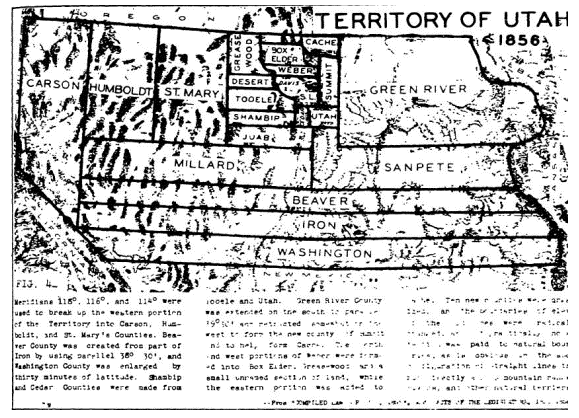
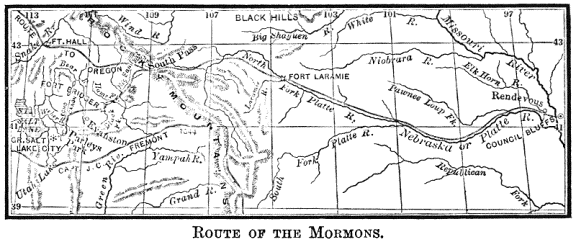
Utah Territory 1856
The Provisional State of
Deseret (“Deseret” a Book of Mormon word meaning “honey bee” and symbolizing
industry) included in addition to present day Utah: parts of Idaho, Wyoming,
Colorado, New Mexico, Arizona, Nevada, Oregon, and even a few miles of Southern
California seacoast. Various acts of
the U. S. Congress reduced these far flung areas to the present boundaries.
In addition to its present
29 counties, Utah also had ten other counties mostly in the 1850 decade: St.
Marys, Humbolt, Rio Virgin, Green River, Shambip, Greasewood, Cedar, Little
Salt Lake, Carson and Desert. The early
day map of Utah on an adjoining
page show some of these pioneer county boundaries.
14 May 1856 the
first camels were imported to travel the South West deserts with burdens of
freight for the mines, army and coast areas.
16 Sept. 1856 The
Mountain Meadow Massacre of 120 California immigrants occurred near St. George,
Utah.
1857 On
the 13th of February 1857 the eighth child of William Hubbard Winterton and Sarah
Marriott was born. Their second
daughter was named Sarah. E. G. Otis
installed the first practical elevator for passenger service in New York City.
1857-58 The
Winterton family was still in England when the so-called “Utah War” caused some
30,000 Mormons to be evacuated from the Salt Lake Valley before Johnston’s Army
marched through to establish camp Floyd in Cedar Valley a few miles west of
Lehi. The Army remained until 1861
buying food and supplies at good prices and hiring many of the local workers.
Then when they left, their surplus supplies and equipment, most of which had
been freighted west from the Mississippi at considerable cost, were sold to the
Mormon settlers at a few cents on the dollar.
15 Sept. 1858 the
first of the Butterfield overland Mail Stage coaches began its 24 day 2800 mile
journey between St. Louis, Missouri and San Francisco, California.
11 June 1859 the
famous Com stock Silver Lode was discovered in Nevada about that same time
across the continent at Titusville, Pennsylvania America’s first oil well was
brought in and at Chicago a cabinetmaker named Pullman converted a railroad
coach into a bedroom on wheels to eventually change the travel habits of the
nation.
1859 the year that the Charlestown area saw
the temporary camp of surveyors Charles Shelton and Alex Wilkins of Provo as
they made field notes concerning the topography of the Upper Provo River and
Wasatch Valley area. This was also the
year that the first known crops were planted by white men -- a small acreage of
grain that was entirely lost to heavy frost. The land claims were made by George Noakes, William and Freeman
Manning.
1860 Saw
the first crude log cabin and
some corrals built near where the town of Charleston is now situated. More settlers came with their families and
livestock and successfully harvested crops of grain and hay.
15 April 1861 President
Abraham Lincoln declared a state of Civil War which was to continue for four years
during which time the three Wintertons came to Utah. Also in 1861 on the 22nd day of May the much publicized
Pony Express was regularly inaugurated between Denver and California Gulch; and
on the 24th of October the telegraph line was completed across the Continent
and joined the two American continental coast lines, the Atlantic and Pacific. Another first for the years.
1862 a
detachment of Federal troops under Col. Connor founded Fort Douglas at the
mouth of Emigration Canyon on the Salt Lake East Bench. Lacking other assignments his troops were
encouraged to prospect in the surrounding hills for minerals, and were largely
responsible for the later mining boom.
1862 Mormon
Church authorities in Great Salt Lake City sent a message:
To all the Saints in
England, Scotland, Ireland, Wales and adjacent countries we say: ‘emigrate as
speedily as possible … bring with you all kinds of choice seeds … of grain,
vegetables, fruit, shrubbery and trees to cheer the soul of man; also the best tools
of every description … and machinery for spinning, weaving, dressing cotton, wool,
flax and silk, etc … or models and descriptions of the same by which you can construct
them … such as corn shellers, grain threshers and cleaners … smut machines,
mills and every implement and article within your knowledge that shall tend to
promote the comfort, health, happiness and prosperity of any people.
1862 The
homesteading of land along the Provo River in the Wasatch Valley was opened by
the government this year.
1862 Early
in this year (January or February) the Utah Territorial Legislature created Wasatch
County out of portions of Salt Lake and Utah County. About 1000 persons were
then residing in the new area which included Charleston.
3 March
1862 The first county
road was established in Wasatch County starting southwest of Charleston and
running in a North-Westerly direction following the old immigrant trail terminating
at Ross Summit (Hailstone) on the Northern County boundary.
1863 This
was the year of Lincoln’s Gettysburg Address and his Emancipation Proclamation freeing
the slaves.
1863 It
was in 1863 that their long cherished dream became a reality and the three
Wintertons were aboard the sailing vessel “John J. Boyd” in the Liverpool,
England harbor and with other Mormon converts on their way to Zion in the Valleys of the Mountains of North
America.
1864 The
Great Salt Lake of the
intermountain United States has been described as a remnant puddle of the once
enormous Lake Bonneville. Fresh water Utah Lake some forty miles to the south is another fossil remnant of
geological time with drainage into the lower elevation to the north where
evaporation effects a super saturation of all the minerals carried down from
the surrounding higher elevations.
Before ancient Lake Bonneville found an outlet through
Red Rock Pass in Northern Cache Valley and escaped via the Snake and Columbia
Rivers to the Pacific Ocean, it covered much of the area that has been called
the Great Basin. It was about 350 miles
in length and 150 miles wide and over a thousand feet deep in some places. Its terraces are still to be seen along the
western slope of the Wasatch Mountains.
The Great Basin, and Utah
in particular, has about 97 acres of wasteland to every three that are tillable.
The small habitable valleys are
isolated between interminable strings of arid, barren rocky mountains and sandy
dry wastelands where even sagebrush has a hard time to live and where now (1963)
salt flats provide the land areas needed for “Bombing Range Sites” and “Race
Car Speed Trials.”
The Great Basin --The Zion
of the Winterton and other Latter-day Saints in 1863 -- the Valleys in the Tops
of the Mountains -- was formed by what geologists call the Cascade Disturbance.
It created the Wasatch and Rocky
Mountains and lifted the Plateau area of Southeastern Utah many hundreds of
feet above sea level. This rock wasteland
is a terrible and at the same time beautiful spectrum of color -- immense,
lonely and empty -- changing each hour as light and shadow vary with the earth’s
rotation.
The thousands of feet of
rock buckled into the air is sculptured by sandblast and wind and an infrequent
gully washing thunder shower. Its hundreds
of miles of meandering cliffs are carved and broken and split by deep narrow
canyons -- too wide to jump across and too long to go around -- even scientific
engineering investigation and survey have found only a very few places for highway
and railroad to cross the Colorado River and traverse the Southeastern Utah
area.
This is the area that
Brigham Young hoped no one would want and that Daniel Webster orated against
adding to the U.S. This was the
Mormons’ sanctuary, this was the refuge from the sinful world, this was Zion in
the tops of the mountains. This was the
country that our Winterton ancestors immigrated to one hundred years ago.
John Winterton, William
Winterton, George Noakes, (John’s future father-in-law) John Eldrige, David
Walker, George Giles, Joe Taylor, Stan Davis, Joe Bagley, Finity Daybell,
Manuel Richman, George Simmons, Ether Davies, Joe Nelson, Isaac Brown, Dave
Young and Eli Gordon were among the first to file on the land.
17 December 1864 The
marriage ceremony of William Hubbard Winterton and Elizabeth Hughes in Salt
Lake City, Utah Territory was performed this date.
1865 The
United States Civil War came to an end and President Abraham Lincoln was assassinated
in April of 1865.
1866 On
27 July 1866 the first submarine telegraph cable was laid across the Atlantic
joining the U.S. with Europe in a new and faster means of communication. This same year in September the first
keyopening tin cans were patented in the U.S.A. and expedited the storage of foodstuffs and facilitated ready
access to their contents. This was the
year of the Utah Black Hawk Indian War with the Winterton brothers participating.
As the Indian trouble subsided the families
moved back to the lands around Charleston and cared for crops and cattle
continuing to build their homes and farms.
1869 Copper
outcroppings had been discovered by the Bingham brothers in 1850 in the Oquirrah
mountains on the southwest side of the Salt Lake Valley. Iron mining and smelting had been tried near
Cedar City as early as 1852-53 and lead mining and smelting in Beaver County in
1858. But it was not until the coming
of the transcontinental railroad in 1869 that large scale mineral development
took place which was to furnish employment to many of the pioneers’ descendants.
The Silver Lead-Zinc
Deposits were discovered at Park City in 1869 and these were in particular only
a couple of hours horseback ride over the hill from Midway and charleston a
ready market appeared there for farm
produce raised in Wasatch County and hauled via team-and wagon within a one-day
trip.
Tom and Ann Winterton
emigrate from Nottingham to Utah.
Other 1869 mineral
(Silver-Lead-Zinc-Gold) discoveries were at Eureka, Utah, The Tintic District
and at Mercur and Ophir. The 1870’s saw
the fabulous Silver Reef west of St. George, Utah and the Horn Silver at Frisco
in Millard County.
Coal was discovered in
Carbon County (about this same time). A colony had settled at Price in Carbon
county as early as 1858. It was greatly
strengthened in 1877 and subsequently.
A group of American women
formed the National Woman Suffrage Association in the year 1869 with the avowed
purpose of securing the ballot for women by amending the United States Constitution
but, for the next few years, the Winterton women in Utah -- Elizabeth, Ann,
Emma and Ellen -- were more concerned with the day to day struggle for bread
and clothing and the care of their
little ones and husbands.
1869 the
Central Pacific Railroad and the Union Pacific Railroad joined their rails at Promontory,
Utah on May 10, 1869. With railroad transportation
assured coast to coast, Utah’s economy and the Winterton Pioneers were certain of
future success and prosperity.
1870 The
next year saw the first railroad cars of refrigerated fresh meat shipped by the
founder of Swift Co. and women were given the right to vote in Utah. Mrs. O’Leary’s cow kicked over a lantern in
Chicago on the evening of Oct. 8, 1871- when the flames died down over 17,000 buildings
had been destroyed, 250 people killed, and the estimated loss was almost
$200,000,000.
1870 On
the 10th of December Sarah Ellen Winterton was born, daughter of
William and Ellen W. Winterton. There
were now about fifteen families and no matches in the valley near Charleston so
the family to raise a smoke from their chimney in the morning was sure to have
a caller with a fire shovel for a start of “live coals” so their breakfasts
could be cooked.
1871 On
Nov. 10, 1871 explorers Stanley and Livingston met in Central Africa.
1871 Two
grandchildren were born this year to William Hubbard and Sarah Marriott
Winterton on 18 Jan. 1871 John Eugene Winterton, son of John M. and Emma
Winterton; on 9 May 1871 Sarah
Ann, daughter of Ann Winterton and George W. Noakes Jr.
1872 On
9 Oct. 1872 Eliza Ann, daughter
of William and Ellen Winterton was born. Also that same year on 11 Nov. 1872 Sarah Sophia, daughter of John
M. and Emma Noakes Winterton was born.
1873 Rosetta
Noakes was born on 23 April, daughter
of Ann Winterton and George W. Noakes Jr. Charleston was surveyed to include 20 blocks each with four lots,
streets were 6 rods wide.
2 May 1873 the
Deseret News published at Salt Lake this date contained an article in which Nymphas
C. Murdock of Charlestown was quoted as saying there were 24 families living in
that community, that considerable land was still available for preempting, a
brick meetinghouse was under construction, he -- Murdock- -- was conducting a small co-operative
store re-exchanging produce in other markets, and that a U. S. post office
would soon be established.
1873 A one room frame schoolhouse was built in Charleston. Utah and John
Brown was the teacher. Tuition
was $1.00 a month paid for by eggs, butter, vegetables, hay or anything the parents
could spare and Mr. Brown could use.
1874 On
9 June Eliza Ann was born
daughter of John M. and Emma Winterton; also William Heber Winterton was born on 4 Oct 1874, son of William and
Ellen W. Winterton.
1874 Chewing
gum had been patented for five
years now. Its discovery was claimed by an Ohio man, William Semple .
1875 On
1 Feb Anne Noakes was born, daughter of Ann Winterton and George W. Noakes Jr. Later that same month her mother
Ann Winterton Noakes died on Feb 26th.
25 June 1876 In
Montana another tragedy -- General Custer’s 7th Cavalry force of 276 soldiers were massacred
at the Little Big Horn River by Indians .
1875 John
and William Winterton helped construct the Upper Charleston Canal and organize the
company which operated the first irrigation system in that area.
1876 John
Joseph Winterton was born on the 31st of August 1876, son of William
and Ellen Winterton. Emma Winterton was
born 2 Dec 1876, daughter of John M. and Emma Winterton. Also
1876 saw the 100th Anniversary of this nation’s Independence. Also on 10 March 1876 the first sentence was
spoken and under stood on Alexander Graham Bell’s new telephone. City and intercity exchanges grew rapidly,
then in a few years interstate exchanges. On 24 December 1876 Sarah Winterton married Arthur Parker at
Nottingham.
1877 Winterton
pioneers and all other members of the LDS Church were saddened by the death of
their church President Brigham Young that year. This was the year that the Charleston LDS Ward was organized with Nymphus C. Murdock
as first Bishop.
1878 George
William Winterton, son of John M. and Emma W., was born 5 July 1878. Hyrum Shurtleff Winterton, son of William
and Ellen W. was born 16 Aug 1878
and the Parkers in England had twins, one died at birth, and John William
Parker was born 8 Feb 1878.
1878 saw
bottled milk delivered in New York City; a mail order house started its
successful business in Chicago and a dime store chain was originated in New
York City. The first telephone switchboard
was used commercially this year.
1879 Eliza
Ann Parker, daughter of Sarah Winterton and Arthur Parker, and 16th grandchild
of William Hubbard Winterton, was born 30 Dec 1879 at Nottingham, England.
1870 The
decade was the scene of Thomas Edison’s triumphant electrical achievements – the
invention of the mimeograph, phonograph and the electric light; on the 3rd
day of Dec. 1881 the first streets were lighted by electricity in Philadelphia,
Penn.
1880 was
the year of the first electric lights in Utah. Also it was the year that the first meat market was opened at
Charleston, Utah. The seventeenth and
eighteenth grandchildren of William H. were born this year. Ralph Stafford Winterton, son of William and
Ellen W., was born 27 Sept 1880. Joseph Winterton, son of John M. and Emma W.,
was born on 4 Dec 1880. The first telephone
exchange in Utah was at Ogden in Sept. 1880. No longer could one sit in their 1850 bath tub without the
telephone ringing !
1882 The
U. S. Congress passed the Edmunds Anti-polygamy Law (which was added to in
1887). Moroni Winterton, son of William and Ellen W. was born at Charleston,
Utah on 28 Sept.
1883 This
was the year that the U.S. Civil
Service Commission was first established. Also on the 6th of February Hyrum Winterton, son of John
M. and Emma W., was born at Charleston, Utah.
1884 The
baby born to William and Ellen Winterton on the 26th of October
lived such a short time that a name was not given. Fred Parker, son of Sarah Winterton and Arthur Parker, was born at
Nottingham, England 3 Nov 1884. The first blacksmith shop in Charleston, Utah was opened this year.
1885 First
appendectomy in medical history performed in which the patient made a complete recovery.
1885 David
Winterton, son of John M. and Emma,
was born at Charleston, Utah 5 Oct 1885.
First electric street railway operated on streets of Baltimore,
Maryland, U.S.A. on Aug. 10, 1885.
1886 Thomas
Frederick Winterton was born on 14 Aug 1886 at Charleston.
14 Feb. 1886 the first train load shipment of
oranges from Los Angeles, California went to Eastern States and started the
citrus fruit industry. In June of that year the incorporation of national labor
organizations was made legal.
1887 Rose
Anna Winterton, daughter of John M. and Emma W. was born 29 May. The Statue of
Liberty on Bedloes Island, New York was unveiled on Oct. 28, 1887.
1888 Alice
Malissa Winterton was born 21 July 1888, daughter of William and
Ellen Winterton.
1888 The
Charleston Lower Canal Irrigation system was completed and put to use in June
1888.
1889
Henry Winterton was born 2 Dec 1889, son of John M. and Emma W. of Charleston. On 8 March
1889 Ellen Nellie Widdison Winterton, wife of William Winterton, died at
Charleston, Utah. Elizabeth Hughes Winterton, second wife of William H. died on
19 Sept 1889 in Salt Lake City, Utah.
1890
L.D.S. President Wilford Woodruff issued the Manifesto in 1890 ending the
practice of Polygamy as an official Mormon doctrine (during the previous decade
thousands of Mormons had been disenfranchised, prosecuted and imprisoned, the
Church disincorporated with much of its property confiscated). During the early 1890 decade many former
Polygamists were pardoned and their Civil rights restored, also the Church
property was returned. Some of the
Mormons, however, who had fled to Mexico and Canada remained there. Ellis
Island opened as Immigration Depot and Castle Gardens closed on Dec. 31, 1890. Also in 1890 newspaper reporter Nellie Bly
raced around the world in 72
days 6 hours and 11 minutes to set a new world’s record for traveling. The United Mine workers labor Union was
organized in 1890.
1890 William
Hubbard Winterton died on 16 March 1890 and was buried in the Salt Lake
Cemetery. He had lived in the Valley
for his last 26 years and at Carlton, Nottingham, England the first 47 years of his life. The obituary notice in the Deseret Evening
newspaper of 17 March 1890 is on microfilm and at the L.D.S. Church Historian’s
Office.
1891 It
was on the 10th of February 1891 that Robert F. Winterton was born, the eleventh child of John M. and Emma W.
and the 28th grandchild of
William H. Winterton. Also in 1891 Edison
applied for a motion picture talking machine patent. The American Baseball League completed its first year of
competition games.
1893 Isabella
Winterton was born 17 Feb 1893, the youngest child of John M. and Emma Winterton
of Charleston, Utah.
1893 Carrie
Elizabeth Winterton was born at Charleston 5 May 1893, the daughter of William and
Jane Steadman Winterton. Duryea
brothers operate first American gasoline buggy successfully -- the inventors aren’t sure whether it was in 1892 or 1893.
1894 This
was the year of the Chinese - Japanese war in which Japan gained Formosa and other
territory. Jacob S. Coxey
led “army”“ of 20,000 unemployed from the Midwest to Washington, D.C. to get
jobs. Diesel engine invented this year.
A
creamery was built at Charleston this year by George Daybell which soon
had seven wagons employed in the transporting of milk from local farms.
1895 Nettie
Rachel Winterton was born at Charleston 7 May 1895, daughter of William and Jane Steadman Winterton. W. K. Roentgen, a German
physicist and Nobel Prize winner, discovered the X-Ray in 1895.
1896 The
first wireless patent was granted by Great Britain to Marconi on June 2, 1896. Finally, after several abortive attempts, Utah was admitted as
the 45th state of the Union
on Jan. 4, 1896 when President Grover Cleveland signed the Congressional
Document admitting Utah to statehood in the United States of America. This was the year that William H., Fred,
Moroni Winterton and others organized the. Charleston Harmonica and Brass Bands
which serenaded the townspeople
on the Fourth and Twenty-fourth of July holidays.
1897 Edward
Marriott Winterton was born at Charleston, Utah on 16 Sept 1897, the son of William
and Jane Steadman Winterton.
1898 Hawaii
annexed by U.S.
Eugene V. Debs formed the Socialist party in the U.S.A. on Feb.
15, 1898. The Battleship Maine blew up
in Cuban waters with a loss of some 260 officers and men, and a few weeks later
we were in war with Spain. Com. Dewey
was in charge of the U.S. fleet. It was
this same year that radium was discovered at Paris, France by Pierre Curie and
his wife, also the year that Greater New York City was established of five
boroughs.
1899 This
was the year that on February 6 the
peace treaty with Spain and the United States was ratified by the Congress. The Filipino insurrection and the Boer (South
Africa war) also occurred in 1899. Charleston,
Utah became an incorporated place on 30 Dec 1899. Also on September sixth of that year at 2:00 P.M. saw the first
steam engine, and six passenger cars of people from Provo, arrive at the new
railroad station.
1900 On
the 10th of October 1900 Valeo James Winterton was born at
Charleston, Utah, the 14th child of William Winterton and the 33rd
grandchild of William Hubbard and Sarah Marriott Winterton. His grandfather had been dead for some ten
years but his grandmother would live another sixteen months and know of her 33 grandchildren and several great
grandchildren.
1900 The
Boxer insurrection took place in China and Carrie Nation, Kansas Anti-Saloon agitator
began raiding bars with a hatchet. The campaign to wipe out yellow fever got
underway. U.S. President William McKinley was shot while attending the
Pan-American Exposition at Buffalo, New York. Upon his death, 14 Sept. 1901, Theodore Roosevelt became our 26th
President.
1901 On
Feb 17th Charleston Ward called William Daybell as its second Bishop.
1902 Sarah
Marriott Winterton, first wife of William Hubbard Winterton, died at
Nottingham, England on 19 February 1902.
On May 8th Mt. Pelee erupted with an active volcano
destroying St. Pierre Martinique with the loss of some 30,000 lives. The Republic of Cuba was inaugurated May 20th.
The First International Court opened at
The Hague, Holland in October, and the first radio message was sent on Dec. 21,
1902.
1903 The
first successful automobile trip across the United States was completed,
leaving San Francisco on May 23rd. The auto and its two drivers reached New York City on August 1st. Henry Ford organized the Ford Motor Company.
1903 The
Wright Brothers flew the first airplane at Kitty Hawk, North Carolina on Dec. 17,
1903.
1904 Many
people claim this was the year that the ice cream cone we know so well was “invented”
at St. Louis, Missouri, U.S.A. The Panama
Canal Treaty with the New Republic of Panama was ratified by the Senate on Feb.
4, 1904. The New York subway was opened.
1905 Russo-Japanese
War started Feb. 6, 1904; peace treaty in U.S.A. Sept. 5, 1905.
1906 The
San Francisco earthquake and fire occurred some 800-900 miles west of the
Winterton home in Charleston, Utah on April 18-19, 1906 with a property loss of
over $350,000,000. There were 452
people reported to have been killed. Norway
became a separate kingdom.
1907 is
to be remembered for the financial panic that occurred then affecting
Wintertons and all other Utahans and Americans.
1908 The
Winterton Progeny were growing rapidly in numbers as the state and nation moved
into the age of the Auto with
Henry Ford’s first successful run in his “horseless carriage” at Detroit,
Michigan on June 4, 1896. Over 4000 such
vehicles were built in 1900 and by 1908 there were 622 autos and trucks
licensed to operate by just the State of Utah alone.
1909 The
North Pole was discovered by Admiral Peary, who planted the United States flag
there on 6 April. John William Parker
died in England.
1910 On the 29th
day of December John Marriott Winterton died at Charleston, Utah, leaving two
surviving brothers and a sister.
1911 Boy
Scouts of America was formed by the joining of two earlier organizations -- Woodcraft
Indians and Sons of Daniel Boone. How many hundreds of the Winterton progeny have been members in the past fifty years is
not known! Capt. Amundsen discovered
the South Pole on Dec. 14, 1911.
1912 China
became a republic on Feb. 12,
1912. The
Titantic (cost $7,500,000) sank in collision with an iceberg; loss of life,
some 1500 people. Camp Fire Girls
incorporated this same year. Revolutions
in Mexico; General Pershing sent there in March 1916.
6 April 1917 U.S. declared war on Germany.
Peace treaty signed 11 A.M. Nov.
11, 1918.
1918 On
the 10th of June Thomas Winterton died at Charleston, Utah leaving a
surviving brother and sister. Also in
1918 on February 24th Moroni Winterton was sustained as Second
Counselor to the new Bishop of the L.D.S.
Charleston Ward, J. M. Ritchie.
1921 The
first airplane to land in Wasatch County was flown by Lt. R. L. Maughan. Schools were closed so the
children could watch the Dehaviland flying machine take off from the Clyde farm
pasture.
1923 First
talking pictures demonstrated.
1924 On
7 May of this year Fanny Boardman Winterton, widow of Tom Winterton, died at Charleston, Utah.
1925 On
the 7th of October George Washington Noakes, husband of Ann Winterton 1849-1875
died at his Charleston home.
1926
David Cluff, second husband of Sarah Winterton Parker, died at Provo.
1927 Lindberg
flies non-stop in 33½ hours from New York to Paris, a distance of 3600 miles alone
in a monoplane.
1928 On
the 27th of December Sarah Winterton Parker died at Charleston, Utah
leaving one surviving brother.
1929 On
the 14th of September 1929 William Winterton died at Charleston,
Utah, the last survivor of the Pioneer Winterton family who emigrated from
Nottingham in 1863. Stock market crash
year. Many Americans lose life savings.
1933 The
Depression year -- for some of the Wintertons and many thousands of their
fellow Americans. On 10 July 1933 Emma
Inkpen Noakes Winterton, widow of John Marrio tt Winterton, died in Salt Lake
City.
1936 On
Feb. 16 Bishop W. C. Whiting of the Charleston
L.D.S. Church chose Heber R. Winterton as one of his counselors.
1943 On
the 25th of February Jane Steadman Winterton, widow of William
Winterton, died at Charleston.
1963 Today
-- 100 years after William Hubbard and his sons John and William Winterton
arrived in Utah -- your guess is as good as mine, but I would venture to say
that the descendants of the Winterton Pioneers own (in partnership with the
finance companies) over 1,000 autos with television sets, radios, electrical
appliances and other modern conveniences in the same profusion.
Would not the people of the
1850’s have considered these “wonderful things” beyond the reach of the most
vivid human imagination, inspiration or dream? And yet we who have lived in the 20th Century have
experienced even more wonders, such
as around the world airplane flights and more recently manned orbital space
missiles circling the globe in a matter of minutes and more than a dozen times
a day.
Some thirty years after
Joseph Smith was reportedly visited by Moses and commissioned to gather Israel
from the four parts of the world we find the three members of the Pioneer
Winterton family in Salt Lake City in 1864 with some fifty or sixty thousand
others, singing from the heights of Zion “just as Jeremiah had prophesied at
the 31st Chapter and 12th Bible verse.”
Did not the missionary
preachers of the Gospel of Jesus Christ of Latter-day Saints from America point
to the 7th verse of the same chapter for their message text “Shout
among the chief of the nations, publish ye, praise ye, and say O’ Lord save my people the remnant of
Israel”? Yes Great Britain was one of
the World’s Chief nations in the 1840 decade and the Wintertons wanted to be God’s
people.
The 8th verse reads “Behold
I will bring them from the North Country … and a great Company shall return
thither.” The William Hubbard Winterton
Family was in the great Company that gathered at Utah and at the Temple in the
Great Salt Lake City. Certainly they
must have been of Ephriam’s branch of the House of Israel for they answered the
call to “Gather to Zion” in the Rocky mountains.
Verse 9 “They shall come with weeping and supplications”
…Recall with me those terrible days at Nauvoo in 1844 the martyrdom of the Prophet
Joseph and his brother Hyrum Smith. Then
in 1846 the forced evacuation of the saints from their homes and escape from the violent mobs across the February ice on the frozen Mississippi River,
nomadic wandering until they
could cross the plains. Certainly there was hardships, hunger and
privation, prayer, humbleness and weeping -- yes much sorrow but happiness too in
reaching the valley.
Verse 9 continues “I will
cause them to walk by the rivers of waters in a straight way wherein they shall
not stumble.” They walked father and two
sons of the Winterton family much of the 600
miles westward along the North Platte River and into the Rocky Mountains.
Verse 12 … “And they shall
not sorrow any more … for the wheat and wine and oil … and water (and verse 13)
… will satiate the soul … and my people shall be satisfied.” The
Wintertons planted crops and harvested them; they raised cattle; they planted
trees and ate their fruit and sat in their shade. They built homes and married and lived in the homes and reared
children and worshiped in the new land. The Winterton Pioneers were fed full with blessings and testified
of their gratitude for that fact in many public meetings.
Isaiah many thousands of
years ago foresaw that God would do a “new thing.” Let us read again the 43rd chapter of Isaiah 19th
and 20th verse “I will even make a way in the wilderness and rivers
in the desert. There was a “way” made
in the wilderness -- a new way of living and farming. Were not the first Utah pioneers inspired to
irrigate their late crops? And did not each group that pushed forward
the frontiers create rivers of water across the dry dusty desert? Yes the irrigation ditches across the parched
wilderness were rivers in the desert -- a new thing for the Winterton pioneers
from textile mills of Nottingham.
The 41st Chapter
and 18th verse reads “I will
open rivers in high places and fountains in the midst of valleys I will make a
pool of water in the wilderness and springs of water in the dry land.” What an apt and correct description of the
Utah irrigation systems built by the pioneers and their descendants. Picture the gates of the 6000 foot elevation mountain valley
reservoirs being raised on a hot summer day and the impounded waters from
melting mountain snow and ice rushing downstream. What are these but “Rivers in High Places”?
Have you ever seen an
artesian well drilled in the valley floor going down through dry earth, sand
rock etc? Then the water gushing up and
soaking the parched land so that seed and plants and trees soon flourished. What are these but “fountains in the valley”?
Yes the pioneers certainly created pools
of water in the Utah wilderness and springs of water in the dry land of many counties
of the intermountain west. A census of irrigation
conducted in 1959 by the U.S. Dept. of Commerce’s Bureau of
Census reports that 3,000,000
acre feet of irrigation water was delivered to 43,000 Utah farms that
year.
Surely
the Utah desert places in the wilderness have blossomed like a rose as a result of the work of the pioneer
Wintertons, their descendants and contemporary Latter-day “Israelite” pioneers from
many chief Nations.
Biography of William Hubbard Winterton
and his first wife Sarah
Marriott (they were married 24 Oct 1842 at Nottingham, Nottinghamshire, Eng.) and his second
wife Elizabeth Hughes (they were
married 17 Dec 1864 at Salt Lake City
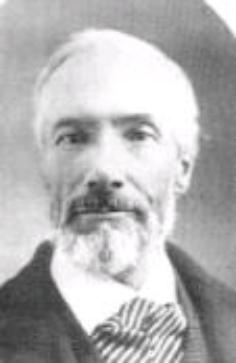
Williarn Hubbard
Winterton
born 26 June 1816
in England
died 16 March 1890
at Salt Lake City,
Utah, U.S.A.
Sarah Marriott
born 14 February 1824
died 19 February 1902
at Nottingham, England
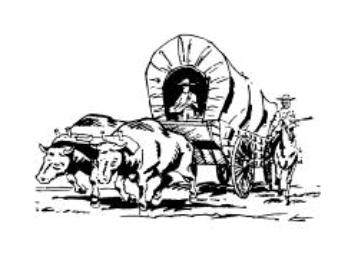
The
name of William Hubbard Winterton did not come to my attention until the latter
part of the 1950 decade. When Viola and
I married in 1933 I knew her mother’s maiden name was Isabella Winterton and
rather vaguely that her grandfather, dead for some twenty years at that time,
was named John Winterton. I am sure
that her great grandfather’s name was not in our conversations then or for
quite some time later.
While visiting some cousins
late in the 1950 decade, we were shown a partially completed progenitor’s chart
with his name among other ancestors. The story of his two sons being early converts
and among the pioneer arrivals to Utah and in particular at Charleston in
Wasatch County was clear. But less was known about great grandfather William
Hubbard Winterton’s activities.
The book “Pioneers and
Prominent Men of Utah” written some fifty years ago by Frank Essholm was found
to contain on page #1256 a brief biographical statement indicating that great grandfather
was a convert in 1850 of the Mormon missionaries and had served as a home
missionary and teacher in England; that after coming to Utah in 1863 he
obtained employment as a Tollgate Keeper in Parley’s Canyon and died in Salt
Lake City in 1890.
The Salt Lake Genealogical
Society’s Library supplied some more research material in the form of cemetery
records. They would show the exact date of death or burial. The microfilmed
index encouraged me to look further; it showed great grandfather had purchased
by deed #991 (register A44) grave space in Plot B, Block 9 in the Salt Lake City Cemetery.
Looking further in the Salt
Lake Cemetery Records (handwritten entries preserved on microfilm tape), I
discovered the entry #10055 “buried Elizabeth Hughes Winter ton, wife
of William Hubbard Winterton, died 19 September 1889, in Platt B lot 9.” Their
residence and church membership was shown as in the 21st Ward in
Salt Lake City.
Six months later the same
record shows William Hubbard Winterton died and was buried at the same place. His entry is #1442 and shows the exact date of death as 16 March 1890. A book
on the shelves of this same reference library (catalogue # Utah S3) records on
page #1615 about the same information. Also
that Elizabeth Hughes Winterton (wife of “Wm. H.”) was born in England 30
August 1817 and that “Wm. H.” was seventy-three years old when he died.
Recently I was privileged
to become acquainted with and to read Hyrum Shurtliff Winterton’s memoirs and
history of his father’s family. His account
of the family’s trip to Salt Lake City and his recollections of a visit to his
grandfather which occurred some seventy years ago is excellent reading. The small boy, his two brothers, and possibly
his sister, too, were caught raiding their grandpa’s strawberry patch with dire
results. Possibly the old gentleman
didn’t mind the young uns eating a few of the nice ripe berries, but he sure
hated to see the whole patch tramped over, the green berries mashed and the new
runners bruised so bad they wouldn’t take root!
“Aunt Bessie” had a kind
word and listened attentively when the small boy told of the wonderful and
exciting sights he had seen on
the trip from Charleston -- a real honest to goodness steam engine and a long
train of freight cars -- and those high wheeled bicycles the big boys and men
rode about the streets of the City -- why didn’t they tip over? He had never before seen such strange things;
it wasn’t a bit like the farm life of the 1880s that he was used to up in
Charleston.
Hyrum’s account indicates
that great grandfather William Hubbard Winterton never returned the visit. For that matter he never was in Wasatch
County before or after his son William and family made their visit in 1883.
That was apparently the last time they saw each other for seven years later
both he and “Aunt Bessie” were dead.
The Ward Records of the
Salt Lake City 21st Ward of the LDS Church were my next source of
biographical information. They reported
that great grandfather William Hubbard Winterton was first baptized by LDS Missionary W. Clayton and confirmed
by W. Brewerton on 6 Jan 1850 in Nottinghamshire, England. He was re-baptized in Great Salt Lake City,
Utah Territory of the United States of America on 26 Nov 1864 by R. Ramsey and
reconfirmed 27 Nov 1864 by John Hall. He
married Elizabeth Hughes on 17 December 1864 in Salt Lake City.
On 7 April 1851 Wm. H. was ordained a preacher by T. W.
Brewerton. On 5 June 1853. Wm. H. was
ordained a priest. Elizabeth Hughes Winterton’s
entry on the 21st Ward microfilm record shows she was re-baptized
about 1866 by Bishop John Sharp (in Salt Lake City) and that her parents were
Joseph and Elizabeth Hughes. The spaces
to show from which ward they had been received were blank. She was
born in England and emigrated to Utah in 1856.
Elizabeth Hughes sailed
from England to America on the vessel “Samuel Cowling” embarking 19 April 1856
according to the Emigration Card Catalog in the LDS Genealogical Library in
Salt Lake City. She crossed the plains in “Bunkers” Company leaving Council Bluffs
(or Florence, Iowa) on 23 June
1856. Apparently Elizabeth Hughes
unmarried at age 38 had insufficient
funds or resources to make the journey. As an LDS Convert, she applied for and received help from the
Perpetual Emigrating Fund Company. She was
still indebted to this Fund some 21 years later as a book published in
1877 by the “Star Book & Job Publishing Company” of Salt Lake City lists
her name. The list of “Persons and
Sureties indebted to the
Perpetual Emigrating Fund Company from 1850 to 1877 Inclusive” is authorized by
that company’s officers: President Albert Carrington, Secretary Robert R.
Anderson and Treasurer Edward Hunter.
No Winterton name is found
in this list, which indicates that William Hubbard, John M., William, Thomas and Ann Winterton’
s emigration fares and expenses were paid for in cash or if they received an
advance from the Perpetual Emigrating Fund Company the amount had been repaid
in full before 1877. The names of five Widdison
girls, all friends and neighbors of the Wintertons, Sarah J., Mary Ann,
Elizabeth, Eliza A. and Ellen,
were on the 1877 list.
The Salt Lake City 21st
Ward, now of the Ensign Stake, was organized 5 July 1877 and detached from the
20th Ward which in turn had been organized in 1856 to include all
who lived north and east of “A” Street
and South Temple Street in the Salt Lake Stake of Zion. The 21st Ward
boundaries were west “H” Street, east “M”
Street, north 7th Ave. and south South Temple Street. It appears that they had been members of the
20th Ward before the transfer in 1877, but I did not find their
names when I viewed that microfilm tape, probably because it was faded and
partly illegible.
Great grandfather William
Hubbard Winterton worked as a Tollgate Keeper in Parley’s Canyon. On Page 194 of Heart Throbs of the West
by Mrs. Kate B. Carter, published in 1939 by the Daughters of the Utah Pioneers
we read:
“From the very
beginning of the settlement of Utah it was the people who paid for the
improvement and construction of the roads they used. The first travelers of course built their own roads. Where ever the wagons could not be pulled
across the desert lands, they unhitched their oxen from the wagons, unloaded a
plow or scraper and went to work. On
hillsides they often no more than plowed a furrow for the uphill wheels of the
wagon to roll in.
“Then as settlements
were made and efforts made to improve and make the roads more passable, a road
tax was charged for everyone who used
that particular section of road. These
were called toll roads to distinguish them from the trails where no charge was
made.”
Perhaps the earliest of
these Tollroads of importance and interest to .the pioneers of the Great Salt
Lake Valley or the State of Deseret was that built by Parley P. Pratt (a cousin of my great grandmother
Jemima VanCott Ambler). He and his associates spent the summer of
1850 improving the road in Big Canyon Creek. Because of this work the canyon soon became known as Parley’s Canyon,
which name has continued over 100 years down to our day. It has been said that he expended about
$2,000 in this work and that he collected $1,500 in tolls that year of 1850.
The road down Parley’s Canyon
is now U.S. Highway #40 and one
of the main east-west routes through the Rocky Mountains. It was originally known as the “Golden Pass”
Toll Road. On 29 June 1850 Parley P. Pratt advertised in Utah as follows:
“Travellers between
this state and California are respectfully informed the new road will be opened
by July 4th avoiding the two great mountains and most of the canyons
so troublesome on the old route. The
road is somewhat rough and unfinished but is being made better every day. Several
thousand are already expended by the proprietor who only solicits the patronage
of the public at the moderate rate of fifty cents for a conveyance drawn by one
animal, 75¢ for a conveyance drawn by two animals and ten cents for each
additional animal.”
Sheep could be driven or
hauled on the Golden Pass Toll Road through Parley’s Canyon in 1850 for only
one cent each!
Several years later after
Utah became a territory, the legislature passed an act empowering the road
commissioner to locate a state road in this same general area and to erect a
tollgate so that no one could use the Parley’s Canyon road without passing
through the gate in order that taxes or tolls could be collected to reimburse
for the cost of improvements, maintenance and road repair.
The toll was to continue in
effect until all costs were refunded. The rates established at that time were
as follows: wagon and two animals (hauling wood, timber, coal, rock, lime,
etc., 25¢; wagon and four animals hauling wood, timber, coal, rock, lime, etc.
, 37½ ¢; wagon and buggy, two
animals and passengers, $1.00; wagon and buggy, four animals and passengers, $1.50; loose animals, l0¢.
A
report made March 1948 to President Brigham
Young at Winter Quarters tells of the efforts to build bridges and roads over
Mill Creek and Jordan River: “ … our pathmaster is instructed to call men and
repair the roads as fast as is consistent with other duties. We tried to have them built by the “Hundreds”
but had to abandon the idea and try a direct poll tax on polls and property … estimates
are being made by the pathmaster
and the people are satisfied the labor tax will bear equal … and the bridges
will be speedily built.” (A later
estimate placed the cost of the first Jordan River bridge at $800.00.)
The Parley’s Canyon toll
privileges and concurrent road maintenance responsibilities passed in 1855 to
the Kimball and Associates group as Parley Pratt went to South America in
response to a mission call. The
contract was for five years and extended to the Karnas Prairie from the
mouth of Big Kanyon. The problem
seemed to be that the toll collected was not enough to pay for the cost of
maintaining the road through the narrow canyon where each thundershower would
cause new washouts.
The bridge across City
Creek (used free by General Johnston’s army in the spring of 1857) was another
toll affair. The rates were reported to be one cent per person on foot, two
cents if mounted or riding in a conveyance, three cents a head for animals and twenty-five cents for
team and wagon.
There was a Toll bridge
built across the Jordan River in 1853 with a Mr. Zimmerman acting as toll
collector.
There was a Toll Gate in Provo Canyon operated
by Sam Pyne in 1876-77. The Provo Canyon charges were somewhat higher than in Salt
Lake being $1.50 for a vehicle drawn by two animals and $2.50 if drawn by six
animals. A horseback rider paid
15¢; sheep, goats and swine were 5 cents each; and horses, mules and cattle could
be driven through for ten cents each.
It is likely that William
Hubbard Winterton as an inexperienced immigrant first worked as a laborer on
road construction that was sponsored by President Brigham Young and other
Church authorities and probably sometime in 1865 or 66 secured the less
physically demanding but certainly thankless position as road tax collector. A Jan. 17, 1867 bill approved by the Utah
legislature and signed by the Governor of the territory doubled the previous
toll rates in an effort to improve the Parley’s Canyon road.
A
Feb. 19, 1869 legislative enactment defined the duties of the
Superintendent of the “Salt Lake City and Wanship Wagon Road” and divided the
road into three sections with separate toll stations for each section. It may be that with the increased number of toll stations in Parley’s Canyon William
H. Winterton was hired and first collected tolls that year. The early impetus
for good roads quickly ended with the joining of rails at Promontory that same
year as the railroads were much more efficient movers of the longhaul freight
and passenger Loads.
Did William H. own a saddle
horse and ride from his home on the Avenues in the 20th (later 21st)
Ward to the tollgate site in Parley’s Canyon each morning and night? Or did he stay in the Canyon all week and
only come home for Sunday worship service? Or did he and Bessie both live in a canyon cabin near the tollgate
for the first ten or twelve years of their marriage? Perhaps they did not move to the avenue home until after his
retirement! No one seems to know many
of these details except that he was still working as a tollgate keeper in 1869
when Ann and Tom arrived in
Utah.
During the 1870 and 1880
decades many toll stations were unattended during the winter months and only sporadically at other times
because there just wasn’t enough traffic to pay the tollgate keepers wages let
alone collect any revenue for road building and repair. My guess is that great grandfather Winterton
and “Aunt” Bessie had a rather meager livelihood at best.
Great grandfather William
Hubbard Winterton arrived at his Zion in the Tops of the Mountains and in The
Valley of the Great Salt Lake early in September 1863 -- 100 years ago. The Murdock Company brought the hundreds of
emigrants over the route from the Black Hills country to the Mormon Church
Headquarters some four weeks quicker than did the Wells-Fargo Freight Wagon train that young John and William Winterton
had attached themselves to. In fact it
was Conference time in October when their slow moving ox teams lumbered through
the streets of the Great Salt Lake City on the way to California.
What an experience those
summer months of 1863 provided the forty-seven year old factory worker from
Nottingham, England! He was pleased, I
feel certain, when he considered the events of those months that he had been
fortunate enough to have been assigned to the J. R. Murdock Company. Why, he was the most experienced and capable
leader of all those who brought
the teams and wagons from Utah to take the
immigrants back across the plains.
Yes! before the railroad
was completed in 1869 -- six
years after great grandfather made the crossing -- this man Murdock had made
eleven (or was it twelve?) round
trips, perhaps more than any other Mormon wagon team driver. They say that Haight made seven, Roundy five,
Andrus, Duncan and probably others made three and … “there were scores of young
fellows that made one or two trips for the new converts but Murdock made at
least eleven and I was with him,” Wm. H. surely soliloquized.
It had been tiresome
waiting there at Council Bluffs for the teams to come in from Utah, but all in
all, the journey was well organized. But
why not? Wasn’t it the will of the Lord? Wm. H. recalled of hearing the account told many times of how
President Brigham Young had a revelation when the Mormons were evacuating
Nauvoo (14 January 1847 The Word and Will of the Lord Concerning the Camp of
Israel in their Journey to the West). Each wagon train company was to have divisions of Hundreds,
Fifties, and Tens with a Captain over each group. A blacksmith and
wagon maker with tools was assigned to each fifty wagons. Then our company had a President and two
Counselors, a Clerk and a Captain of the guard who were all sustained by a vote
of all the emigrants before we ever left our camp at Council Bluffs.
That guard duty was hard
for Wm. H. He had never been on the
prairie before, such strange noises and the stories he heard about the savages that
lurked out there waiting for a straggler – man or beast. What would he do if he were to actually encounter
one?
“The Mormon Wagon Trains
were fine examples of fairness but we were all required to do our share of the
work. If anyone neglected his assigned
guard duty, he would be publicly rebuked for the first offense and the second
time he would get extra duty herding the cattle. No profanity was allowed, no card playing and if one was found
being cruel to animals there was a heavy fine to pay. Only a moderate use of the whip was permitted those who drove the
teams,” recalls one pioneer journal.
“Each wagon took its turn
to lead off from the night’s camping grounds at 7:30 in the morning and the next day it would be last in line. In that way everyone had a turn at eating the
dust from all the other wagons. We all
had to be in our wagons by 9:00
P.M. except those on guard. No one
could leave camp without the Captain’s permission. Everyone in camp attended regular prayer meetings. Wagons and wagon wheels were inspected frequently
on the trip and kept in repair and spokes tightened or soaked in water, “ relates another paragraph by the same writer.
Can
we reconstruct great grandfather Wm. H‘s
thoughts while on guard duty outside the elliptical coral of wagons linked
together to prevent the animals from straying and to safeguard them from Indian
attack or theft. The animals have
grazed during the late afternoon and evening, the company is probably 15 or 20 miles closer to their
destination, the cattle have been
watered, the firewood has been gathered for evening and morning cooking, the
food for the night meal has been eaten, prayers said, the Captain of the Guard has
blown his horn and now I am responsible for
the safety of all these people and all their possessions.
Wm. H. hears the lowing of
oxen, the bleating of sheep, the neighing of horses near by and the howling of
coyotes and wolves out over the prairies and on the distant hills or possibly
an occasional bird. Then there may be
some quiet times broken only by the snore of some loud sleeper. Thank goodness one half hour has passed and the #1 guard has cried “all is right.” I
must answer him in kind. With such
enchanting scenes so fresh in his mind it is no wonder that Wm. H. had feelings
of praise, veneration and thanksgiving for the God of the Saints when he
arrived in Great Salt Lake City.
The wagons at the start of
the journey westward, generally, were each loaded with 1000 lbs. of flour, 50
lbs. of sugar, 50 lbs. of bacon, 50 lbs. of rice, 30 lbs. of beans, 25 lbs. of
salt, 20 lbs. of dried fruit, a gallon of vinegar and a dozen bars of soap
which was thought to be enough supplies for about eight or nine adults for the
several months the trip would take. The
experienced drivers might be able to shoot deer or antelope or other wild
animals on the trip to provide some fresh meat as extra food.
The few personal
possessions and bedding of each of the Wintertons and other emigrants assigned
to the wagon probably increased the load to about 2000 pounds which was a more
reasonable load than the 2500-3000 pounds often piled on the commercial freight
wagons. The next year 1864 saw freight
depots established by the Mormon Church along the route of travel. Several in Wyoming
were three stories high and warehoused as much as 2,500 sacks of flour and
70,000 pounds of bacon with beans, dried apples and other miscellaneous
supplies to replenish the emigrant wagons as they came by.
Then in 1869 most wagon
train travel was abandoned in favor of the new Iron horse -- the steam-powered
railroad locomotive and its long string of cars. Wm. H. was glad that Ann and Tom obtained transportation to Salt
Lake City on this wonderful new invention and did not have to tramp the long
weary way across the plains as he and their brothers John and William had done
six years before.
Great grandfather William
Hubbard Winterton with sons John and William crossed the Atlantic Ocean in the
sailing vessel “John J. Boyd” of
1400 tons registry and Capt. J. H.
Thomas, Master. They left the
Liverpool, England harbor on 30 April 1863 bound for New York, U.S.A. where agents of the Church of Jesus Christ of latter-day Saints provided them with rail
transportation most of the way to Council Bluffs. It was necessary to arrange a detour in 1863 through part of Southern
Canada because the fighting between the Confederate and Union armies had
disrupted rail travel in the southern Pennsylvania area that year.
The parting of the family
had been a sad experience -- Sarah had clung tearfully to young Bill until the
gangplank was being hoisted. Would it
have been better to have waited until they could all leave together? Surely it would be best for her to come later
when the three smaller children were older. Why, little Sarah was only six years old, she couldn’t possibly
make the trip across Ocean and Plains.
Wm. H. recalled their
twenty-one years of marriage. Of their
eight children three had died and the others had worked from the time they were
5 or 6 years old and nothing to show for it.
They just had to take a chance that things would be better in America. Thirteen years now since they had accepted
the Gospel preached by the LDS Missionaries. Other textile workers from Nottingham with no more worldly goods
than they had traveled to Zion.
Thirteen years since their
baptism. Wm. H. was certain that he had
learned to teach the new gospel as it had
been explained to him by the preachers and missionaries from Great Salt
Lake City. But Sarah had so little time to study and listen to the
explanations of some of the strange new doctrines. She was so busy keeping up the home and caring for the children
when she wasn’t at the factory -- actually when does she sleep? if ever?
Did William H. ever recall
Sarah’s insistence that he plant and raise vegetables -- something useful and
edible in the few square feet of soil connected with their living quarters
instead of those ”useless flowers” he
enjoyed. Certainly Sarah was the
practical one in the family who made their meager income -- probably not more than
two or three dollars a week by modern rates of exchange in the equivalent of
our money system -- that would be the earnings of the four of them in the 1850
decade with father, mother and two oldest sons working to bring home some 15-20
shillings a week at best.
She seemed particularly
troubled about the doctrine of plural marriage. It was rumored that Joseph Smith Jun. the Prophet had over fifty spiritual
wives and Sarah heard other disquieting stories at the factory -- those
busybodies. Well she had agreed to wait
a while until he could send for her and the three young ones.
It is not known when Sarah
Marriott Winterton first learned of her husband’s plural marriage. Did he plan such action before leaving
England? Did he write her before the ceremony?
Or did Ann and Tom first discover the
fact when they arrived in Great Salt Lake City in 1869? Sarah could never under stand it.
Despite offers by her
children to send her fare for the trip to Utah both before and after her husband’s death (and the other wife’s
death also) Sarah Marriott Winterton remained in England. When young Sarah married Arthur Parker, it
was soon evident that he spent too much time in the local pubs to support a
family so Sarah helped her daughter and grandchildren until they, too, left for
Utah.
Before her death in 1902 at
the age of 77, Sarah knew her posterity numbered 33 grandchildren with great
grandchildren in ever increasing number. She also knew Mrs. Widdison had died in New York City while on her
way to Utah. If widow Ellen Stafford
couldn’t live through the rigors of travel, she couldn’t either! Did Sarah ponder the reasons why Jane and
Elizabeth Widdison and their husbands had left Utah and the LDS Church to live in Nebraska and New
York?
There are many unanswered
questions about the life and beliefs of great grandmother Sarah Marriott
Winterton. Of this we may be certain, she wanted her children to have the best
opportunities available and made many sacrifices to assure their going to Zion
and a better life in Utah, U.S.A. than
had been her lot in the textile town of Nottingham, England.
While she could apparently
not reconcile herself to her husband’s second marriage, she tried to avoid
criticizing or embarrassing him. To her
sons’ offer of transportation and a home in Utah she replied “1 am afraid I
could not stand the long trip and especially the voyage across the sea.” Or was there in reality another reason why she
stayed in England. A man -- a better companion for her declining
years than William Hubbard had been? Family gossip, legend, or misunderstood remarks of their elders in
council overhead by Winterton youth who should haw been outside playing
indicate great grandmother Sarah may have decided (after learning of William H’s desertion and polygamy she called
it -- the Mormons said it was the doctrine of Plural Marriage) that two could
play the game. Be that as it may my
research failed to locate such a man’s name and many of the Winterton descendants
vehemently denied such a rumor.
Perhaps she had heard
accounts of the many hundreds, yes thousands, who had perished crossing the
Atlantic in over-crowded vessels with insufficient food and water and disease infected
passengers; and the uncounted numbers who were buried along the trail crossing
the plains and mountains of North America on their way to Utah. But I think it more likely
that she was ready and willing to brave those dangers and risk her life
to get to the Valley of Zion
until she learned of her husband’s plural marriage.
Since Orson Pratt publicly
announced that doctrine from the pulpit in Great Salt Lake City that day in
1852 and the press of the world had published stories for and against for a
dozen years before her husband and two older
sons left England, it would seem likely that Sarah and William Hubbard as marriage partners and as believers in
the Revealed Gospel had discussed the subject.
It seems likely that Sarah
had told her husband that the revelation Joseph Smith Jun. claimed to have
received in 1843 and kept secret from the world was not for her. She did not understand it and could not live
what she didn’t understand. Surely they
had read together or heard the words of the strange document read aloud by
someone with that much education. Perhaps
the song so many immigrants sang as they crossed the plains during the 1850s
and 1860s did not inspire her !
The
Emigrants Song
Ye Saints that dwell
on Europe’s shore
Prepare yourselves
with many more
To leave behind your
native land
For God’s sure judgment is at hand.
Prepare to cross the
stormy main
Before you to this valley gain
And with the faithful make a start
To walk across the plains with hand-cart.
Some must push and some must pull
As we go marching up the hill
As merrily on our way we go
Until we reach the
Valley. Oh!
William Hubbard Winterton’s
parents were John and Ann Hubbard Winterton of Little Chester, Derbyshire,
England. William Hubbard Winterton’s
paternal grandparents were William and Ruth
Buxton Winterton of Breadsall, Derbyshire, England. He moved with his
parents some 25 or 30 miles east to Carlton then a suburb and now a part of the
City of Nottingham, England.
W1 William
Hubbard Winterton on 24 Oct. 1842 married Sarah Marriott born 14 Feb 1824 or 5
(died 19 Feb 1902) at
Nottingham, England where they were married and their children were born. Her parents were George Marriott and Rachel Shaw.
William Hubbard and Sarah Marriott Winterton
were the parents of:
W11 John
Marriott Winterton born 16 May 1844 died 29 Dec 1910
W12 William
Winterton born 6 May 1846 died 14 Sept 1929
W13 John
Winterton born 18 May 1847 died 19 May 1847 (the year was probably 1843)
W14 Ann
Winterton born 11 Sept 1849 died 26 Feb 1875
W15 Thomas
Winterton born 4 Sept 1851 died 10 June 1918
W16 Baby
Winterton born 26 Dec 1853 died 26 Dec 1853
W17 Hyrum
Winterton born 30 Dec 1855 died 24 Jan 1856
W18 Sarah
Winterton born 1.3 Feb 1857 died
27 Dec 1928
William Hubbard Winterton
on 17 Dec 1864 married 2nd Elizabeth Hughes born 30 Aug 1817 (died
19 Sept 1889) at Salt lake City, Utah.
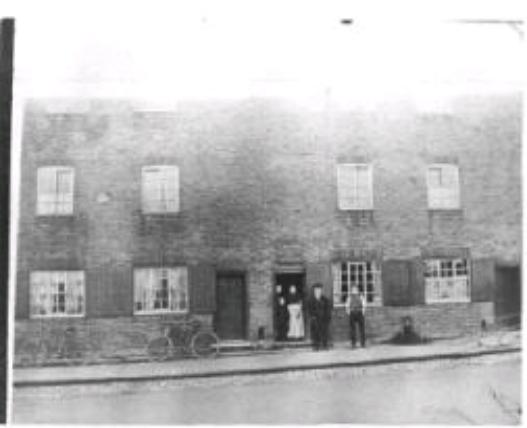
The House at Carlton, Nottinghamshire, England in which
the Winterton family lived during the 1840, 1850 and 1860 decades as it looked
in 1910.
Journal Entries of William Hubbard Winterton
(Extracted February 1, 1964
as the manuscript of Winterton Pioneers of Utah was being prepared for
the printer from an old and partly illegible bound book preserved by his son
William Winterton and presently in the custody of his grandson Leo Winterton of Charleston. Most of the entries are concerned with his
(Wm. H.) missionary activities in the 1850 decade. )
My father John Winterton was born April 6, 1871 at Bredson or
Little Chester Derbyshire. My mother Ann Hubbard was born July 10, 1772 at Nottingham, England. John Winterton and Ann Hubbard were married
November 8, 1802 at Saint Mary’s Church, Nottingham. My sister Ruth Ann Winterton was born October 22, 1803 at
Nottingham.
(John Winterton served in
the British Armed forces and was in Africa during the Boer expedition of 1803
under the command of General Baird and was reportedly away from England for
twelve years returning disabled for further service and discharged in late 1815
[dates approximate]).
I (William Hubbard
Winterton) was born June 26, 1816 at Nottingharn. John Winterton, my father, died April 5, 1825 was buried April 8
in Saint Mary’s churchyard, Nottingham. Ann Hubbard Winterton, my mother, died January 20, 1857 about 9 in the morning. She was
buried in St. Ann’s Cemetery on Sunday Jan. 25, 1857.
I, William H. Winterton,
and Sarah Marriott were married October 24, 1842 at St. Paul’s Church, Nottingham.
Sarah Marriott was born February 14, 1825 at Nottingham. Her father was George Marriott born at
Wilford near Nottingham August 28, 1798 (died end of 1856 or spring of 1857). Her mother
was Rachael Shaw born April 14, 1804 (or 1805) at Chester, Derbyshire (died end
of 1888 or 1889). They were married
April 18, 1824 at St. Mary’s Church, Nottingham. Had in issue the following children: Sarah, my wife; Joseph, born
10 June 1827; Rachel Lovena, born 5 Dec. 1830 (died Dec 1910), John born 13
March 1833, Thomas born 12 January 1836 died same day, Ann born 24 June 1837,
William born 8 September 1841 and Eliza Marriott born 4 August 1844 -- all born
in Nottingham.
My wife’s sister Rachel
Lovena Marriott on 8 Sept 1849 married Germain Riley born 16 Jan 1827. They lived at Nottingham, England, where these
children were born to them: Maryann 1850-1851, Germain 1851, James 1853, Sarah
Ann 1855, Elizabeth 1857, Rebecca 1859, and Rachel Riley
born about 1861.
(Our first child a son)
John Winterton was born March 18, 1843 died the next day.
John Marriott Winterton
born May 16, 1844. William Winterton
born May 6, 1846. Ann Winterton born
September 11, 1849. Thomas Winterton born
Sept 4, 1851. On- December 26, 1853
about 9 o’clock at night Sarah Winterton was delivered of a female child dead. Hyrum Winterton was born December 30, 1855
about hour after 9 Sunday night and died January 24, 1856 at 25 minutes to nine
at night aged 25 days, buried in St. Ann’s Cemetery, Nottingham. Sarah Winterton Junior was born February 13,
1857 twenty minutes past 8 at night.
I (William Hubbard
Winterton) was baptized into the Church of Jesus Christ of Latter-day Saints on
January 6, 1850 by Elder William Clayton. Sarah (my wife) was baptised into the Church of Jesus Christ of
Latter-day Saints on June 3, 1850 by Priest William Butterick (at Nottingham, England).
I was ordained a Teacher in
the Church of Jesus Christ of Latter-day Saints by Elder Thomas William
Brewerton on April 7, 1851. I (William Hubbard Winterton) was ordained a Priest
on June 5, 1853 by Elder John Orton and others. On July 3, 1853 my
children William, Ann, and Tom were blessed by Elders John Orton, William
Orton, Joseph Holmes and others. They were
confirmed the next day, a Sunday, by John Orton. John Marriott Winterton, my oldest son, was baptised August 13,
1853 by Elder William Clayton.
Carlton, Notts. April 29, 1855
Dear Brother
According to the
correspondence of the Presidency of the British Isles Franklin I. Richards I
set me down to pen a few lines to you. If you can assist me to gain the
desire of my heart. … (the next several sentences are illegible) … the building
up of the kingdom on the earth
and that my family may be away from this wickedness with which they are
surrounded for youth gets worse and worse -- more corrupt continually. If you can assist me or if you know of any
who can, I should be thankful. You know
a little of me and Brother William Reville knows a little of me. Give my respects to him if you ever see him
also Bro. Grimshaw. Tell them I am
still a Latter-day Saint with the desire by the help of God to overcome all
things. I am Sister Ann Crooks’ teacher
at this time and she desires me to write to you at this time. I do assure you the family is in the midst of
poverty -- but buoyed up in their spirits with the hopes of being shortly
relieved from bondage. She sends her
kind love to you all. They are all well
in health. Brother Carragan is our
Pastor now. War is now almost all of
what the generality of people talk about or think about. Parliament has granted 22 millions of pounds
to further carry on the war against Russia. I still live in the same house as when you used to call and see us
on Carlton Hill. You can ask Brother Moses
Thurston of my character when he arrives in your midst. He set sail out of Liverpool on the 20th
of this month. If you or anyone who you are acquainted with will send for us I
am willing to refund the money in any way you or the Authorities may desire. There is six of us at this time. The oldest (child) is nearly eleven years
old. I am a stocking maker -- earn
about 8 or 9 shillings a week
and they are reducing wages still further. Trade is very bad with us … (the next page is missing. It
apparently contained the closing of the letter).
My sister Ruth Ann
Winterton married at St. Mary’s, Nottingham on April 12, 1841 William Britton
born December 22 (or 23) 1796 at Nottingham. William died April 10, 1862 and
was buried at St. Ann’s Cemetery in Nottingham over my mother. They had no children. Ann died July 10, 1854 (my wife’s sister)
Eliza Marriott was baptized today by Elder Josiah Holmes and confirmed the same
night by Elder John Orton in Nottingham.
(my wife’s brother ) William Marriott was baptized Oct. 27, 1854 by
Elder Josiah Holmes and confirmed the next day by him and others. (my wife’s mother) Rachel Shaw Marriott was
baptized 25 April 1854 and confirmed next day by Elder John Wigley.
(William Hubbard’s journal
also contains names of people he knew or preached to that joined the Latter-day
Saint Church at about this time such as Chrabett Sharpe, Martha Chambers, Joseph
Shephard, Thomas Oliver, Nellie Oliver, Edward Smith, William Pierce, Mary Ann
Pierce (or Pearce), John Shephard and possibly some others, also to various
Elders whom he referred to as “Pastors from the Valley.”
On the 29th of
April 1855 I was ordained an Elder by Josiah Holmes. On the 10th of July 1854 my son William was baptized by
Elder Josiah Holmes and confirmed the same night by Elder John Wigley and
others. Tithing began in the Nottingham
Branch for the first time on August 10, 1856. John and William were rebaptized by President Josiah Holmes on
Sunday, April 5, 1857 and reconfirmed that afternoon by John and George Taylor,
missionaries from Utah.
On Sunday, April 29, 1855 at a special eleven o’clock
council of the Priesthood of Nottingham Branch of the Church of Jesus Christ of
Latter-day Saints when various villages
was chosen and decided upon and volunteers were called for I volunteered to go to Burton and
Bulcote … I afterwards with Elder William Clayton administered the Sacrament of
the Lord’s Supper when some of the Brethren spoke on the liabilities of the
Priesthood. In the evening when I cam
home I prayed God my Heavenly Father to assist me, to magnify my high and holy
calling to his honour and glory amen.
June 10, 1855 went down to Burton and Bulcote,
delivered tracts out to several houses that would have them. Some people thanked us for them and some
refused to take the tracts (which were entitled) “Only Way to be Saved” on June
17th we (Bro. Mathews) changed to the tracts “Exclusive Salvation.” Got our dinner and tea at Brother Peterman’s
house. May God bless him and all his family.
June 26, 1855 I am 39 (years old) today. Attended Nottingham Council and was ordered
by Brother Holmes to labour alone in Burton. I delivered my testimony and some more tracts. Testified to the truth of the Latter Day work to several. May the
God of Truth, whose servant I am, assist me.
July 22, 1855 Went down to
Burton delivered out and changed some tracts. Bore a fruitful testimony to some
that God has set up his kingdom for to stand forever … attended Sacrament at St.
Ann’s Chapel and confirmed one boy … attended a meeting in the market at
Nottingham. Brother Butterick addressed
them and I conducted with a prayer … I went
down to Gunthorpe with Brother Stringfellow and bore our testimony that God had set up his kingdom -- very few
attended.
August 16, 18 55 Attended
Nottingham Council where I was approved
President of Carlton Hill District in all things … presided over meeting and asked
if any had questions -- bore my testimony that God had raised up a prophet and
had set up his church again with Power and
Authority in these last days.
September 2, 1855 I went down to Burton and
changed some tracts. A would-be
gentleman said the Mormons was a very bad set of people and would not take
another of our tracts as they weren’t worth reading.
April 26, 1856 I was
released from the Presidency of the Carlton Hill District and put to No. 1
District in Nottingham … Bought a pair of bedsteads of James Farmer who was
going away to the Valley of the Great Salt Lake. He asked 18 shilling and I did not examine them as I trusted his
word as a brother. I had but ten
shilling and he went from Nottingham without the remainder. When I went to take them down I thought 18
shillings was too much so did Bros. Ward, Shipley, and Pearce so I sent him six more shillings.
August 4, 1856 Preached at
Bridgeford only a few there -- about
a dozen were very attentive … Sunday School Anniversary. My son John and daughter Ann each said a
piece … preached in Old Fenton, not many present but very orderly.
The Presidents of the
Branches and all the Nottingham priesthood were rebaptised in the Nottingham
public baths on Feb. 29, 1857. Ezra T. Benson, one of the Twelve and Brother
Ray both counselors to Orson Pratt visited Nottingham and spoke that day on the
Reformation and need for rebaptism and reconfirmation.
March 15, 1857 Elders
William Pearce, William Stayney, Edward Smith, Teacher Sarah Smith and several
others cut off for neglect of duty and contempt of Council. May 10, 1857 Orson Pratt and Ezra Benson visited
Nottingham and preached in the assembly room three times.
(Great grandfather has
apparently made no entry concerning his final arrangements and experiences in
journeying to America and Zion in the tops of the mountains or possibly that
portion of his journal has been lost or destroyed. As indicated elsewhere he, John and William sailed on the ship “John
Boyd” in April 1863 and arrived in Utah during the autumn, September or
October, of 1863 in the John Murdock Company, one hundred
years ago. )
Feb. 9, 1863 (my son)
Thomas Winterton was baptized by Elder Isaac Gough at the New Baths in
Nottingham this date and confirmed Feb. 15, 1863 by Elder Thomas Pixton from
Utah.
Nov. 26, 1864 I (William
Hubbard Winterton) was rebaptized in City Creek, Great Salt Lake City, Utah
Territory U.S.A. by Ray Ramsey. Confirmed on Nov. 27 by Brother Allen
and-Bishop John Sharp.
Nov.
27, 1864 I was reconfirmed in the 20th
Ward Schoolhouse by John Hall.
December 17, 1864 Elizabeth
Hughes and I were married by Bishop John Sharp at his own house in the 20th
Ward, Great Salt Lake City.
February 24, 1866 We
(William Hubbard Winterton and Elizabeth Hughes) passed through our endowments and were sealed together for all eternity
by George Q. Cannon.
October 11, 1869 My oldest
son John married Emma Inkpen Noakes of Charleston this date. My son Tom and
daughter Ann have arrived from Nottingham.
Feb. 2 1, 1870 My son William married Ellen
Widdison of Nottingharn and my daughter Ann married George Noakes this date.
January 26, 1875 (my
daughter) Ann Winterton Noakes died this date in Provo Valley, Utah. Buried at Charleston, Wasatch County, Utah January
28, 1875. (As his granddaughter Anna was
born 1 Feb. 1875 William H. or someone writing for him in later years has
probably erred by writing January when February should have been shown.)
December 24, 1876 My
youngest daughter Sarah married Arthur Parker at the St, Nicholas Church in
Nottingham, England this date.
19 January 1877 My sister
Ruth Ann Winterton Britton died this date in Nottingham, England.
(1864- 188?) An entry -- clearly
not in great grandfather William Hubbard Winterton’s handwriting -- states he
worked in 1864 for Joseph Young in Lamb’s Canyon clearing roads. That in1865 and 1866 he worked on a farm -- some
indication that it was for the Young family. He was employed as a Tollgate Keeper in Parley’s Canyon from 1866
or 1867 until sometime in the 1880 decade. He lived in three different places in Parley’s Canyon keeping the
tollgate for Brother Brigham Young.
November 19, 1889 my
youngest son Tom married Fannie Boardman. He is the last of my children to marry.
In a shaky trembling
handwriting is the entry “Elizabeth Hughes Winterton died September 21, 1889 - burial
next day Salt Lake City Cemetery.
She was born August 30, 1817.”
The
last entry in the journal made by a handwriting
unknown to me reads: “died in Salt Lake City, Utah on the 16th day of March
1890 William Hubbard Winterton buried in the Salt Lake City Cemetery. Died in Nottingham England Sarah Marriott
Winterton on the 19th day of February 1902 and buried there.”
PART I
John Marriott Winterton
16 May 1844 - 29
Dec 1910
John Marriott Winterton was
born at Carlton, Nottinghamshire, England the first child and son of William
Hubbard and Sarah Marriott
Winterton. When he was about six years
old his parents were converted from their Anglican church religion to a belief
in the Gospel of Jesus Christ of Latter-day
Saints.
Beginning in 1850 with his
parents’ baptism by Mormon missionaries the
talk and plans in the home was to go to Zion in the Tops of the
Mountains of North America. Wages were
low, the hours of work long, the tasks
were tedious, but there was that vision of someday crossing the ocean to a
better land and a better life. Everyone
in the family worked from the time they were able.
There were no child labor
laws in England in those days so John had worked in the textile factories some
twelve or more years before coming to Utah at the age of nineteen. Someone has previously recorded the story of
the Wintertons journey to Utah. Let’s let them tell it in their own words.
“As a young boy every one
in the home had to work to keep the family going. His mother was a stocking seamer at a factory and would bring work
home for her sons Will and John to work on and help her while they were very
young. She was seaming stockings for
the frames which was run by hand. Later
they worked in the factory themselves while still very young (by our 1963 standards).
John’s father joined the
Church of Jesus Christ of Latter-day Saints in January, 1850, and his mother
joined in June of the same year. With his
mother, father and brother Will they would go to Church walking three miles
each way. In the year of 1863 when John
was 19 years old he, his father and his brother William set out to join the saints
in Utah by boarding the ship “John J. Boyd”
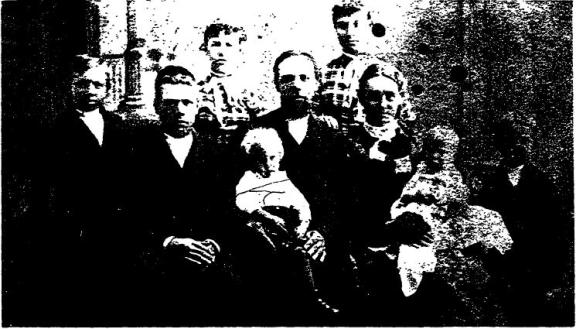
Picture taken in 1892
before Isabella’s birth. Standing from left to right: George, Eliza Ann, Sarah,
Hyrum. Seated: John E., John Me, Rose Anna, Emma I. and Robert.
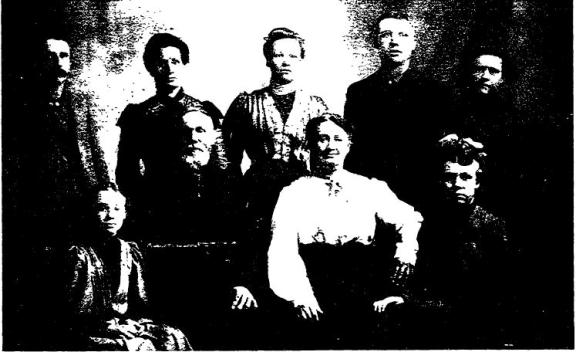
Picture taken about 1906 or
7. Standing: George Simmons, Sarah, Eliza Ann, Robert and Olive.
Seated:Isabella, John M. , Emma I. , and Rose Anna.
Grandfather’s story
continues “William celebrated his seventeenth birthday on the ship. We made a birthday cake and put it in the
fire oven, but the rocking of the ship tipped it out into the ashes. The cooks rolled it up again, ashes and all,
and put it back in the oven. There were
only two small ovens four or five feet square in which to cook for 700
passengers. We had to prepare our own
meals and nearly every time we tried to cook something the cooks would say, “There
is no room”, so we became discouraged and ate for a month on uncooked food. We ate hard tack and raw salty bacon. We experienced rough storms on sea, saw
people on deck almost drowned with waves going over the ship.
We landed at Castle
Gardens, New York, U.S.A. about May
20, 1863. On account of the Civil War,
we had to go around through Canada. We
traveled for hundreds of miles
through nothing but timber, sailing up the river two days and finally reaching
the Missouri River. While on board we
were not allowed to sit or lie down. We
were treated just like so many cattle. We arrived at Florence, Nebraska and found that the rebels had
captured the train the day before so we had to wait 24 hours for more cars. When they came the box cars still had coal
dust in them. (This ride in coal train was before the ride on the Missouri River.)
While waiting at Florence,
Nebraska about a month for the immigrants train for Utah, we went out and
worked for a Mr. Davis for
board. We learned, afterwards, that
this was against council but were glad we did not know as we were about
starved. The night before we were to leave,
father came out and got us. It rained so hard that we had to sit up in
the wagon all night.
We left Florence, Nebraska
June 29, 1863 with 375 souls in the wagon train. John R. Murdock was captain of
the company, with Brother Abraham Hatch as first assistant. We traveled with this train almost to the
Black Hills on the
Sweet Waters River.
There Captain Creighton’s
train drivers had left him to go to California where there was a gold rush so
Captain Creighton came to Captain Murdock for help. We stayed with Captain Creighton’s train but father continued with
his train to Salt Lake City.
This Company promised to
treat us well and to pay us $20.00 a month. Here is where we first experienced our first job with oxen. We traveled very slowly. On arriving at Devils Gate we turned our
cattle out for the night next morning we found some of them dead from drinking
Salaratus water. We stayed three or four days until another train came along. The leader told us to leave or it would kill
all the cattle. We traveled so slowly that
we were behind 4 weeks of the other train we started with. It was conference time in the fall of 1863
when we got to Salt Lake City. We drove
on to California but did not stay there.
I worked for Brother Isaac
Decker for the winter of 1864-65 feeding a herd of sheep, cattle and milk cows.
I dragged cedar wood from Cedar Hill in
Deckers Canyon, to keep five fires burning because Decker had four wives in
four separate places and we had our own fire to keep burning.
In 1866 the Indian trouble
began and Decker moved into town. That
left us to take the sheep north east of Heber but the people complained that
the sheep were eating the cows food so we moved them back to the ranch (despite
the danger of marauding Indians).
In the spring Mr. Decker
moved back with one of his wives and Will and I got our first experience mowing
hay with a scythe. We cut two or three
weeks. Mr. Decker and Farmer Little
bought the first mowing machine and cut the rest of the hay with it.
Mr. Decker gave us land
instead of the promised wagons. Will and I made a little dugout on our
land near William Bagley home and commenced putting hay up off our land,
because Mr. Decker would not help us put the hay up as was promised, we cut it
with a scythe. Later we sold the land
to William Bagley for 1400 feet of lumber.
In the fall we had our stack of hay and Mr. Decker paid us our wages in
sheep and they ate the hay.
In 1869 Mr. Walker told William and me we could have all we could
raise on the ranch land if we would take care of the place so we started to work.
The following Sunday President Hatch came to Finity Daybell’s house and held a
meeting. He wanted men to work in Provo Canyon to build a road and he didn’t
want any excuses. We had not gotten our
crops in yet, but we went. After we worked
two or three weeks we came back and planted the crops. The grasshoppers were so bad that year that
we had very little to depend on.
We received word that our
sister Ann and brother Thomas were with father in Salt Lake and wanted William
to come for them. My father was tollgate
keeper in Parley’s Canyon. We went with
pony team. Ann wanted to bring Nellie
Widdison who was in Salt Lake back with her. Nellie and Ann had been good friends and palled around together in
the Nottingham Lace Factory in England where they worked. They were both good singers and often sang
together. We hated to bring them here
as we had no lights, stove, or floor. When
Will got back he came over to George Noakes place, as I was visiting George Jr.
to get me to come home and help build a bed out of quakenasp poles for the
girls to sleep on.
Next morning will and I
cooked breakfast on the campfire because the girls weren’t used to our work and
ways. Will later married Nellie Widdison.
I was courting Emma Noakes at that time
and asked her to marry that fall,“ is the conclusion of this account of early
day pioneer experiences.
Grandfather John M.
Winterton fought in the Black Hawk War and was stationed at Decker Hall. He homesteaded at Charleston where he later
built
his own home and had a farm
and raised cattle.
Many residents of the
Wasatch Valley have appreciated the craftsmanship Grandpa John Winterton
possessed as a well maker. Most of these
wells would be dug by hand to a depth of between 20 and 30 feet, often iron
wagon tires would be used to hold the shoring in place while the digging was in progress, then as
Grandpa John carefully built up the rock
walls, sections of the shoring next above would be removed. The water would drop close to the bottom of
the well in the wintertime but as soon as irrigating started in the spring the
water table would rise to within a few feet of the ground level and remain
there all summer. He lived and farmed
at Charleston until his death Dec. 29, 1910 and is buried at the Charleston
Cemetery.
W11 John
Marriott Winterton on 11 Oct 1869 married Emma Inkpen Noakes born 3 Dec 1854 (died 10 July 1933)
daughter of George Noakes and Sophia Crowfoot (see Part IX for more Noakes family
information). They lived at Charleston, Wasatch County, Utah, where their
children were born. They were the
parents of:
W111 John
Eugene Winterton born 18 Jan 1871 died 24
April 1959
W112 Sarah
Sophia Winterton born 11 Nov 1872 died 5 Dec 1954
W113 Eliza
Ann Winterton born 9 June 1874 died 4 Feb 1941
W114 Emma
Winterton born 2 Dec 1876 died 7
July 1877
W115 George
William Winterton born 5 July 1878
died 24 Dec 1909
W116 Joseph
Winterton b. 4 Dec 1880 d. 28 Jan 1883
W117 Hyrum
Winterton born 6 Feb 1883 died 23 Dec 1953
W118 David
Winterton born 5 Oct 1885
W119 Rose
Anna Winterton born 29 May 1887 died 1 Oct 1921
W 11- 10- Henry
Winterton born 2 Dec 1889 died 8 Dec 1889
W 11- 11- Robert
Winterton born 10 Feb 1891
W 11 - 12- Isabella
Winterton born 17 July 1893 died
4 March 1929
Chapter 1
John Eugene Winterton
John Eugene Winterton was
born at Charleston, Utah 18 Jan 1871, the first child of the John Marriott and
Emma Inkpen Noakes Winterton family and their first son.
John Eugene Winterton was
the second grandchild of the William Hubbard and Sarah Marriott Winterton
family and their first grandson.
John Eugene Winterton’s
maternal grandparents were George W. (1811-1893) and Sophia Crowfoot Noakes
(1818-1904) who came to Utah in 1852.
W111 John
Eugene Winterton on 4 Dec 1899 married Oria Nibarger born 5 Nov 188 1. They lived
at 3 108 N. 4th Street, LaGrande, Oregon and were the parents of:
W1111 Jesse
Richard Winterton born 7 Nov 1900
W1112 Mattie
Winterton born 20 Jan 1903
W1113
William Winterton born 7 Aug 1905
W1114 Gladys
Isebell Winterton born 12 July 1907
W1115
Alberto (Bert) Winterton born 18 Aug 1909
W1116
Kenneth Winterton b. 14 March 19 12 died b22 May 1912
W1117 Robert
Eugene Winterton born 25 Feb 1918 died 8 May 1918
W1118 Gideon
Eldon -Winterton born 20 April 19 13
W1119 Stella
May Winterton born 24 May 19 15
W111-10-
Dorothy Evelyn Winterton born 5 Aug 1920 died 14 Oct 1925
Oria Nibarger Winterton
married second 12 Sept 1963 Mr. J. W. Prince and they live at 2415 North Fir,
LaGrande, Oregon.
W1111 Jesse
Richard Winterton about 1925 married Alta Florence Davis.
They are the parents of:
W11111
Ernest Winterton born about 1926
W11112
Wilbur Winterton born about 1928
W11113
Virgil Winterton born about 1930
W11114
Raymond Winterton born about 1932
W11115
Marvella Winterton born 1 Oct 1940
W11113 Virgil
Winterton about 1953 married and divorced Barbara Ruth Kaufmann born 19 Oct
1933 daughter of Viet Kaufmann and Jeanette Levison. They are the parents of:
W111131 Stephen
Eugene Winterton born 9 July 1953.
W111132 Robert
Kenneth Winterton born 30 Mar 1955.
W111132 Robert
Kenneth Winterton married 22 Sep 1991 and divorced 2 May 1998 Jennifer Eileen
Feilen born 30 May 1966. They are the parents
of:
W1111321 Gabrielle
Britanny Winterton born 25 Apr 1994.
W11114
Raymond Winterton about 1953 married _______________. They are the parents of:
W111141
Debra Winterton born about 1954
W111142
David Winterton born about 1956
W111143
Donna Winterton born about 1958
W111144
Sharon Winterton born about 1960
W111145
Raymond Winterton Jr. born about 1962
W111I5
Marvella Winterton on 7 Oct 1955 married 1st and divorced Paul Allen
born 29 June 1935 and they were parents of:
W111151 Paul
Michael Allen born 7 May 1956
Marvella Winterton Allen on
5 June 1958 married 2nd and divorced Ronald Arbogast born 13 March
1938.
Marvella Winterton Allen
Arbogast married 3rd Donald Lee Sears born 27 July 1936 son of Willard
Sears and Lucille Ranck. They live at 402 “M” Ave., LaGrande, Oregon and are
the parents of:
W111152
Debra Lynn Sears born 1 July 1963
W1112 Mattie
Winterton about 1920 married William Barker. They are the parents of:
W11121
William Barker born about 1922
W11122 John
Barker born about 1924
W11123 Ruby
Barker born about 1926
W11124
Catherine Barker born about 1928
W1113 William
Winterton on 6 Aug 1927 married Gladys Evelyn Frazier born 6 Aug 1910 daughter
of Thomas Henry Frazier and Bessie Jane Giddings. They live at Cashmere,
Washington and are the parents of:
W11131
Dorlisa E. Winterton born 4 Feb 1928
W11132
Dorothy J. Winterton born 3 Feb
1929
W11133 Edna
Jane Winterton born 27 March 1931 died 25 Sept 1931
W11134
Donald Wilbur Winterton born 3 Aug
1932
W11131
Dorlisa E. Winterton on 27 Sept 1947 married Frank Alfred Nelson born about 1925
son of John Nelson and Mary Ellen Jamison.
They are the parents of:
W111311
Donald Nelson born 23 Aug 1949
W111312
Frank Nelson born 4 Oct 1950
W111313
Deborah Ann Nelson born 14 Jan 1953
Dorlisa E. Winterton
married 2nd on 11 Feb 1956 Robert Lee Norris son of Jackson Early
Norris and Julie Emeline Harrison. They
live at Cashmere, Washington.
W11132
Dorothy J. Winterton 5 Nov 1945 married Merl Thayer born about 1924 son of
Floyd M. Thayer and Lora Baker. They
are parents of:
W111321
Michael K. Thayer born 27 May 1947
W111322
Mitchell B. Thayer born 18 Oct 1951
Dorothy J. Winterton
married 2nd on 16 Sept 1953 Roy William Austin born about 1928 son
of William S. Austin and Ingaborg Aanaason.
They live at Cashmere, Washington and are the parents of:
W111323
Robin Kaye Austin born 26 Jan 1954
W111324
Kevin William Austin born 4 June 1959
W11134
Donald Wilbur Winterton on 16 May 1952 married Eleanor Jane Patterson born
about 1953 daughter of Russel Jordan Patterson and Martha Eunice. They live at Cashmere, Washington and are
the parents of:
W111341
Edward Russel Winterton born 4 Mar 1953.
W111342
Kenneth LeRoy Winterton born 15 Apr 1954.
W111343
Donna Marie Winterton born 12 Oct 1956.
W111344
Susan Lorraine Winterton born 29 Apr 1962.
W1114 Gladys
Isabell Winterton about 1925 married Vern Allen. They are the parents of:
W11141 Irma
Allen born about 1926.
W11141 Irma
Allen about 1947 married ______ Kuhne.
They are the parents of:
W111411
Cindy Kuhne born about 1949
W1115
Alberto (Bert) Winterton on 20 May 1933 married Cuba Buchanan born 10 May 1916
daughter of George William Buchanan and Blanche Jordan. They live at 308 Lake Street, LaGrande,
Oregon and are parents of:
W11151 Ralph
Dean Winterton born 13 Nov 1933.
W11152
Jerald Owen Winterton born 4 Nov 1935.
W11153
Delbert Eugene Winterton born 30 Aug 1937.
W11151 Ralph
Dean Winterton on 13 Nov 1952 married
Marilyn Bruins born 24 Jan 1934 daughter of John Bruins and Wilma Backer. They live at
1306 “V” Ave., LaGrande, Oregon and are the
parents of:
W111511 Randy Dean Winterton born 26 Aug 1953
W111512
Ricky Winterton born 5 Sept 1959
W11152
Jerald Owen Winterton on 10 Nov 1961 married Judy Kay Wagoner born 17 Sept 1944
daughter of Gibbs Wagoner and June Hug. They live at 1703 N. 4th St., LaGrande, Oregon and are the
parents of:
W111521 Kevin Duane Winterton born 5 March 1962
W111522 ____________
Winterton born ________ 1964
W11153 Delbert Eugene Winterton on 7 April 1957 married Myrna Lea Christian born 16 Jan 1938 daughter
of Richard Christian and Hazel Christian. They live at 3017 SW Jay, Pendleton, Oregon
and are the parents of:
W111531
David Eugene Winterton born 24 July 196 1
W111532 __________
Winterton born__________ 1964
W1118 Gideon
Eldon Winterton about 1934 married Celesta Cook. They live at 11326 Rainier Street, Seattle, Washington and are the
parents of:
W11181 Dixie
Lee Winterton born 6 July 1935
W11182 Cora
May Winterton born 16 Nov 1936
W11181 Dixie
Lee Winterton about 1955 married Dean Morton. They are the parents of:
W111811
Randall Dean Morton born about 1956
W111812 Gary
Eldon Morton born about 1958
W1119 Stella
May Winterton about 1932 married Chester Doas born about 1912. They are the
parents of:
W11191
Chester Alonzo Doas born 26 Dec 1933
W11192
Ronald Earl Doas born about 1935
W11193
Dennis Doas born about 1937
W11194
Darlene Doas born about 1939
Chapter 2
Sarah Sophia Winterton Simmons
Sarah Sophia Winterton was born at Charleston, Utah 11
November 1872 the second child of the John Marriott and Emma Inkpen Noakes Winterton
family and their first daughter.
Sarah Sophia Winterton was
the fifth grandchild of the William Hubbard and Sarah Marriott Winterton family
and their fourth granddaughter.
Sarah Sophia Winterton’s
maternal grandparents were George W. (1811-1893) and Sophia Crowfoot
(1818-1904) Noakes who came to Utah in 1852.
W112 Sarah
Sophia Winterton on 11 Oct 1889 married George W. Simmons born 31 May 1861 (died 29 Nov 1947) son of
George Edward Simmons and Charity Waller of Sussex, England. They are buried at Charleston, Utah where
their children were born and where they lived. They are the parents of:
W1121 Zettie
Rosetta Simmons born 21 Aug 1890 died 15 Aug 1937
W1122 George
Edward Simmons born 3 Feb 1892
W1123 Lillie
Simmons b. 27 Aug 1894 d. 28 Aug 1894
W1124 Jessie
Simmons born 8 Oct 1895
W1125
Charles Julian Simmons born 31 July 1897 died 4 June 1922
W1126 Albert
Simmons born 14 June 1898
W1127 Ellen
Simmons born 15 Feb 1900
W1128 Sylvan
Simmons born 24 Oct 1902
W1129 Ernest
Le Roy Simmons born 1 Oct 1904
W 112-10- Joseph
William Simmons b. 4 March 1908
W112-ll-
Violet Simmons b. 2 Dec 1910 d. 7 Mar 1961
W1121 Zettie
Rosetta Simmons about 1910 married Lawrence H. Marrott born about 1885 (died 15
Aug 1937). They were the parents of:
W11211 Leah
Arthella Marrott born about 1912
W11212
Arthur Marrott born about 1914
W11213
Jarvis Marrott born about 1916
W11211 Leah
Arthella Marrott married Francis Williams. They are the parents of:
W112111 ____________
Williams born _________ 19__
W11212
Arthur Marrot about 1940 married __________. They are the parents of:
W112121
(girl) Marrott born about 1941
W112122 (girl)
Marrott born about 1943
W11213
Jarvis Marrott about 1950 married Wanda Anderson born about 1930. They were
divorced 195? They are the parents of:
W112131
Sarah Marrott born about 1951
W1122 George
Edward Simmons on 22 Jan 1913 married Elsie Fern Marrott born 7 Feb 1892 daughter
of Arthur Marrott and Selena Martha Stradling. They live at Provo, Utah and are the parents of:
W11221 Farrell
Marrott Simmons born 23 April 1914
W11222 Evelyn
Selena Simmons born 9 Feb 19 16
W11223 Ora
Simmons born 22 Sept 1917
W11224 Ardella
Simmons born 22 Aug 1919
W11225 Donald
B. Simmons born 24 Sept 192 1
W11226 Orwin
Edward Simmons b. 22 Oct 1922
W11227 Lula Mae Simmons born 2 1 April 1925
W11228 Gene
Elvis Simmons born 19 July 1927 died 195?
W11229 Verna
Simmons born 6 March 1929
W 1122-10-
Merlyn K. Simmons born 13 June 1931
W1122-11-
Ivan Leon Simmons born 23 June 1935
W11221 F a r
r e l l Simmons on 11 Dec 1939 married Sarah Helen Harvey born 16 Sept 1916 daughter
of James Burton Harvey and Ethel Diantha Glines. They live at La Point, Utah and are the parents of:
W112211 Peggy
Simmons born 19 March 1941
W112212 Bobby
Farrell Simmons born 26 Aug 1942
W112213 Gary
H. Simmons born 30 Nov 1944
W112214 Margie
Ann Simmons born 18 Feb 1946
W112215 Richard
Dan Simmons born 10 Aug 1947
W112216 Aaron
Eugene Simmons born 18 Mar 1950
W112217 Lewis
Simmons born about 1953
W112218 Susan
Simmons born about 1956
W112219 Arnold
Simmons born about 1959
W11221-10-
Beverly Simmons born ___ Sept 1962
W112211
Peggy Simmons on 22 Aug 1958 married Arnold Perry. They are the parents of:
W1122111
Ricky Perry born about 1959
W1122112
Lynda Perry born about 1961
W1122113
(boy) Perry born about 1963
W11222
Evelyn Simmons on 28 June 1934 married
Charles Earl Schwartz born 18 Oct 1914 son of Norman Schwartz and Elvaretta
Randall. They live at 1155 West Center
Street, Orem, Utah and are the parents of:
W112221
Norman Dale Schwartz born 26 Aug 1935
W112222
Maxine Schwartz born 14 March 1937
W112223 Joan
Louise Schwartz born 3 June 1940
W112224
Wilma Ray Schwartz born 17 Oct 1943
W112225 Fern
Schwartz born 24 June 1946
W112221 Norman Dale Schwartz on 20 Aug 1954 married Joyce Fillmore daughter of George Fillmore and
Beatrice. They live at Provo, Utah and
are parents of:
W1122211
Deborah Rae Schwartz born 31 May 1955
W1122212
Norman Dale Schwartz born 25 Feb 1957
W1122213
Charley Earl Schwartz born 28 Jan 1961
W112222
Maxine Schwartz on 19 Aug 1955 married Ardell Cobbley Harris son of Verl Harris
and _______________. They live at
Springville, Utah and are parents of:
W1122221
Tonia Harris born 1 July 1956
W1122222
Terry Harris born 25 May 1957
W1122223
Brent Harris born 4 Sept 1958
W1122224
Harris born about 1960
W1122225
Harris born 10 Jan 1964
W112223 Joan
Louise Schwartz on 4 Sept 1957 married Grant L. Cragun son of Edmund Cragun and
Genevieve They live at 342 E. 6 S., Springville, Utah and are parents of:
W1122231
Mandy Lynn Cragun born 26 July 1958
W1122232
Eddy L. Cragun born 27 May 1960
W11223 Ora
Simmons on 2 July 1935 married Verlyn Wayne Morrill born 4 Nov 1916 son of
Elmer Morrill and Mary Mae Le Baron. They lived at Orem, Utah and are the
parents of:
W112231
Verlan Veloy Morrill born 22 June 1936
W112232
Shirl Wayne Morrill born 30 Oct
1938
W112233
Leora MorriIl born 22 Sept 1943
W112234
Carol Jean Morrill born 16 May 1950
W112235
David Morrill born 16 March 1959
W112231
Verlan Veloy Morrill on 9 Aug 1957 married Irene Laura Rawlings and they were parents
of:
W1122311
Cindy Morrill born about 1958
They were divorced and he
married 2nd Selma ______. They live at 411 N. 600 West St., Orem, Utah and are the parents
of:
W1122312
Lorraine Morrill born _____ 1961
W1122313
Corrine Morrill born _____1963
W112232
Shirl Wayne Morrill about 1960 married Carol Price. They are the parents of:
W1122321
Suzanne Morrill born 6 Nov 1961
W11224
Ardella Simmons on 28 July 1945 married Russell North West born 17 Aug 1915 son
of Clinton Albert West and Ocela Minerva Summerfield. They live at 64 West 700 North St. Orem, Utah
and are the parents of:
W112241 Lyndon
Mathew “Matt” West born 26 June 1958
W11225
Donald Bobby Simmons on 19 May 1944 married.Edna L. Smith born 5 March 1924 daughter
of William Albert Smith and Sarah Merkley. They lived at Rt. 1, Roosevelt, Utah
and are the parents of:
W112251 Clay
S. Simmons born 22 Nov 1950
W112252
Uleta Simmons born about 1952
W11226 Orvin
Simmons on 4 May 1946 married Barbara
Louise Duke born 29 June 1926 daughter
of Jerold Duke and Edith Lunceford. They lived at 1120 N. 1750 W. , Provo, Utah
and are the parents of:
W112261 Lee
Ann Simmons born 8 Oct 1948
W112262
Jerold Edward Simmons b. 2 May 1952
W112263
Orvin Kendall Simmons b. 5 Nov 1959
W11227 Lula
Mae Simmons on 22 April 1945 married Ray C. Holt born 2 April 1925 son of Aaron
Holt and Pheobe Ann Cook. They lived at 231 Polk Ave., Ogden, Utah and are the parents of:
W112271
Larry Ray Holt born 30 April 1947
W112272
Gwendolyn Holt born 1 May 1951
W112273
Russell Eugene Holt born 29 Dec 1955
W112274 Lou
Ann Holt born Aug 1960
W112275
Stanley S. Holt born29 Oct 1963
W11228 Gene
Elvis Simmons on 25 Aug 1947 married Twila Bigelow born about 1930 daughter of
Raymond Bigelow and Vera Lee.
W11229 Verna
Simmons on 15 Dec 1947 married Ralph Prescott born 6 Sept 1922 son of Ernest
Jay Prescott and Elizabeth Maud Page. They
lived at Neola, Utah and are the parents of:
W112291
Douglas R. Prescott born 28 June
1948
W112292 Dick
Gene Prescott born 2 Nov 1951
W112293
Donald S. Prescott born 16 May 1953
W112294 Lynn
C. Prescott
born 6 Aug 1958
W112295
Elvis S. Prescott born 1 Sept 1959
W1122-10-
Merlyn K. Simmons on 14 June 1957 married Carol Lynn Cragun daughter of Edward
M. Cragon and ___________. They
live at Layton, Utah and are the parents of:
W1122-10-1
Lynda Simmons born ___ April 1948
W1122- 10-2
Maurice Simmons born ___ Nov 1960
W1122-11-
Ivan Leon Simmons on 11 Sept 1954 married Shirley B. Lawrence born 14 Sept 1934 daughter of Glen Rue Lawrence and
Eliza Bowcutt. They lived near Layton
and are the parents of:
W1122-11-1
Julie Lee Simmons born 20 March 1957
W1122-11-2
Curtis Leon Simmons born 15 July 1960
W1124 Jessie
Simmons on 23 Oct 1915 married Susie Patrolina Christensen born 24 Oct 1894
daughter of Christen Christensen and Phylinda Clark. They lived at Chester,
Utah and were the parents of:
W11241
Ometta Simmons born 18 May 19 16
W11242
Phylinda Simmons born 2 3 July 19 18
W11243
Robert Jessie Simmons born 11 Dec 1920
W11244 Boyd Simmons
born 28 July 1924 died 18 Nov 1924
W11245
Donnetta Simmons born 26 Aug 1925
W11246
Charles Keith Simmons born 2 1 Nov 1928
W11247
DeVerl Simmons born 1 Sept 193 1
W11248
Francis Delon Simmons b. 12 April 1934
W11249
Sherral Ann Simmons born 20 May 1938
W11241
Ometta Simmons on 24 May 1934 married Delon Dyches born 30 May 1911 son of Roswell Dyches and
Annie Elvina Curtis. They live at
Chester, Utah and are the .parents of:
W112411 Baby Dyches b. 1936 died at birth
W112412
Beverly Dyches born 19 Jan 1939
W112413
Sharan Delon Dyches born 11 Oct 1942
W112414 Tommy Allen Dyches born 6 Sept 1950
W112415
James Ricky Dyches born 11 Sept 1952
W112412
Beverly Dyches on 27 Dec 1956 married Hal
Walter Hansen son of Walter Hansen and Ruth Thomas. They live at Ephraim, Utah and are the
parents of:
W1124121
Tanya Hansen born 2 July 1958
W11242
Phylinda Simmons on 5 Sept 1934 married Oscar Shepherd. They are the parents of:
W112421 _________
Shephard born about 1935
W112422 _________
Shephard born about 1937
W112423 _________
Shephard born about 1939
W112424 _________
Shephard born about 1941
W112425
_________ Shephard born about 1943
W112426 _________
Shephard born about 1945
W112427 _________
Shephard born about 1947
Phylinda Simmons Shephard
married 2nd John Simpkins. They live at Twin Falls, Idaho
and are parents of:
W112428 _________
Simpkins born about 1949
W112429 _________ Simpkins born about 1951
W11243
Robert Jessie Simmons on 25 Aug 1948 married Darlene Tolley. They live at
Rigby, Idaho and are the parents of:
W112431 _________
Simmons born _____ 19?
W11245 Donnetta
Simmons on 14 Jan 1945 married Paul Rasmussen. They are the parents of:
W112451 Girl
Rasmussen born about 1946
Donnetta Simmons Rasmussen
married 2nd Neal Blackburn. They
live at Moroni, Utah and are the parents of:
W112452 _________
Blackburn born about 195 1
W112453 _________
Blackburn born about 1953
W11246 Charles Keith
Simmons on Oct 1953 married Betty Orr. They
live at 77 W
. 450N., Orem, Utah.
W11247
DeVerl Simmons on 29 Nov 1950 married 1st Elsie Barney and 2nd _____________. They live at Moroni, Utah and are the parents of:
W112471
(twin) _________ Simmons born _____ 19?
W112472 (twin)
_________ Simmons born _____ 19?
W11248 Francis Delon
Simmons about 1950married ____________.
They were the parents of:
W112481 _________
Simmons born _____1952
W112482 _________
Simmons born _____1954
W112483 _________
Simmons born _____ 1955
W112484
Francine Simmons born about 1957
W11249 Sherral Ann Simmons
on ___ Oct 1953 married Richard Rigby. They live at Mt. Pleasant, Utah and are
the parents of:
W112491
(boy) _________ Rigby born _____ 19?
W1125
Charles Julian Simmons on 23 Dec 19 15 married May Mc Donald born about 1899
died about 1918. He married second a
few months before his death in a mine accident at Park City, Utah. Floyd was reared by Mulholland. and Dora Mc
Donald Hair of Midway, Utah after his mother died during the flu epidemic.
W11251 Floyd
Simmons born 21 March 191.7 died 30 July 1959
W11252 Baby
Simmons born about 19 18 and died same day.
W11251 Floyd
Simmons on 5 Jan 1938 married Elsie Elizabeth Gurney born 30 Sept 1920 daughter
of William J. Gurney and Emma Bushman. They lived at Lehi, Utah and were the parents of:
W112511
Carol M. Simmons born 2 Sept 1938
W112512 Carl
Simmons born 2 Sept 1938
W112513
Kenneth Simmons born 7 April 1942
W112514
Robert Floyd Simmons b. 31 Aug 1948
W112511
Carol Simmons on 7 Dec 1956 married
Gerald Sorensen born 29 Oct 1935 son of Guy Sorenson and Grace Limb. They lived at 435 E. 9 N., Pleasant Grove,
Utah and are the parents of:
W1125111 Jerry
Lynn Sorensen born 13 Oct 1957
W1125112
Kathleen Sorensen born 21 Dec 1960
W112512 Carl
Simmons on 23 Dec 1957 married 1st Janet Rawlings. They were
parents of:
W1125121
Michael Simmons born 21 May 1958
W1125122
Tammy Simmons born 20 Aug 1959
Carl married 2nd
about 1961 Bonnie Jean Bethers daughter of Allen Bethers and Eleanor ________. They live in Daniels, Utah and are parents
of:
W1125123 Vicki Lynn Simmons born 20 April 1962
W112513 Kenneth Simmons
about 1960 married Anita Peterson. They
are parents of:
W1125131
Bradley Simmons born 18 Feb 1961
W1126 Albert
(Bert) Simmons on 1 Oct 1924 married Nettie May Prescott born 23 Aug 1906 daughter of Amos Prescott and
Melvina Margaret Davis. They live at Francis, Utah and at 257 E. 7th S., Salt
Lake City, Utah and are the parents of:
W11261 Rita
Simmons born 24 Aug 1925
W11262 Dale
Leon Simmons born 19 July 1929
W11263 Doyle
P. Simmons born 13 March 1935
W11261 Rita Simmons on 9
Feb 1944 married Doyle Blaine Gee born 28 June 19 13 son of Charles Ray Gee and
Verda O’ Conner. They lived at Francis, Utah and are the
parents of:
W112611 Thomas
Devon Gee born 27 Nov 1944
W112612 Allan
Ray Gee born 29 Sept 1946
W112613 Beverly
Ann Gee born 21 Feb 1950
W112614 Terry
Wayne Gee born 17 April 1954
W112615 Darwin
Richard Gee born 23 Feb 1957
W11262 Dale
Leon Simmons about 1954 married Luella Isabel1 Settlemoir born 10 May 1937
daughter of Norman Settlemoir and Catherine Pagni. They lived at Francis, Utah
and were the parents of:
W112621
Alvin Leroy Simmons born 6 June 1955
W112622
Patsey Jean Simmons born 6 Oct 1956
W112623
Brent Howard Simmons born 18 May 1959
W112624
Janet May Simmons born 9 April 1961
W11263 Doyle
P. Simmons about 1954 married Mary Jean McKenzie born 16 Dec 1932 daughter of
Wilbur Franklin McKenzie and Minnie Jeannette Neilson. They live at Francis,
Utah and were the parents of:
W112631
Michael Albert Simmons born 17 Nov 1955
W112632 Mark
Bryan Simmons born 5 Dec 1957
W112633
Keith Doyle Simmons born 11 Sept 1959
W1 12634
Blaine LaVar Simmons b. 24 Oct. 1960
W112635 Stanley
Gene Simmons b. 14 Nov 1961 died 20 Sept 1962
W112636 Karma
Lee Simmons born 7 Nov 1963
W1127 Ellen
Simmons on 3 July 192 1 married Melvin Eatough born 3 Jan 1902 son of Richard Eatough
and Margarerite “Etta” Yates. They
lived at Eureka, Utah and were the parents of:
W11271
Melvin George Eatough born 19 Feb 1923
W11272 Helen
June Eatough born 8 June 1924
W11273
Victor Fay Eatough born 20 Sept 1925 died 20 Oct 1925
W11274
Vivian Jay Eatough born 20 Sept 1925 died 11 Oct 1925
W11275 Floyd
Carl Eatough born 3 Nov 1926
W11276
Donald Simmons Eatough b. 29 April .I930
W11277
Richard Dean Eatough born 30 July 1932
W11278
Lowell Keith Eatough born 7 May 1938
W11271 Melvin
George Eatough on 11 Nov 1945 married Zelma Daniels. They lived at Lima, Peru
and are the parents of:
W112711
Richard Melvin Eatough b. 6 Feb 1946
W112712
Michael Eatough born ____ May 1947
W112713
Joyce Eatough born about 1949
W11272 Helen
June Eatough on 23 July 1946 married Robert C. Fields. They live at Eureka, Utah and are the parents of:
W112721
Diane June Fields born 24 Feb 1947
W112722
Robert Fields born - May 1953
W11275 Floyd
Carl Eatough on 27 March 1947 married Shirley Long. They live at Garden City,
Utah and are the parents of:
W112751
Joleene Eatough born 24 Feb 1948
W112752
Betty Jean Eatough born about 1950
W112753
Floyd Eatough born about 1953
W112754 Larry
Eatough born 3 Dec 1955
W112255
Terry Lee Eatough born 3 Dec 1955
W112756 Susan
Eatough born _____ Aug 1956
W11276
Donald Simmons Eatough on 7 July
1951 married Maurine Herbert. They
lived at Clinton, Maryland and are the parents of:
W112761
Rosemary Eatough born 27 Feb 1951
W112762
Larry Eatough born about 1953
W112763
Terresa Eatough born about 1955
W112764
Patrick Eatough born about 1957
W112765 _________
Eatough born _____ 1961
W11277
Richard Dean Eatough on 26 Jan 1952 married Marylin Hayes. They live at Lyndyll,
Utah and are the parents of:
W112771
Shawna Eatough born ____ Aug 1953
W112772
Kathryn Eatough born 6 Feb 1955
W112773 Mary
Eatough born 26 March 1959
W11278
Lowell Keith Eatough married Betty Price. They are the parents of:
W112781 _________
Eatough born _______ 19??
W1128 Sylvan
Simmons on 20 Feb 1925 married Lucinda Allred born 5 March 1900 daughter of
Marlin R. Allred and Rosetta Barney. They
lived at Twin Falls, Idaho. (No children)
W1129 Ernest
Le Roy Simmons on 4 Dec 1928 married Addie Nielsen born 24 Nov 1907 daughter of
Joseph Christian Nielsen and Hannah Maria Mc Clelland. They live at 113 E. 1 N.
St. Heber City, Utah and are the parents of:
W11291 Itha
Simmons born 20 Oct 1929
W11292 Elva
Simmons born 24 March 1931
W11293
Roselina Simmons born 15 June 1933
W11294
Ernest Le Roy Simmons born 24 Nov 1934 died 24 Nov 1934
W11295 Reva
Simmons born 15 Dec 1940
W11296 Myrl
Simmons (F) born 13 March 1945
W11297
Roberta Simmons born 26 Aug 1946
W11298 Bruce
Simmons born 10 Sept 1948
W11291 Itha
Simmons married 1st Joseph Sheldon Wilson and they were the parents
of:
W112911
Rhoda Lee Wilson born 25 Oct 1947
Itha married 2nd
Lloyd James Sweat and they were the parents of:
W112912
Dallas Jay Sweat born 12 Feb 1949
Itha married 3rd
Merrill Allison.
W112911
Rhoda Lee Wilson married Robert McNight in 1963 and they live in Heber City,
Utah.
W11292 Elva
Simmons on 23 Jan 1948 married Roy L. Ludlow born 26 April 1922 son of Charles
Wesley Ludlow and Lucy Margaret Sweat. They live at 337 1 S. 9 W., Salt Lake
City and are the parents of:
W112921
Raymond Lavon Ludlow born 20 Feb 1949
W112922
Eugene Ludlow born 14 May 1951
W112923 Lucy
Marie Ludlow born 12 Dec 1953
W112924
Gloria May Ludlow born 19 Feb 1955
W11293
Roselina Simmons on 15 Sept 1950 married Arnold Paxman and were parents of:
W112931
Myron Paxrnan born 26 June 1951
W112932 De
Ann Paxman born 1 Dec 1953
Roselina married 2nd
Stephen C. Smith. They live in
California and are parents of:
W112933
David Lorie Smith born about 1959
W112934 Robin
Marie Smith born 21 Feb 1963
W11295 Reva
Simmons on 19 Aug 1960 married Roll William Hailey. They live at Salt Lake City
and are the parents of:
W112951
Barbara Ann Hailey born 10 March 1963
W112-10-
Joseph William Simmons on 16 April 1931 married Idonna Nielson born 6 Feb 19 13
at Tropic, Utah daughter of Joseph Christian Nielson and Hannah Maria Mc
Clelland. They lived in Charleston, Utah, where their children were born and
later at Heber City, Utah. They were the parents of:
W112-10-1
Leola La Rue Simmons be 30 March 1932
W112-10-2
Reah Jean Simmons born 24 April 1933
W112-10-3
Wilma Von Simmons be 31 March 1935
W112-10-4
Pauline Simmons born 22 June 1936
W112-10-5
Maurine Simmons born 1 May 1938
W112-10-6
Sheron William Simmons b. 18 July 1941
W112-10-7
Sheral Ann Simmons born 27 March 1943
W112-10-8 Joyce
Simmons born 6 Feb 1945
W112-10-9
Karl Delynn Simmons b. 25 Jan 1947
W112-10--10-
Neil Junior Simmons born 16 Sept 1949 died 30 Nov 1957
W112-10--11-
Jolene Simmons born 8 March 1951
W112-10--12- Craig
Jay Simmons born 15 Sept 1952
W112-10-1
Leola La Rue Simmons on 11 Sept 1952 married Kenneth Elwood Gotberg born 30
April 1927 son of Carl Oscar Gotberg and
Lillian Olive Carlson. They live at 1229 E. 12400 S., Draper, Utah and
are the parents of:
W112-10-11
Scott Kerwynn Gotberg be 14 May 1953
W112-10-12
Richard Arthur Gotberg b. 13 Mar 1955
W112-10-13 Randall
Carl Gotberg b. 13 March 1955
W112-10-14
Lynnette Gotberg born 26 Aug 1956
W112-10-15
Trent Kenneth Gotberg born 28 Dec 1958
W112-10-16
Le Ann Gotberg born 24 Dec 1960 died 18 Feb 1961
W112-10-2
Reah Jean Simmons on 5 May 1950 married
Francis William Johnson born 26 Aug 1928 son of Francis S. Johnson and Bainey Aline Williams.
They.lived at 8572 S. 150 W., Sandy, Utah and are the parents of:
W112-10-21
Francis William ‘‘Billie” Johnson Jr. born
14 March 1951
W112-10-22
Richard Glen Johnson born 9 April
1952
W112-10-23
Rhonda Jean Johnson born 13 June 1954
W112-10-24
Penny Dianne Johnson born 3 June
1956
W112-10-25
Anthony Wayne Johnson born 11 Jan 1959
W112-10-3
Wilma Von Simmons on 8 Oct 1951 married
Lyndon Charles Maxfield born 6 April 1927 son of Ellis Reed Maxfield and Lavera Bailey Evans. They live at Charleston and are the parents of:
W112-10-31
Dennis Maxfield born 25 March 1953
W112-10-32 Gary Maxfield born 12 June 1955
W112-10-33
Bonnie Maxfield born 31 May 1957
W112-10-34
Cindy Lou Maxfield b. 9 Sept 1958 .
W112-10-35
Kathy Ann Maxfield b. 15 Feb 1963
W112-10-4
Pauline Simmons on 3 Dec 1954 married
John Arlin Peterson born 16 Nov 1933 son of Jerome Young Peterson and Maybell
June
Forman. They live at Heber and are the parents of:
W112-10-41
Lora Jane Peterson born 18 Dec. 1956
W112-10-42
Alan Peterson born 24 Feb 1960
W112-10-5
Maurine Simmons on 24 June 1958 married Roy
Loynd Kendall born 14 Dec 1935
son of George C.
Kendall and Sarah Loynd. They live
at Heber, Utah and are the
parents of:
W112-10-51
Patricia Kendall born 21 Dec 1958
W112-10-52
Phillip Roy Kendall born 10 May 1960
W112-10-53
Laurie Kay Kendall born 3 July
1963
W112-10-6
Sheron William Simmons on 16 July 19?? married Nancy Carol Johnson born about 1943 daughter of Todd O. Johnson and Barbara _______. They live at 1825 E. 5 S., Salt Lake City,
Utah and are the parents of:
W112-10-61
Travis William Simmons born 7 Sept 1963
W112-10-7
Sheral Ann Simmons on 22 June 1962 married Ted H. Taylor son of Wayne C. Taylor
and Ameda Gordon. They live at Heber City and are the parents of:
W112-10-71
Kristy Taylor born 10 March 1963
W112-11
Violet Simmons on 22 Nov 1930 married Elmer Broadhead born 22 May 1899 died 20 Feb 1958 son of Elmer Broadhead and Elizabeth
McFee. They live in Charleston and at Midway, Utah in the house built by Louis Coleman.
(No Children)
Chapter 3
Eliza Ann Winterton Giles
Eliza Ann Winterton was
born at Charleston, Utah 9 June 1874 the third child of the John Marriott and
Emma Inkpen Noakes Winterton family and their second daughter.
Eliza Ann Winterton was the
seventh grandchild of the William Hubbard and Sarah Marriott Winterton family
and their sixth granddaughter.
Eliza Ann Winterton’ s
maternal grandparents were George W. (1811-1893) and Sophia Crowfoot (1818-1904)
Noakes who came to Utah in 1852.
W113 Eliza
Ann Winterton on 20 July 1892 married Robert Giles born 13 Sept 1869 died 22 March
1917 or 1916 son of George Thomas Giles and Sarah Daybell. Robert’s paternal grandparents were Thomas H.
Giles and Elizabeth Moore of Lincolnshire, England. His maternal grandparents were Finity Daybell and Mary Draper. They lived at Heber and Tabiona, Utah and
were the parents of:
W1131 Draper
Giles born 19 Oct 1893
W1132 George
Alfred Giles born 25 Nov 1895
W1133
Pollard Giles born 22 Nov 1898
died 5 Jan 1899
W1134 Roy
Giles born 1 June 1900
W1135 Robert
Franklin Giles born 2 Jan 1903
W1136 Lillie
Giles born 17 Nov 1905
W1137 Ila
Duschene Giles born 13 April 1908
W1138
Winford Giles born 13 Nov 1910 died 30 Sept 1911
W1139
Elthora Giles born 15 July 1912
W113-10-
John Arthur Giles born 15 Feb 1915 died 14 Aug 1949
W1131 Draper
Giles on 8 Jan 1919 married Nellie
Charlotte Casper born 7 May 1899 daughter
of John Rueben Casper and Terressie Albertina Carlen. They live at 335
N. 1 lth West, Salt Lake City, Utah and were the parents of:
W11311 Della
Giles born 30 Dec 1920
W11312 Laura Giles born 3 July 1922
W11313 John
Robert Giles born 3 Oct 1923
W11311 Della
Giles on 23 Sept 1938 married Wilford W. Rawlings born 20 Oct 19 11 son of George
Henry Rawlings and Laura E. Baker. They
live at 156 East 7660 South, Midvale, Utah and are the parents of:
W113111
Vance Draper Rawlings born 28 May 1943
W113112
Linda Rawlings born 23 Feb 1945
W113113
David Wilford Rawlings born 7 April 1948
W113114
Terri Lynn Rawlings born 11 Jan 1954
W113111
Vance Draper on 6 Dec 1963 married Marie Louise Holter born 2 March 1945. They live in Salt Lake City, Utah
W113112 Linda
Rawlings on 23 Sept 1963 married Jack Neil Mc earthy born 10 Aug 1940 son of James Mc Carthy and
Olive Earley. They live in Midvale, Utah.
W11312 Laura
Giles on 15 Sept 1945 married Ernest Gunner Erickson born 15 Aug 1920 son of Erne
st Henning Erickson and Gertrude Ingeborg Janson. They live at 3282 W. 9000 S.,
West Jordan, Utah and are the parents of:
W113121 Carl
Robert Erickson born 2 June 1946
W113122 Katherine
Nell Erickson b. 26 Nov 1948
W113123
Richard Lee Erickson born 2 May 1950
W11313 John
Robert Giles on 10 March 1948 married Helen Geneva Mowbrey born 2 Dec 1948 daughter
of Lawrence Carl Mowbrey and Lovina
Beal. They live at Tabiona,
Utah and are the parents of:
W113131
Rodney Robert Giles born 11 Sept 1949
W113132 Bobi
Lee Giles born 15 Dec 1955
W113133 Dirk Choya Giles born 1 July 1957
W113134
Kelly Laurence Giles born 26 March 1959
W113135 Peggi
Giles born 20 July 1961
W1132 George
Alfred Giles on 6 Nov 1923 married Grace Giles born 26 Aug 1907 daughter of
Thomas Monroe Giles and Martha Rachel Guys.
They lived at Tabiona, Utah and are the parents of:
W11321
Elaine Giles born 24 June 1924
W11322
Alfred Allen Giles born 24 Feb 1926
W11323 Ralph
Monroe Giles born 1 May 1928
W11324
Robert Delyle Giles born 42 April 1930
W11325
Idawna Grace Giles born 11 Sept 1932
W11326
Leslie Buys Giles born 10 Dec 1934
W11327
Marvel Giles born 12 Dec 1937
W11328 Nolen
Tom Gile s born 4 March 1940
W11321
Elaine Giles on 21 Dec 1940 married Lyle Grant Webb born 13 Feb 1919 son of
Charles Ether Webb and Mildren Ann Jones. They live at 8700 W. 35 S., Magna, Utah and are the parents of:
W113211
Bobby Lyle Webb born 5 Oct 1941
W113212
Cloyd James Webb born 28 Sept 1943
W113213 Lila
Jean Webb born 21 April 1946
W113214 Nyle
Dee Webb born 5 April 1956
W113215
Laura Elaine Webb born 24 July 1961
W113211 Bobby Lyle Webb on
30 July 1960 married Anna Lynnette Lewis born 12 Dec 1941 daughter of Elvin
William Lewis and Angeline Lunceford. They
live in Salt Lake City, Utah.
W113212
Cloyd James Webb on 15 Nov 1963 married Bonnie Bradshaw born about 1943 daughter
of Collis Bradshaw and Virl ________.
W11322 Alfred Allen Giles
on 1 Nov 1956 married Gwen Fisher born 4 Dec 1931 daughter of William Marriott
Fisher and Nina Grace Jensen. They live
at 4450 S. 23rd East, Salt Lake City, Utah and are the parents of:
W113221
William Alfred Giles born 10 Nov 1962
W11323 Ralph
Monroe Giles on 31 Jan 1946 married Wanda Jolene Josie born 18 April 1929 daughter
of Joseph Josie and Norma Louise Beckstead. They live at Heber, Utah and are the
parents of:
W113231
Carolyn Jolene Giles born 26 Sept 1946
W113232
Lavon Ralph Giles born 31 March 1949
W113233 Dale
Alfred Giles born 1 Feb 1951
W113234 Jan
Grace Giles born 29 July 1956
W113235 Hal
Joseph Giles born 6 Jan 1959
W11324
Robert Delyle Giles on 6 March 1952 married Lena Geraldine Defa born 1 Nov 1934
daughter of Leo Defa and Nettie Lazenby. They live at 341 N. 11th West,
Salt Lake City and are the parents of:
W113241
Delyle Leo Giles born 7 Aug 1956
W113242
Shiela Joy Giles born 20 May 1958
W113243
Dallas Alfred Giles born 22 Aug 1960
W11325
Idawna Grace Giles on 14 Feb 1949 married Max Dee Roberts born 17 April 1928
son of Dewey Roberts and LaVerna Young. They live at Heber City, Utah and are
the parents of:
W113251
Sherri Fay Roberts born 27 Sept 1951
W113252
Maxine Idawna Roberts born 22 Aug 1954
W113253 Vern
Dee Roberts born 20 June 1956
W11326
Leslie Buys Giles on 29 April 1953 married Linda Mae Carter born 28 April. 1938
daughter of Elwood Berlin Carter and Linda Ella Newell. They live at 1217 Iola
Street, Salt Lake City and are the parents of:
W113261
Shanna Marie Giles born 28 Aug 1961
W113262 Rose
Ella Christine Giles born 6 Jan 1963
W11327 Marvel
Giles on 17 Sept 1955 married Myrthan Dermont Defa born 13 Jan 1936 son of
Andrew Defa and Sarah Calista Chatwin. They live at 1456 W. 3 S., Salt Lake
City and are the parents of:
W113271 Guy
Murray Defa born 27 May 1960
W113272
Scott Andrew Defa born 5 Dec 1961
W113273 Val
Craig Defa born 16 March 1963
W11328 Nolen
Tom Giles on 26 Aug 1957 married Alta Thomas born 22 Feb 1940 daughter of Ray
Thomas and Erma Clayburn. They live at Heber City, Utah and are the parents of:
W113281
TreasaAnn Giles born 22 Jan 1958
W113282 Nola
Erma Giles born 16 Nov 1960
W113283 Tom
Nolen Giles born 11 March 1963
W1134 Roy
Giles on 25 July 1928 married La Dacy Wagstaff born 7 Aug 191 1 daughter of Claud
L. Wagstaff and Armina Shephard. They live
at 568 East Third North Street, Provo, Utah and are the parents of:
W11341 Vida
Arminia Giles born 10 Sept 1929
W11342
Redgionel G1ade.Giles born 14 March 1932
W11343
Robert Alma Giles born 17 Aug
1935
W11344
Thomas Ray Giles born 4 April 1942
W11341 Vida
A. Giles on 12 Aug 1949 married Dick Ross Kay born 25 March 1931 son of Roscoe
Kay and Maud Smith. They live at Long Beach,
California and are the parents of:
W113411
Rosemary La Dacy Kay born 21 Nov 1950
W113412 Roy
Roscoe Kay born 27 May 1953
W113413
Thomas Dick Kay born 8 Dec 1955
W11342
Redgionel Glade Giles on 26 Dec 1951 married Lois Patricia Sunday born 30 Oct
1936 daughter of William Jacob Sunday and Ada Norene Hartzfield. They live at Orem, Utah and are the parents of:
W113421 De
Lain Glade Giles born 22 May 1954
W113422 Rex
Redgionel Giles born 23 Nov 1955
W113423
Glaid William Giles born 14 June 1956
W113424
Rexine Patricia Giles born 9 Oct 1957
W113425
Mavrick Roy Giles born 27 April 1959
W113426
Clint Sunday Giles born 6 Dec 1961
W11343
Robert Alma Giles on 6 Aug 1954 married Joyce Nelson born 21 Feb 1936 daughter of
Elmer Frank Nelson and Olive De St, Jeor.
They lived at Orem, Utah and are the parents of:
W113431 Jo
Deen Giles born 12 Aug 1955
W113432 Karen Giles born 13 March 1957
W113433
Robert Ray Giles born 14 June 1960
W113434
Terry A. Giles born 26 June 1962
WI135 Robert
Franklin Giles on 8 Sept 1926 married Eva Grace Rigby. They were the parents
of:
W11351 Donna
Viola Giles born 21 Jan 1927
Robert F. Giles married 2nd
on 12 March 1943 Edna Gines Sizemore born 4 Oct 1908 daughter of Jacob Gines
and Esther Ann Widgis. They live at Tabiona, Utah and are the parents of:
W11352 Jacob
Jay Giles born 8 Feb 1944
W11351 Donna
Viola Gile s on 1 May 1945 married Lincoln Clair Le Cherninaut born 12 Feb 1924
son of Victor Le Cheminaut and Viola Sigrid
Soderland. They lived at
Las Vegas, Nevada and are the parents of:
W113511
Darlene Le Cheminaut born 27 Nov 1946
W113512
Terry Lee Le Cheminaut born 3 Dec 1947
W113513
Kenneth Le Cheminaut born 17 Nov 1949 died 18 Nov 1949
Donna Viola Giles Le
Cherninaut married 2nd on 10 March 1956 Donald David Grinnell born
13 July 1924 son of Winford Ernest Grinnell and Mabel Louella Reynolds. They live at 1609 East Bonanza, Las Vegas,
Nevada and are the parents of:
W113514
Shelley Lynn Grinneli born 22 May 1961
W113515 Lori
Ede Grinnell born 22 Aug 1963
W1136 Lillie
Giles married 12 May 1894 1st Henry Bear1 Gines born 6 Nov 1899 son
of Abrahm Gines and Alice Coe and they were the parents of a son.
Lillie Giles Gines on 19
March 1927 married second Ronald Waddell Johnson born 19 Jan 1906 son of John Lo Johnson and Lillian Waddell. They
live at 441 North 600 East, Provo, Utah and are parents of:
W11361 Cloyd
Giles Gines born 12 July 1925
W11362 Tracy
Ronald Johnson born 27 Jan 1928
W11363 Helen
Mar Johnson born 26 June 1930
W11364 Devon
R. Johnson born 30 Dec 1938
W11365
Lillian Johnson born 28 Jan 1941
W11366 Keith
Andrew Johnson b. 31 July 1943
W11361 Cloyd
G. Gines on 15 Oct 1947 married Ve Nile Kulni born 10 July 1929 daughter of
Frederick Kuhni and Ore1 May Carlile. They live at 4121 W. 5700 S., Kearns, Utah and are the parents of:
W113611 Alan
Cloyd Gine s born 2 Nov 1952
W113612
Susan Gines born 29 Nov 1956
W113613 Lane
“C” Gines born 13 July 1959
W11362 Tracy
Ronald Johnson on 18 June 1948 married first Hettie Ann Carter born 22 Feb 1930
died 21 Feb 1953 daughter of Austin R. Carter and Ellen Henrie. They live at
613 No 300 E., Orem, Utah and
are the parents of:
W113621
Catherine Wadell Johnson b. 14 Sept 1950
Tracy married 2nd
7 Aug 1954 Glenna Hone born 10 June
1938 daughter of George Fay Hone and Phyllis Allen. They are the parents of:
W113622
Terry Ronald Johnson born 23 May 1955
W113623
Myron Kay Johnson born 2 Jan 1961
W11363 Helen
Mar Johnson on 16 April 1954 married Max “E” Wilson born 18 Aug 1924 son of Heber
C. Wilson and Laura M. Ogden. They live at Safford, Arizona and are the parents
of:
W113631
Steven Max Wilson born 25 March 1955
W113632
David Lee Wilson born 30 June 1957
W113633
James Kevin Wilson born 26 Sept 1961
W11364 Devon
R. Johnson on 22 June 1956 married Katherine Jones born 12 April 1940 daughter
of John Faddis Jones and Anna Lou Oldham. They live at Provo, Utah and are the parents of:
W113641
Michael DeVon Johnson born 9 Oct 1959
W113642
Shannon Robert Johnson born 3 Nov 1961
W1137 Ila D. Giles on 5 June 1929 married Clarence
Casper born 2 April 1906 son of George Nephi Casper and Eva Maud Miles. They
live at Tabiona, Utah and are the parents of:
W11371 Darreld
Francis Casper born 26 Jan 193 1
W11372 Normond
George Casper born 5 March 1932
W11373 Ila
Mae Casper born 20 July 1938
11371
Darreld Francis Casper on 14 Oct 1949 married De Etta Alice Jones born 30 Oct 1935
daughter of Curtis “H” Jones and Jenny Chatwin. They live at Tabiona, Utah and are the parents of:
W113711
Darreld Blaine Casper born 2 June 1950
W113712 Laura
Mae Casper born 27 Sept 1952
W113713
Leslie Lynn Casper born 15 Oct 1954
W113714
Wayne Clarence Casper born 8 May 1958
W113715
Terry Curtis Casper born 24 May 1959
W11372
Normond George Casper on 28 Jan 1956 married Loretta May Jones born 18 Feb 1938
daughter of Curtis “HI1 Jones and Jenny Chatwin. They live at 1025 McFrind
Drive, Salt Lake City, Utah and are the parents of:
W113721
Julie Ann Casper born 27 June
1961
W11373 Ila
Mae Casper on 25 May 1959 married John J. Gordon born 26 Dec 1935 son of Lynn
Gordon and Cleta Louise Delaney. They live
at Salt Lake City and are the parents of:
W113731
Gayle Ann Gordon born 2 March 1960
W1139
Elthora Giles on 23 Dec 1929 married Clinton Casper born 4 Dec 1907
son of George Nephi Casper and Eva Maud Miles. They live at Tabiona, Utah and
are the parents of:
W11391 Doris
Eliza Casper born 31 0ct 1931
W11392 Dicey
Casper born 23 Jan 1933
W11393 Viola
Maud Casper born 23 July 1936
W11394
Harold Clinton Casper born 1 June 1940
W11395
Robert Farris Casper born 8 June 1945
W11391 Doris
Eliza Casper on 23 Dec 1948 married first Dale H. Horricks born 26 Dec 1929. They were divorced and were the parents of:
W113911
Delores Agnes Horricks b. 18 July 1949
Doris Eliza Casper Horricks
married 2nd 18 Sept 1950 Floyd Alexander Gines born 30 Aug 1917 son
of Abram Gines and Isabel Mabel Knight. They live at 13084 South 1000 East,
Draper and are the parents of:
W113912 Alvin
Clinton Gines born 2 March 1952
W113913
Juanita Althora Gine s born 11 March 1954
W11392 Dicey
Casper on 25 July 1953 married Antone Renne Marcus born 10 May 1925 son d Pat
Renne Marcus and Francis Anita They lived at 390 E. 3 N. , Provo, Utah and were the parents of:
W113921
Francis Anita Marcus born 7 March
1954
W113922
Victoria Jean Marcus born 2 July 1957
W11393 Viola
Maud Casper on 7 Aug 1954 married Darrell Alfred Ivie born 11 April 1934 son of
Alfred William Ivie and Wanda Gines. They
live at 342 Navajo, Salt Lake City and are the parents of:
W113931 Mark
Darrell Ivie born 8 Aug 1963
W11394
Harold Clinton Casper on 1 Oct 1960 married Mildred Ann Carbon born 11 Sept
1942 daughter of William Lee Carbon and Mildred Ruth Cottrill. They live at 28 E. 2 N. , Murray, Utah and
are the parents of:
W113941
Tamara Ann Casper born 9 Nov 196 1
W113-10-
John Arthur Giles on 26 Feb 1936 married Phylis Murdock Hicken born 24 Aug 1915
daughter of Orson Thomas Hicken and
Eunice Murdock. They lived at Tabiona, Utah and are the parents of:
W113-10-1
John Devar Giles born 31 Oct 1937
W113-10-2
Phyllis Joyce Giles born 30 May 1939
W113-10-3
Ronney Frank Giles born 30 Sept 1941
W113-10-4 Steven
“H” Giles born 20 June 1946
W113-10-1 John DeVar Giles
on 14 July 1956 married Sylvia Chloe Mechan born 4 Sept 1939 daughter of
Brigham Warren Mecham and Sylvia
Clegg. They are divorced.
They are the parents of:
W113-10-11 Peggy M. Giles born 6 April 1957
W113-10-2
Phyllis Joyce Giles on 21 Nov 1958 married Joe N. Coleman born 2 Jan 1939 son
of Delbert T. (Burt) Coleman and Sylvia Jo
Nielsen. They live at Heber City, Utah and are the parents of:
W113-10-21
Carla Mae Coleman born 6 Sept 1961
W113-10-22
Lesa Coleman born 2 July 1963
W113-10-3
Ronney Frank Giles on 24 Jan 1959 married Afton Vera Wagstaff born 1 May 1943 daughter
of Alma Leland Wagstaff and Norma
Jensen. They live at
Tabiona, Utah and are the parents
of:
W113-10-31
Randa Lynn Giles born 12 Sept 1959
W113-10-32
Phyllis Jewel Giles born 6 Sept 1960
W113-10-33
Ronnie Leland Giles born 14 May 1962
W113-10-34
Amy Vera Giles born 18 Sept 1963
Chapter 4
Emma Winterton
Emma Winterton was born at
Charleston, Utah 2 Dec 1876 the fourth child of the John Marriott and Emma
Inkpen Noake s Winterton family and their third daughter.
Emma Winterton was the 13th
grandchild of the William Hubbard and Sarah Marriott Winterton family and their
eighth granddaughter.
Emma Winterton’s maternal
grandparents were George W. (1811-1893) and Sophia Crowfoot (1818-1904) Noakes
who came to Utah in 1852.
Emma Winterton died 7 July
1877 age 8 months.
Chapter 5
George William Winterton
George William Winterton
was born at Charleston, Utah 5 July 1878 the fifth child of the John Marriott
and Emma Inkpen Noakes Winterton family and their second son.
George William Winterton
was the 15th grandchild of the William Hubbard and Sarah Marriott
Winterton family and their seventh grandson.
George William Winterton’s
maternal grandparents were George W. (1811-1893) and Sophia Crowfoot
(1818-1904) Noakes who came to Utah in 1852.
George William Winterton
died unmarried on 24 December 1909.
Chapter 6
Joseph Winterton
Joseph Winterton was born
at Charleston, Utah on 4 Dec 1880 the sixth child of the John Marriott and Emma
Inkpen Winterton family and their third son.
Joseph Winterton was the 19th
grandchild of the William Hubbard and Sarah Marriott Winterton family and their
tenth grandson.
Joseph Winterton’ s
maternal grandparents were George W. (181 1-1893) and Sophia Crowfoot (1818-19-04)
Noakes who came to Utah in 1852.
Joseph Winterton died 28
Jan 1883 age 26 months.
Chapter 7
Hyrum Winterton
Hyrum Winterton was born at
Charleston, Utah on 6 February 1883 the seventh child of the John Mar riott and
Emma Inkpen Noakes Winterton family and their fourth son.
Hyrum Winterton was the 21st
grandchild of the William Hubbard and Sarah Marriott W interton family and
their twelfth grandson.
Hyrum Winterton’s maternal
grandparents were George W. (1811- 1893) and Sophia Crowfoot (1818-1904) Noakes
who came to Utah in 1852.
W117 Hyrum
Winterton about 1902 married Margaret “Maggie” Thompson born 15 March 1884 died
17 Dec 1931 daughter of William Thompson and Sarah Fenn. Maggie’s paternal grandparents were George
Thompson and Sarah Goldthorpe of Hull, Yorkshire, England. Her maternal
grandparents were William Fenn and Sarah _________ . They lived at Park City,
Utah and were the parents of:
W1171 Zella
Winterton born 15 Oct 1903
W1172 Thelma
Marie Winterton born ____ Sept 1904
W1173 Eliza
La Vilda Winterton born 2 April 1906
W1174 John
William Winterton born 19 March 1908 died 13 April 1908
W1175 Lola
Mae Winterton born 23 March 1912
W1176
Lucille Winterton born 26 June 19 14
W1177
LaPrele Winterton born 9 Jan 19 16
W1178
Russell Winterton born 27 Oct 1918
W1179 June
Winterton born 29 June 1920 died 6 July 1920
W117-10-
Velda Winterton born 19 May 1921 died 20 May 1921
W117-11-
Laver1 Winterton born 19 May 192 1 died 16 June 1921
W117-12-
Darwin H. Winterton born 29 April 1922
W117-13-
Beth Winterton born 12 Feb 1924 died 4 Dec 1926
W117-14-
Virginia Winterton born 17 Dec 1925 died 7 April 1926
Hyrum Winterton married 2nd
Ann Gordon Farley born 28 Feb 1894. Ann was the mother of five children by her
first husband Mr. Farley. Hyrum and Ann
were the parents of:
W117-15- Max
Winterton born 3 Nov 1938
Hyrum Winterton died at
Park City, Utah at the age of 70. His obituary notice in the Salt Lake Deseret
News and Tribune newspapers of 26 Dec 1953 are on microfilm in the Genealogical
Library of that city.
W1171 Zella
Winterton about 1923 married Milton Peterson. They lived at 3158 West 157 St., Gardenia,
California and were parents of:
W11711
Wilbur Pederson born 12 Feb 1924
W11712 Donna
Pederson born 1 Sept 1925
W11713
Darrel Pederson born about 1927
W1172 Thelma
Marie Winterton married Richard Pinell. They live at Fountain, Colorado (near Colorado Springs) and are
parents of:
W11721
Richard Pinell born about 19?
W11722
Deanna Pinell born about 19 ?
W11723
Gerald Pinell born about 19 ?
W1173 Eliza
La Vilda Winterton about 1924 married Cloyd Lamont Provost born 4 Aug 1903 son
of Luke E. Provost and Ella Jane Hofeltz.
They live at Midway, Utah and are parents of:
W11731
Junior Lamont Provost born 14 Aug 1925
W11732
Victor Dee Provost born 19 Nov 1927
W11733 DeWayne
Verne11 Provost born 14 Aug 1929 died 28 Oct 1933
W11734 Wanda
Provost born 16 Nov 1931
W11735 Buddy
Eldon Provost born 2 March 1934
W11736 Lloyd
Provost born 25 April 1935
W11737
Donald Ray Provost born 15 May 1937
W11738 Shirley
Provost born 15 April 1939
W11739
Michael Provost born 29 Dec 1941
W1173-10-
Joan Diane Provost born 1 Nov 1946
W11731
Junior Lamont Provost on 3 July 1946 married Darl Blackley. They live at Heber City,
Utah and are the parents of:
W117311
Donnette Provost born about 1947
W117312
Julia Provost born about 1949
W117313 ________
Provost born 1961
W11732
Victor Dee Provost on 27 Sept 1947 married Eva Irene Johnson. They live at
Heber City, Utah and are the parents of:
W117321
Bryant Provost born about 1948
W117322 Carl
Provost born about 1950
W117323 Gary
Provost born about 1952
W11734 Wanda
Provost on 18 May 1957 married Don Louis Ryan. They live at Midway, Utah and are
the parents of:
W117341 Linda
Ryan born about 1958
W117342 Terresa
Ryan born about 1960
W11735 Buddy
Provost on 3 July 19? married Joan Clark. They are the parents of:
W117351
Brenda Provost born _______
W11736 Lloyd
Provost about 1956 married Lavon Witt. They
live at Heber City, Utah and are the parents of:
W117361 _________
Provost born about 1957
W117362 _________ Provost born about 1959
W117363 _________
Provost born about 1961
W11737
Donald Ray Provost on ____ July 1960 married Marjorie Snodgrass. They live at Herber City; Utah and are
parents of:
W117371 _________
Provost born about 1961
W11738
Shirley Provost about 1958 married Wayne Ivie. They live in Salt
Lake City, Utah.
Wl173-10-
Joan Diane Provost on 20 July 1959 married Robert Carpenter. They live at Midway,
Utah and are parents of:
W1173-10-1
Debra Carpenter born 6 Sept 1960
W1175 Lola
Mae Winterton about 1930 married first Harold Johnson born 14 Dec 1906 died 26
May 1941 son of Alfred H. Johnson and Myrle Holdaway. They lived at Park City
and were the parents of:
W11751 Myrl
Yvonne Johnson born 30 May 1931
W11752 Arlen
John Johnson born 5 April 1933
W11753
Barbara Johnson born 10 April 1935
W11754
Marlene Johnson born 4 March 1937
W11755 Carol
Ann Johnson born 29 May 1940
Lola Mae Winterton Johnson
married 2nd about 1945 Clarence Raymond Jordan born 20 Feb 1909. They live at Park City, Utah and are parents
of:
W11756
Raymond Jordan born 9 Aug 1946
W11751 Myrle
Yvonne Johnson on 26 Sept 1952 married James Murvin born 22 May 1924 son of
James Murvin and Ellen _______. They live at Park City, Utah and are parents
of:
W117511
James Murvin born 2 April 1954
W117512 John
Murvin born 19 Aug 1956
W117513
Gayle Murvin born 3 Feb 1960
W11752 Arlen
John Johnson on 10 Oct 1954 married Edwina Reynolds born 2 1 Nov 1936 daughter
of Edward Reynolds and Catherine _______. They live at Park City, Utah and are
the parents of:
W117521 Lola
Catherine Johnson born ____ Aug 1955
W117522
Carrie Johnson born ____ May 1957
W117523
Arlene Johnson born _______1958
W117524
Edward Johnson born ____ Feb 1961
W11753
Barbara Johnson on 11 June 1954 married Keith Bates born 19 Sept 1935 son of William
Bates and Mary ________. They live at Salt
Lake City and are parents of:
W117531
Keith Bates born 10 May 1955
W117532
Randy Bates born 6 April 1957
W11754 Marlene
Johnson on 10 May 1957 married Howard Miller son of Herman Miller and Margie ________.
They live at Salt Lake City and are
parents of:
W117541
Stacy Lynne Miller born 13 April 1959
W117542 Vickie
Miller born 1 Nov 1960
W11755 Carol
Ann Johnson on 18 March 196 1 married Michael Weaver born ___ Dec 19__ son of
Howard Weaver and Margie ________.
W1176
Lucille Winterton married Bill Birkenshaw. They live at 733 S. Ramona, Hawthorne, California and are parents
of:
W1176
William Birkenshaw born ________.
W11762 Gwenn
Birkenshaw
W11763 Linda
Birkenshaw born about 1947
W1177 La
Preale Wintertoa about 1933 married Floyd Hamilton. They live in Park City, Utah
and are the parents of:
W11771 Rhea
Hamilton born about 1934
W11772
Shirlene Hamilton born about 1935
W11773 Le
Roy Hamilton born about 1937
W11774 /Rex
Hamilton born 19 June 1939 died - 16 Feb 1963
W11775
Sharon Hamilton born about 1941
W11771 Rhea
Hamilton married Jack Watson. They live in Heber City.
W11772
Shirlene Hamilton about 1953 married Stanley Walton. They live in Daniels, Utah
and are the parents of:
W117721 Gary
S. Walton born 9 July 1954
W117722
Ronald Walton born 9 April 1957
W117723
Brenda Lee Walton born 2 Dec 1960
W11773 Le
Roy Hamilton about 1956 married Marie Miles. They live at Salt Lake City and
are parents of:
W117731 _________
Hamilton born about 1958
W117732
_________ Hamilton born about 1960
W117733
_________ Hamilton born about 1960
W11774 Rex
Hamilton about 1960 married Barbara Ann Workman born about 1940. They were the parents of two children before
his death in an auto accident.
W117741 Rex
Lloyd Hamilton born 1961
W117742
Malinda Kay Hamilton born 1962
W1178
Russell Winterton married first Lois Ferguson and second Maud ______. He lives at 6356 Cinnabar Drive, River side,
California and is father of:
W11781 Russell
Winterton born about 1939
W11782
Ronnie Winterton born about 1941
W11781
Russell Winterton married Irene ________ and they lived at Lehi, Utah in 1962.
W117-12-
Darwin Winterton on 6 Sept 1942 married Bonda Juckett born 30 Dec 1935 daughter
of E. E. Juckett and Leona Yearsley. They liveat 4802 Camerino Lakewood 17, California (near Long
Beach) and are the parents of:
W117-12-1
Bonnie Winterton born 31 Oct 1946
W117-12-2
Jacquelyn Winterton born 15 Aug 1948
W117-12-3
Margaret Winterton born 1 Oct 1954
Chapter 8
David Winterton
David Winterton was born at
Charleston, Utah on the 5th of October 1885 the eighth child of the John
Marriott and Emma Inkpen Noakes Winterton family and their fifth son.
David Winterton was the 23rd
grandchild of the William Hubbard and Sarah Marriott Winterton family and their
fourteenth grandson.
David Winterton’s maternal
grandparents were George W. (181 1-1893) and SophiaCrowfoot (1818-1904) Noakes
who came to Utah in 1852.
David Winterton was living
in 1963 at Vernal. He has never
married.
Chapter 9
Rose Anna Winterton Scorup
Rose Anna Winterton was
born at Charleston, Utah on 29 May 1887 the ninth child of the John Marriott
and Emma Inkpen Noakes Winterton family and their fourth daughter.
Rose Anna Winterton was the
25th grandchild of the William Hubbard and Sarah Marriott Winterton
family and their tenth granddaughter.
Rose Anna Winterton’s
maternal grandparents were George W. (1811-1893) and Sophia Crowfoot (
1818-1904) Noakes who came to Utah in 1852.
W119 Rose
Anna Winterton married first about 1905 Hardy of Sevier, Utah. They were the
parents of:
W1191 (Baby)
Hardy born about 1906 died same year.
Rose Anna Winterton Hardy
on 9 June 1908 married 2nd Peter C. Scorup born 26 July 1867 son of
Christian S. Scorup and Karen Payne. They
lived at Salina, Utah and were the parents of:
W1192 Lacey
Scorup born 5 Feb 1909
W1193 Albert
Christian Scorup born 18 Jan 19 11
W1194 Dee
Scorup born 30 Nov 1912
W1195 Peter
Carl Scorup born 17 April 19 15
W1196 Infant
Scorup born 1 Oct 1919 died 1 Oct 1919
(Peter Scorup married 2nd
Dorinda Peterson and they were the parents of Jean Scorup, also two infants one
born in 192 1 and one in 1924 died same year. Peter was blacksmith, City Councilman
of Salina eight years and held other public and corporation offices -Farmer
-Merchant - Stockraiser).
W1192 Lacey
Scorup on ___ Dec 1926 married Percy Steele. They lived at La Salle, Utah.
W1193 Albert
Christian Scorup on 20 July 1939 married Shirley Hardin born 15 July 1921 daughter
of Lloyd Hardin and Jennie Mae King. They
live at Paradox, Colorado and are the parents of:
W11931 James
Albert Scorup born 27 Feb 1940
W11932 Peter
Carl Scorup born 18 April 1943
W11933 Beryl
Lynn Scorup born 20 Jan 1951
W1194 Dee
Scorup on 24 May 1941 married Joaquin Y. Soto born 17 May 1913 son of Joaquin Soto
and Agnes Magetti. They live at Cambria, California and are the parents of:
W11941 Karen
Marie Soto born 13 Dec 1945
W11942 Janet
Patricia Soto born 2 May 1947
W1195 Peter
Carl Scorup on 10 April 1946 married Ruth Reid born 18 July 1918 daughter of Robert
J. Reid and Maud Miller. They live at Othello, Washington and are the parents
of:
W11951 Carl
Jay Scorup born 12 Oct 1947
W11952 David
Lee Scorup born 15 April 1950
W11953 Marla
Dee Scorup born 29 Nov 1951
W11954 Sara
Lou Scorup born 14 June 1953
W11955 Margaret
Ruth Scorup born 13 April 1955
W11956 Christie
Joe Scorup born 29 Dec 1958
W11957 Lori
Ann Scorup born 7 June 1962
Chapter 10
Henry Winterton
Henry Winterton was born at
Charleston, Utah on 2 December 1889 the tenth child of the John Marriott and
Emma Inkpen Noakes Winterton family and their sixth son.
Henry Winterton was the
twenty- seventh grandchild of the William Hubbard and Sarah Mar riott Winterton
family and their sixteenth grandson.
Henry Winterton’ s maternal
grandparents were George W. (181 1-1893) and Sophia Crowfoot (1818-1904) Noakes
who came to Utah in 1852.
Henry Winterton died at age
of six days on December 8, 1889.
Chapter 11
Robert F. Winterton
Robert F. Winterton was born
at Charleston, Utah 10 Feb 189 1 the eleventh child of the John Marriott and
Emma Inkpen Noakes Winterton family and their seventh son.
Robert F. Winterton was the
28th grandchild of the William Hubbard and Sarah Marriott Winterton family and
their seventeenth grandson.
Robert F. Winterton’ s
maternal grandparents were George W. (181 1-1893) and Sophia Crowfoot (1818-1904)
Noakes who came to Utah in 1852.
W11-11-
Robert F, Winterton on 24 March 1911 married Olive Mc Millan born 2 Oct 1891daughter
of Ephrian Mc Millan and Mary Day.They lived at Samuels, Idaho and were the parents
of:
W11-11-1
Robert Doyle Winterton born 30 July1912 died 22 July1947
W11-11-2
Retta Winterton born 26 Aug 1914
W11-11-3
Frank Wayne Winterton born 7 Dec 1916 died 22 May 1935 unmarried
W11-11-4 Fay
Winterton born 5 Oct 1919
W11-11-5
Wilma Winterton born 10 Jan 1929
W11-11-6
Gail Winterton born 1 April 1935
W11-11-7
Patsy Winterton born 28 July 1938
W11-11-1
Robert Doyle Winterton married first on 25 Dec 1938 June Saffel later divorced.
He married 2nd Jo Ann Ray. They were the parents of:
W11-11-11
Derrell Winterton
W11-11-12
Gary Winterton
W11-11-2
Retta Winterton on 16 Nov 1929 married Farrell R. Abplanalp. They lived at 17047-53rd
South st., Seattle, Washington and were the parents of:
W11-11-21 La
Ray Abplanalp born 20 Sept 1930
W l1-11-22
Bobby Abplanalp born 7 July 1932
W11-11-21 La
Ray Abplanalp about 1956 married Orvell Olsen. They are the parents of:
W11-11-211
Kimberly Olsen born la June 1957
W11-11-212
Joel Olsen born 26 Oct 1961
W11-11-22
Bobby Abplanalp about 1960 married Mona Kennedy. They are the parents of:
W11-11-221
Roxann Faye Abplanalp born 25March 1961
W11-11-4 Fay
Winterton on 2 July 1939 married Robert Reed. They live at Sand Point, Idaho and were the parents of:
W11-11-41
Larry Reed born 17 June 1940
W11-11-41
Larry Reed on 30 Sept 1959 married Dixie Kathleen Erickson born about 1943 daughter
of Bruce Percy Erickson and Doris Marietta We sterfield. They live at Sand Point, Idaho and are the
parents of:
W11-11-411
Torie D. Reed born 5 April 1961
W11-11-5
Wilma Winterton on 7 March 1952 married Kenneth Maurice Nave born 13 Sept 1927 son
of Maurice Aubry Nave and Elsie Essex. They live at 211 South Normandy Road,
Seattle, Washington and are the parents of:
W11-11-51
Nancy Wilma Nave born 16 April 1956
W11-11-52
Bowden Kenneth Nave born 11 Sept 1958
W11-11-6
Gail Winterton on 17 Dec 1955 married Lyle Anderson born about 1932 son of Charles
Anderson and Winnie Burns. They live at
Samuels, Idaho and are the parents of:
W11-11-61
Tab Anderson born 12 July 1957
W11-11-62
Marla Anderson born 11 Feb 1959
W11-11-7
Patsy Winterton on 5 Sept 1959 married William Ray Dunn Jr. born about 1935 son
of William Ray Dunn Sr. and Lenny Moody. They live at Samuels, Idaho and are
the parents of:
W11-11-71
Paegon Kurt Dunn born 7 Aug 1961
Chapter 12
Isabella Winterton Coleman
Isabella Winterton was born
at Charleston, Utah on 17 February 1893 the twelfth child of the John Marriott
and Emma Inkpen Noakes Winterton family and their fifth daughter.
Isabella Winterton was the
29th grandchild of the William Hubbard and Sarah Marriott Winterton
family and their twelfth granddaughter.
Isabella Winterton’s
maternal grandparents were George W. (1811-1893) and Sophia Crowfoot (1818-1904)
Noakes who came to Utah in 1852.
W11-12
Isabella (Bell) Winterton on 16 Nov 1910 married George Albert Coleman born 14
July 1884 (died 4 March 1934) son of Louis Coleman and Rachel O’Neil. Georges’ paternal grandparents were George
Coleman and Elizabeth Bailey of Hemelhempstead, England and his maternal grandparents
were John O’Neil and Agnes Cochran of Dalry, Ayreshire, Scotland. They lived at Roosevelt, Midway, Heber, and
Provo, Utah and were the parents of:
W11-12-1
Viola Mae Coleman born 7 Dec 1911
W11-12-2
Arthur George Coleman born 4 Aug 1913
W11-12-3 Vinnie
La Preale-Coleman b. 10 Oct 1920
W11-12-4
Vilda Arvella cbleman born 12 Dec 1922
W11-12-1
Viola Mae Coleman on 1 Nov 1933 married Arthur Donald Coleman born 1 Nov 1906 son
of Elmer Newton Coleman and Cora Esther Ambler. They lived in Provo and at 4014
South 565 East Salt Lake City and are the parents of:
W11-12-11
George Elmer Coleman born 21 Jan 1935 died 16 June 1935
W11-12-12
Arthur Donald Coleman Jr. born 18 June 1937
W11-12-13
Harold Dean Coleman b. 2 1 Sept 1938-
W11-12-14
Gary Allen Coleman b. 26 Dec 1942
W11-12-15
Robert Jay Coleman b. 29 July 1944
W11-12-13
Harold Dean Coleman on 16 June 1962 married Karen Crane born 27 Oct 1942 daughter
of Elliott Crane and Wanda Shepherd of Salina, Utah. He is in Military Service stationed at San Francisco, California.
They are parents of:
W11-12-131 Gregory
Scott Coleman b. 31 Oct 1963
W11-12-2
Arthur George Coleman on 15 Nov 1939 married Ida Lowe born 13 June 1921
daughter of Joseph Merrill Lowe and Emily Beal. They live at 604 East 2 North, Springville, Utah and are the
parents of:
W11-12-21
Arthur Eugene Coleman born 20 Dec 1940
W11-12-22
Gerald Wayne Coleman born 22 June 1943
W11-12-23
Keith Jay Coleman born 3 Jan 1946
W11-12-24 Jo
Anne Coleman born 20 April 1948
W11-12-25
Stephen Lowe Coleman born 3 Sept 1951 died 4 Sept 1951
W11-12-26
Kevin Dee Coleman born 26 Dec 1956
W11-12-27
Lisa Coleman born 13 May 1961
W11-12-21
Arthur Eugene Coleman on 28 June 1963 married Patricia Gagon daughter of Mr.
and Mrs. David H. Gagon of Alexandria, Virginia. They live at 471 E. 5th
North, Provo, Utah. He recently
completed a mission to the Gulf States and is currently attending B Y Univ.
W11-12-3
Vinnie La Priel Coleman on 15 April 1937 married first Leonard Carter born ___ Nov
1910 son of William Carter and Esther Matilda King. They lived at Provo, Utah
and were the parents of:
W11-12-31
William Carter born - Aug 1938 died - March 1939
W11-12-32
Dean Carter born March 1940
W11-12-33
Donna (Carter) Mott born 24 Feb 1942
W11-12-34
Shirley (Carter) Bullock b. 21 Dec 1943
W11-12-35
Kenneth Carter born 12 Dec 1945 died April 1946
W11-12-36 Jay
(Carter) Bullock born 11 May 1948
W11-12-37
Carol (Carter) Mott born 2 July 1949
Their four children were
legally adopted by action of 3rd Dist Court at Provo, Utah on 5 Jan 1954.
W11-12-32
Dean Carter on 31 March 1962 married Mary Engen born 7 Aug 1944 daughter of Alf
Martin Engen and Viola Lorraine Amundsen.
They live at Downey, California and are the parents of:
W11-12-321
Troy Allen Carter born 5 Jan 1963
W11-12-33
Donna Mott on 21 Dec 1959 married Lawrence Grace son of David Grace and Mary
Smith. They live at 2000 North 5 West
St. Lehi, Utah and are the parents of:
W11-12-331
David Lawrence Grace born 19 June 1960
W11-12-332
Kevin Glenn Grace born Aug 1961
W11-12-333
Darren Todd Grace born 20 July 1963
W11-12-34
Shirley Carter Bullock on 9 Nov 1962 married J. Lowell Austin son of Mr. & Mrs. Frank C. Austin. They live at 1024 North 6th West, Pleasant
Grove, Utah and are the parents of:
W11-12-341
Shire11 Austin born 11 Aug 1963
Vinnie L Coleman Carter
about 1951 married 2nd Ole May born 29 Oct 1909 son of Sherman
Franklin May and Lena Nielson. They live
at 5373 Canton, Long Beach, California and are the parents of:
W11-12-38
Beverly Faith May born 2 May 1953
W11-12-4
Vilda A. Coleman on 10 July 1942 married Lynn Carter born 2 March 19 18 son of Kimball
Carter and Esther Carter. They live at
1700 West 6th South St., Provo, Utah and are the parents of:
W11-12-41
David (Rusty) Carter born 16 Nov 1943
W11-12-42
Rita Sue Carter born 15 Aug 1948
W11-12-43
Jimmy Val Carter born 16 Aug 1949
PART II
William Winterton
6 May 1846 – 14 Sept 1929
William Winterton was born
at Carlton, Nottinghamshire, England, the second child and son of William
Hubbard and Sarah Marriott Winterton. When he was four years old his parents
joined the Church of Jesus Christ of
Latter-day Saints. For the next thirteen years the family
dreamed and talked of the time when they could save enough money to go to Zion—the
Valley in the Tops of the Mountains in North America.
In the meantime it was
necessary for all to work to earn a meager living as the wages in the textile
mills of Nottingham where stockings and lace were made were notoriously low and
especially so when they were open only part time.
The Mormon missionaries
held cottage meetings occasionally in William’s parents home and at neighbors
places especially the Widdisons, but it was a three mile walk to the Church
services and another three mile walk home. The boy William did not like to go
unless his mother went too and she was often too tired to make the trip with
her babies after making stockings all week long.
William started to help his
mother knit stockings when he was six years old. Instead of going to school, he
went to the factory and put the yarn on bobbins so that his mother could keep
on operating the knitting machine without loss of time to prepare the bobbins
as some of the other women had to do. The mother-son team soon had the reputation of producing more
stockings at their station than anyone else in the factory.
This work in the factory
prevented William from attending school. What little book learning he obtained in later life was self
taught as he is reputed to have literally and actually “never went to school a
day in his life.”

 Jane
Steadman - William Winterton Ellen Widdison and two of their
Jane
Steadman - William Winterton Ellen Widdison and two of their
children: Moroni & Hyrum.

Old home in Charleston, Utah where Hyrum S., John
Joseph, Ralph, Moroni and Melissa Winterton were born.
It was in 1863 when he was
seventeen years old that he quit the knitting factory job and finally set sail
for Utah in America the gathering place of all who believed in the Gospel of
the Latter-Day Saints. When the Captain of the sailing ship “John J. Boyd”
shouted “all aboard”, William had to tear himself from his weeping mother’s arms
or be left on shore--his brother John 19 and his father were already aboard as
were all the other converts who had arranged for passage to the new land.
William’s son recalls
asking his father in their Charleston, Utah home during the 1880 decade why he
sat in such deep meditation. He replied,
“I am thinking of my mother; I feel I should go to England and see her and
bring her back with me to our home here. Her children are all here now and she is left all alone.” But he was never to realize his desire to
again see his mother
who had sacrificed so much
to get her family to Utah. Her answer
to his letters and offer to pay her expenses to Utah was “I am afraid I could
not stand the long trip and especially the voyage across the sea.”
William Winterton left his
father at the Black Hills as their wagon train crossed the Sweetwater River
near there. He had obtained a job as an
ox team driver for Wells-Fargo Co. under Captain Creighton. It was October before the slow-moving wagon
reached Salt Lake several weeks after his father’s arrival. William continued on to California and did
not reach Utah for a permanent home until early in 1864.
He then drifted about
seeking work first in the Salt Lake Valley, then at Provo and finally by 1865
he decided on the Wasatch Valley which was just beginning to be settled.
William had traveled as far as Wanship in Summit County in his search for work
and it was late fall when he visited his brother John at the Decker Ranch on
the west side of the Provo River near what we now call Charleston.
When the Decker Brothers,
Charles and Isaac, offered him his board for the winter if he would stay there
and work, he .accepted for at least the Winterton brothers would be together and
have something to eat for the next several months. The brothers herded the Decker’s sheep and cattle, gaining
valuable experience in farming and ranching in this new and strange country.
In the spring of 1866 with
the Indian trouble and the Black Hawk War starting all the people in the
Charleston area were instructed by the Church authorities to move to the fort
at Heber. The Decker cattle and sheep
being more numerous than the other settlers soon threatened to eat all the
pasture near the fort.
To avoid trouble William
moved the herds back to the Charleston area and was later joined by the Noakes
and other menfolk while the women and children remained in the relative safety
of the fort. For several months though in 1866 he was apparently the only
person in the south end of Wasatch County and could easily have been harmed had
any Indians chanced upon him and his herd.
William Winterton was no
doubt lonesome while herding the flocks and thought about how nice it would be
to get a letter from his mother or his friends. But where would he go to find a
post office? Heber or Provo were the
closest places and he could not leave the herd that long. One day when the mail carrier stopped to feed
his horse and eat with the lonesome sheepherder, he voiced his problem.
James Herbert is reported
to have said, “If you fellows around here will give me a name for this place, I
will bring your mail to you.“ The name
chosen was Charles’ Town in honor of Charles Decker, one of the leading
settlers and farmers of the community and the year was 1867. Soon common usage shortened and abbreviated
the name to that of Charleston as we use it today. Another account contends that William and a man named Parcel1
were herding their sheep and Parcel1 had told such glowing accounts of
Charlestown, South Carolina that William thought it would be a good name for
the Provo Valley area where he lived. It
was probably the next year 1868 that he (Decker) brought the first mowing
machine into the valley; prior to that time the Wintertons and others cut their
winter hay with a scythe.
William Winterton is
reported to have brought the first grain reaper into the Wasatch Valley a few
years later. It took three good men to
tie the bundles with straw bands as fast as this machine could cut the grain! This was much easier and faster than the hand
cradle the Wintertons and others had swung in previous years.
William Winterton was happy
to see his brother John marry Emma Noakes in October 1869. He was even more happy and somewhat embarrassed,
too, when his sister Ann and brother Tom arrived from England about that same
time and brought their
childhood friend and neighbor Nellie Widdison with them. Nellie was a lovely woman of 20 years and Ann
a few months younger. What would they
think of the way he was living; his home had only a dirt floor and he had no
stove to cook on and no bed for the girls to sleep on!
Junior Noakes and Brother
John helped solve the bed problem by cutting slender quaking aspen poles and
framing them into a homemade bed stead. Tied together with strips of rawhide
hurriedly cut by the light of a campfire and filled with fresh straw it served
to provide a reasonably comfortable night’s sleep. Yes, Junior was George Washington Noakes, brought to Utah when he
was three years old and four months later he was the husband of sister Ann. They were married the same day that William
married Nellie Widdison, 21 Feb 1870.
Nellie’s three sisters had
come to Utah and were married before she arrived. They were Mrs. Fred (Mary Ann
Widdison) Brewster of Salt Lake City, Utah, Mrs. John (Jane Widdison) Craddock
of Omaha, Nebraska, and Mrs. Joe (Elizabeth Widdison) Squires of Brooklyn, New York.
Her brother Heber William Widdison came
to America in 1873 and Nellie‘s widowed mother died in New York City in 1873 as
she was on her way to rejoin her daughters and the other Saints in Zion.
As William Winterton’s
family grew he built better housing and acquired more land and livestock. It was shortly after their tenth child was born
and only two weeks after their 19th wedding anniversary that Nellie died of
complications from a throat goiter.
William Winterton’s wife
Ellen “Nellie” Widdison was the daughter of William Widdison Sr. 1813 - 1855 of
Nottinghamshire, England and Ellen Stafford born 1819 at Arnold, Notts, England
died about 1873 at Brooklyn, New York.
Ellen Widdison Winterton’s
paternal grandparents were Thomas Widdison and Ruth Rigley who were married 16
Sept 1809 presumably at Nottinghamshire, England.
Ellen’ s maternal
grandparents were Ralph Stafford of Arnold, England and Mary McMannus of
Ireland. Her great grandparents Samuel Stafford
and Martha Newharn were married 11 Feb 1771 at Arnold, Nottinghamshire,
England, and her second great grandparents were also born there in the early
part of the 1720 decade, William Newharn and Catherine Musson.
William Winterton’s
posterity numbers close to 700 people at this writing, 100 years after his arrival
in Utah. His son Hyrum Shurtliff
Winterton in writing his father’s story counts some 90 relative s who have
followed him into the foreign mission fields, and 160 relatives who have had
Temple marriages. Eight of William’s
descendants have served their Church in Stake High Councils, twenty have been
members of Ward Bishoprics, and many others have served in the Relief Society,
Sunday School, M.I.A., Primary and in other church work.
The book “Pioneers and
Prominent Men of Utah” written by Frank Essholm some fifty years ago summarized
Pioneer William Winterton’s activities by saying he was a prominent and successful
rancher and livestock raiser, having reared a large family, that he was one of
the leading forces in the construction of the first irrigation canal on the
Upper Provo River which has always been known as the Charleston Canal; he
worked on the railroad in Echo Canyon; he was an early member of the guard
against the Indians’ depradations on the Provo under the leader ship of Edward
Pea; he served his church as Ward Teacher, High Priest, President of the Deacon’s
Quorum and in many other ways.
W12 William
Winterton on 21 Feb 1870 married Ellen “Nellie” Widdison born 9 May 1849 died 8
March 1889 daughter of William Widdison and Ellen Stafford. They lived at
Charleston, Utah and were the parents of:
W121 Sarah
Ellen Winterton born 10 Dec 1870 died 1 Sept 1944
W122 Eliza
Ann Winterton born 9 Oct 1872 died 195?
W123 William
Heber Winterton born 4 Oct 1874 died 27 April 1963
W124 John
Joseph Winterton born 31 Aug 1876 died 4 Oct 1882
W125 Hyrum
Shurtleff Winterton born 16 Aug 1878
W126 Ralph
Stafford Winterton born 27 Sept 1880 died 22 Nov 1959
W127 Moroni
Winterton born 28 Sept 1882 died 10 Aug 1929
W128 Baby
Winterton born 26 Oct 1884 died 26 Oct 1884
W129 Thomas
Frederick Winterton born 14 Aug 1886 died 12 Nov 1938
W12-10-
Alice Malissa Winterton born 31 July 1888
William Winterton married
second on 13 April 1892 Jane Elizabeth Steadman born 16 Feb 1864 died 25 Feb
1943 daughter of George Steadman and Elizabeth Wilkins. They lived at
Charleston, Wasatch County, Utah and were parents of:
W12-11-
Carrie Elizabeth Winterton born 5 May 1893
W12-12-
Nettie Rachel Winterton born 7 May 1895 died 20 March 1956
W12-13-
Edward Marriott Winterton born 16 Sept 1897 died 21 June 1920
W12-14-
Valeo James Winterton born 10 Oct 1900
“Aunt Jane” Winterton
reared Nellie’s children to maturity as well as her own and a nephew. She lived to see them grow up, marry and to
enjoy a large posterity. Everyone in
Charleston and surrounding area it is said enjoyed a drink of her favorite
recipe for homemade herb beer. It is reproduced here for your pleasure.
Aunt Jane’s Herb Beer Recipe
Gather, wash and dry herbs.
Then take following amounts of each and
put in a large kettle with about 1 ½
gals. water each time and bring to a boil, then strain. Fill up kettle a second time, bring to a boil
and strain one more time. Strain into a
honey can with lid taken off (5 gal. tin).
Into this put 8 or 12 cups of white granulated sugar and ¼ cake of
Fleishman’s yeast. Let stand until white
foam covers top of liquid, then bottle and cap. Be sure to keep in a cool place to cure for about 24 hours before
drinking. Treat as you would homemade root beer.
(Plan to have about 4
gallons of liquid with the three cookings.) If no old honey can is available, better
add a tablespoon of honey. For tart tasting
beer use the lesser amount of sugar.
Dandelions 1
handful
Clover blossoms 1 handful
Hops 1 handful
Mullen 8
or 9 leaves
Peppermint 1 large
bunch
Nettles a
large bunch
Catnip 1
large bunch
Plantain leaf a small bunch
Slippery elm a large
bunch
Yarrow 1
sprig
Horehound 1 sprig
Dock (can be left out) 1 sprig
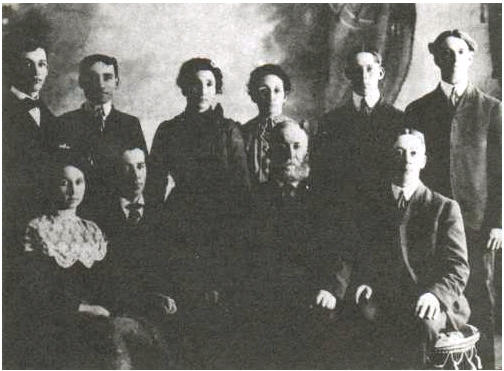
William Winterton’s First Family. Standing L to R: Hyrum S., Ralph, Sarah Ellen, Eliza Ann, Moroni, Fred Parker, a nephew. Seated: Malissa, William H., WILLIAM, and Frederick.
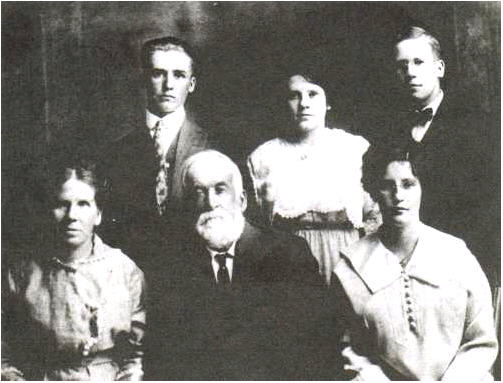
William Winterton’s Second Family. Standing L to R. Edward M., Nettie Rachel, and VaLeo. Seated JANE, WILLIAM and Carrie as they looked in 1916.
Chapter 13
Sarah Ellen Winterton Price
Sarah Ellen Winterton was
born on 10 Dec 1870 at Charleston, Utah, the first child of the William and
Nellie Widdison Winterton family and their first daughter.
Sarah Ellen Winterton was
the first grandchild of the William Hubbard and Sarah Marriott Winterton family
and their first granddaughter.
Sarah Ellen Winterton’s
maternal grandparents were William (1813- 1855) and Ellen Stafford (1819- 1873)
Widdison of Nottinghamshire, England.
W121 Sarah
Ellen Winterton on 22 Feb 1893 married John Heber Price born 22 May 1869 died 26
October 1951 son of James Price and Ann Powell. John’s paternal grandparents
were James William Price and Ann Danks of Ludlow, Staffordshire, England. His maternal grandparents were George Powell
and Maria Mouseley of Bromwick, England. They lived at Charleston and were the
parents of:
W1211 HeberFrederick
Price born 6 Dec 1893
W1212 Nellie
Ann Price born 3 Nov 1895 died 1902
W1213 Montesse
Price born 2 April 1897 died 2 April 1900
W1214 Florence
Ella Price born 22 Jan 1901
W1215 Earl
W. Price b 15 Sep 1905 d 14 Jan 1910
W1216 Rula
Lavina Price born 10 July 19 10
W1217 Vernon
Washington Price born 22 Feb 1912
W1211 Heber
Frederick Price on 21 Nov 1917 married Ruby Leona Bagley born 12 March 1897
daughter of George Bagley and Eliza Edwards. They lived at Charleston, Utah and
were the parents of:
W12111 J.
Fred Price Jr. born 28 May 1924
W12112 Verna
E. Price born 22 Oct 1918
W12113 Clara
Price born 7 Jan 1922
W12114 Russell
Price born 19 Feb 1926
W12115 Inez
Price born 28 Aug 1930
W12116 Edna
Price born 29 March 1934
W12117 Leona
Price born 15 arch 1937
W12118
Louise Price born 28 March 1942
W12111 J.
Fred Price Jr. on 15 Nov 1950 married
Nadine Giles born 24 April 1930. They live at Heber City, Utah and are the
parents of:
W121111 John
H. Price born 1 Oct 1951
W121112
Laurel June Price born 1 Aug 1953
W121113 Jay
Fred Price born 22 Feb 1956
W12112 Verna
E. Price on 14 Aug 1940 married Wilburn Ferris Huffaker born 26 May, 1917 son
of Royal Huffaker and Anna Louise Haueter. They live at Heber City, Utah and are the parents of:
W121121
Audrey Huffaker born 27 July 1942
W121122 Mary
Huffaker born 4 Dec 1947
W121123 Anna
Huffaker born 23 Nov 1950
W121124 Allen
W. Huffaker born 18 March 1953
W121125
Wayne Price Huffaker born 6 March 1956
W121121
Audrey Huffaker on 21 Dec 1960 married Carl Reese.
W12113 Clara
Price on 28 Nov 1941 married George Holmes born 16 Dec 1914 son of William Holmes
and Annie S. Mallie. They live at Heber City, Utah and are the parents of:
W121131
George Price Holmes born 19 Sept 1944
W121132 Jane
Holmes born 16 Dec 1949
W121133
Susan Holmes born 8 Feb 1951
W121134 Glen
William Holmes born 11 April 1956
W12114
Russell Price on 3 May 1950 married Veon Crook born 5 Nov 1930 daughter of J. Thomas
Crook and Annie Harvey. They live at Heber City, Utah and are parents of:
W121141 Judy
Ann Price born 3 March 1951
W121142
Malene Price born 13 Jan 1953
W121143
Marsha Price born 23 Feb 1957
W121144 Lynn
Russell Price born 8 March 1961
W121145
Laurie Price born 8 March 1961
W12115 Inez
Price on 20 March 1952 married Don Nile Horner born 17 Oct 1927 son of Thomas C.
Horner and Luella Mae Cummings. They live at Heber City, Utah and are parents
of:
W121151
Carol Michele Horner born 7 Dec 1954
W121152
Phyllis Horner born 6 Jan 1958
W12116 Edna
Price on 18 Sept 1952 married Raymond Alexander Bird born 1 March 1931. They live at 5884 S. 75 West St., Murray,
Utah and are the parents of:
W121161
Kenneth A. Bird born 15 June 1953
W121162
Charles Bird born 6 June 1956
W121163
Annette Bird born 13 July 1959
W12117 Leona
Price on 31 May 1956 married Mark J. Barnard born 27 Nov 1936 son of John Jeff
Barnard and Rae Abbott. They are the parents
of:
W121171
Marie Barnard born 24 May 1959
W121172
Carol Barnard born 4 Dec 1960
W12118
Louise Price on ___ April 1963 married Robert Lee Wilding son of Mr. & Mrs.
Floyd L. Wilding.
W1214 Florence Ella Price
on 21 Jan 1920 married John Hartley Carlile. They live at 389 North 2nd West St.,
Heber City, Utah and are the parents of:
W12141 Grant
Carlile born 11 Feb 1921
W12142 Relva
Carlile born 25 Nov 1923
W12143 Nelda
Carlile born 14 Sept 192 5
W12144 Gwen
Carlile born 26 March 1931
W12141 Grant
Carlile on 26 June 1950 rnarried Thelma Burgener born 25 Feb 1911 daughter of
Jack Burgener and Minnie May Bunnell. They live at Centerville, Utah. No children.
W12142 Relva
Carlile married and divorced Cyrus C. Holt. They were the parents of:
W121421
Karen Holt born 19 Sept 1944
Reva Carlile Holt on 19 Nov
1946 married 2nd Ray Wendell Swain born 26 July 1913 son of Ephraim
Swain and Phebe Oaks. They live at Bountiful,
Utah and are parents of:
W121422 Linda
Ray Swain born 29 April 1948
W121423 Allen
Swain born 20 Feb 1951
W121424
Lynette Swain born 7 March 1955
W121421
Karen Holt about 1960 married Gary Haslam and they are the parents of:
W1214211
DavidHaslam born 22-Dec 1961
W1214212
Sherri Haslam born about April 1963
W12143 Nelda
Carlile married on 1 Aug 1946 Kenneth Whiting born 29 April 1935 son of Wayne C.
Whiting and Violet Wright. They live at R.F.D. Lewiston, Utah and are parents
of:
W121431 Neil
Whiting born 6 March 1948
W121432
Lanna Whiting born 9 Nov 1950
W121433 Gary
Wayne Whiting born 25 Dec 1951
W121434 Roy
Whiting born 9 Feb 1957
W121435 Marcia
Whiting born 31 Oct 1959
W12144 Gwen Carlile married
on 6 June 1951 Donald Pitts born 6 June 1931 son of George,Pitts and Zella
Moulton.. They live at Centerville, Utah and are parents of:
W121441
Joyce Pitts born 28 April 1952
W121442 Janeen
Pitts born 14 May 1954
W121443
Carlyn Pitts born 31 May 1955
W121444 Kent
Pitts born 28 Feb 1957
W121445
Annette Pitts born 25 Sept 1962
W1216 Rula
Lavina Price on 3 Sept 1937 married Jaspep Ray Mc Clellan born 19 Jan 1913. They live at 3220 S. 9 E., Salt Lake City (currently
1964 in Mexico City on mission) and are parents of:
W12161 Boyd
Mc Clellan born 5 June 1938
W12162 Rulon
Me Clellan born 23 June 1946 died 1947
W12163 Keith
Mc Clellan born 23 Nov 1943
W12164 Jay
R. Mc Clellan born about 1945
W12165 Dale
Ronald Mc Clellan born about 1947
W12161 Boyd
Mc Clellan about 1962 married _________________. They live at 3220 South 9th East, Salt Lake City and are parents
of:
W121611
(twin) Mc Clellan
W121612
(twin) Mc Clellan
W1217 Vernon
Washington Price on 2 June 1937 married Relva Ritchie born 9 Feb 1914 daughter
of John M. Ritchie and Sarah Elizabeth Wright. They live at R. F. D. Heber,
Utah and are parents of:
W12171 Duane
Price born 7 April 1939
W12172
Elaine Price born 16 Nov 1942
W12173 Lu
Anna Price born 15 March 1946
W12174 Neil Price
born 4 Sept 1947
W12171 Duane
Price on 28 Aug 1963 married Suzanne Law born 24 March 1943 daughter of J. B.
Law and Lorraine Baird. They live in Garland, Utah.
Chapter 14
Eliza Ann Winterton Thacker
Eliza Ann Winterton was
born at Charleston, Utah 9 October 1872 the second child of the William and
Nellie Widdison Winterton family and their second daughter.
Eliza Ann Winterton was the
4th grandchild of the William Hubbard and Sarah Marriott Winterton family and
their third granddaughter.
Eliza Ann Winterton’s
maternal grandparents were William (1813-1855) and Ellen Stafford (1819-1873)
Widdison of Nottinghamshire, England.
W122 Eliza Ann Winterton on
19 Dec 1894 married John Thacker born 7 June 1867 died 25 Feb 1951 son of
William Thacker and Rachel Tonks. John’s paternal grandperents were Aaron Thacker
and Leah Horton of Darlington, Staffordshire, England. His maternal
grandparents were Firnally Timothy Tonks and Ann Jones. They lived at Daniels,
Wasatch County, Utah and were parents of:
W1221 Ralph
Alonzo Thacker born 30 Oct 1895
W1222 Ellie
Rachel Thacker born 30 July 1897 died 29 Jan 1963
W1223 Chloe
Isabelle Thacker born 3 Feb 1899
W1224 Fay
Elgie Thacker born 24 Sept 1900
W1225 Hyrum
Thacker born 29 July 1902 died 29 July 1902
W1226 Harold
Thacker born 29 July 1902 died 29 July 1902
W1227 Irwin “W”
Thacker born 8 March 1904
W1228 Thora
Ann Thacker born 11 Dec 1905 died 7 July 1946
W1229
Aurtance Ellen Thacker born 20 Oct 1908
W122-10-
Horton E. Thacker born 19 Aug 1910
W122-11-
Afton Marriott Thacker born 6 July 1915
W122-12-
John Weston Thacker born 21 Aug 1917
W1221 Ralph
Alonzo Thacker on 12 Nov 1924 married Ethel Jamima Jacklin born 13 March 1905
daughter of Ernest Elijah Jacklin and Emma Miriam Casper. They lived at
Daniels, Utah and were parents of:
W12211 Dona
Thacker born 31 Aug 1925
W12212 Zina
Thacker born 7 Sept 1927
W12213 Ralph
Leo Thacker born 9 Dec 1928
W12214 Vida
Thacker born 1 Sept 1930 died 10 Dec 1931
Wl2215 Hilda
Thacker born 15 May 1932
W12216 Lynn
D Thacker born 16 Aug 1933
W12217 J.
Reed Thacker born 13 Nov 1935
W12211 Donna
Thacker on 25 May 1942 married Doyle V Sweat born 19 April 1922 son of Orval
Sweat and Bertha Gallie. They live at Heber City, Utah and are parents of:
W122111 Linda
T Sweat born 31 Oct 1945
W122112 Vida
sweat born 24 Dec 1946
W122113
Brent D Sweat born 19 Aug 1948
W122114 Vern
O. Sweat born 25 July 1950 died 20 Feb 1957
W122115 Jill
Sweat born 16 Nov 1960
W12212 Zina Thacker on 22
Sept 1948 married Lars Elwin Jenkins born 9 Nov 1921 son of Junius Paxman
Jenkins and Sylvia Murdock. They live
at Lehi, Utah and are parents of:
W122121 Dona
June Jenkins born 23 Aug 1949
W122122
Annette Jenkins born 8 Dec 1951
W122123
Kathleen Jenkins born 16 Nov 1953
W122124
Keith Lars Jenkins born 29 June 1956
W122125
Larry Stewart Jenkins born 26 Jan 1959
W12213 Ralph
Leo Thacker unmarried.
Wl2215 Hilda
Thacker on 31 May 1950 married Bob Jimmy Patterson born 30 June 1926 son of Bob
J. Patterson and Sarah Marrilla Carlisle. They live at Daniels, Utah and are parents of:
W122151
Diane Patterson born 16 May 1951
W122152 Julie
Marie Patterson born 16 May 1953
W122153
Robert Patterson born 17 June 1954
W122154 Joan Patterson
born 28 Feb 1957
W122155 Kim
Patterson born 28 Oct 1958
W122156
David Michael Patterson born 27 July 1961
W12217 J
Reed Thacker on 28 June 1962 married Kathleen Shaw born 29 Aug 1943 daughter of
Harold J Shaw and Maurine . They live at
Salt Lake City, Utah and are parents of:
W12217 Connie
Kay Thacker born 21 June 1963
W1222 Nellie
Rachel Thacker .on 19 Oct 1918 married Leslie Webb born 16 Nov 1897 son of Simon
Webb and Harriet Ann Welch. They lived at
Hinckley (Rt. 1 Delta) Millard Co., Utah and were parents of:
W12221 Ardis
Harriet Webb born 14 Aug 1919
W12222 John
Oren Webb born 10 Dec 1920 died 22 Dec 1920
W12223 Reed
Webb born 2 Oct 1921 died 2 Oct 1921
W12224
Beulah Webb born 31 Aug 1922
W12225
Calvin Thacker Webb born 15 April 1924
W12226 Delma
Jean Webb born 17 March 1927
W12227 Elva
LaRue Webb born 16 Nov 1929
W12228
Leslie Fay Webb born 22 Apr 1932 died 29 June 1951
W12229 Gary
Webb born 27 March 1937
W1222-10-
Ronald Herbert Webb born 15 Feb 1940
W12221 Ardis
Harriett Webb on 3 Oct 1940 married Boyd Ashby Murray born 31 Jan 19 17 son of
James Beck Murray and Arta Amelia Ashby.
They have lived in Utah, Arizona and 1286 San Mateo Drive, San Luis
Obispo, California and are parents of:
W122211
Norman Boyd Murray born 6 July 1942
W122212 Jane
Ardis Murray born 31 Aug 1944
W122213
Kathryn Murray born 12 Jan 1946
W122214 Evan
Leslie Murray born 6 Jan 1948
W122215
Margaret Ann Murray born 29 June 1952
W122216
Elaine Murray born 3 March 1955
W122217
Robert James Murray born 25 Nov 1958
W122218
Golden Eugene Murray born 12 Sept 1962
W122211 Norman Boyd Murray
on LDS mission in Peru 1962-63.
W12224 Beulah Webb on 3 Aug
1942 married Loren Delaine Rowley born 24 Dec 192 1 son of Hugh Cleveland
Rowley and Nellie Deane Conk.
They live at Oasis, Millard
Co., Utah and are the parents of:
W122241
Steven Dee Rowley born 15 Oct 1944
W122242
Susan Ranell Rowley born 30 July 1947
W122243
Scott Cleve Rowley born 2 1 July 1948
W122244
Sharon Loraine Rowley born 1 Jan 1952
W122245
Shane Webb Rowley born 16 Sept 1954
W122246
Stewart Loren Rowley born 6 Dec 1956
W12225
Calvin Thacker Webb on 6 Nov 1946 married Carol Emma Halgren born 24 Nov 1927 daughter
of John Aubrey Halgren and Jewel Nordberg. They live at 609 Bently Drive, Fairbanks,
Alaska and are parents of:
W122251
Kathryn Diane Webb born 11 July 1947
W122252
Kenneth Douglas Webb b 18 Sept 1949
W122253 Jim
Roger Webb born 23 July 1958
W12226 Delma
Jean Webb on 12 June 1947 married Duane Dean Galli born 8 Sept 192 1 son of Albert
Dean Galli and Lumena. Doutre. They
live at Hinckley, Utah and are parents of:
W122261
Paula Galli born 9 Feb 1948
W122262
Allen Duane Galli born 30 March 1949
W122263
Judith Gal5 born 29 Aug 1950
W122264
Phyllis Ann Galli born 13 Nov 195 1
W122265
Linda Jean Galli born 27 Jan 1954
W12227 Elva
LaRue Webb on 11 Aug 1950 married Fred Arthur Skeem born 29 May 1930 son of
Peter Edwin Skeem and Verna Fontella Talbot, They live at Hinekley, Utah and
are the parents of:
W122271
Beverly Rae Skeem born 18 May 1951
W122272
Sheldon Lee Skeem born 2 March 1953
W122273 Gwen
Ann Skeem born 13 Jan 1955
W122274 Paul
Edwin Skeem born 8 April 1957
W122275 Jerry
Leslie Skeem born 23 Nov 1958
W122276 David
James Skeem born 16 Dee 1960
W12229 Gary
Webb on 24 Aug 1957 married Evelyn Kay Skeem born 24 Aug 1937 daughter of Glen
I. Skeem and Eathel Ingram. They live
at 3555 W. 3310 South, Salt Lake City and are parents of:
W122291
Vicki Lynn Webb born 25 Sept 1958
W122292
Russell Gary Webb born 26 Aug 1960
W122293 Jody
Glen Webb born 12 Aug 1961
W122294
Cindy Kay Webb born 24 Feb 1963
W1222-10-
Donald Herbert Webb on 17 Sept 1959 married Wanda Kenney born 12 Aug 1341 daughter
of George Wells Kenney and Ramona Jackson. They live at 444 North Owen Street, Layton,
Utah and are parents of:
W1222-10-1
Ronda Kay Webb born 22 July 1960
W1222-10-2 Howard
Kenney Webb b 10 July 1962
W1223 Chloe
Isabelle Thacker on 10 Oct 1923 married William Elbert Slade born 19 March 1895
son of William Alfred Slade and Annie Swan. They lived at Heber City and 158 N
4 E:, Kaysville, Utah and were parents of:
W12231
Elbert J. Slade born 21 July 1924 died 26 July 1944
W12232
Curtis William Slade born 22 Feb 1926
W12233 Norma
Slade born 1 May 1927
W12234
Harold Dean Slade born 27 March 1931
W12235 Rhea
Slade born 10 March 1934
W12236 Beth
Slade born 9 Oct 1942
W12231
Elbert J. Slade died age 20 unmarried. Served
19 mos. in U.S. Air Force.
W12232
Curtis William Slade on 6 Nov 1952 married Roselyn Woodward born 13 July 1927 daughter
of Robert Lewis Woodward and Loretta Thompson. They lived at Kaysville, Utah
and were the parents of:
W122321
Kathleen Slade born 13 Sept 1953
W122322
Keith Curtis Slade born 22 Nov 1954
W122323
Janalee Slade born 10 April 1956
W122324 Neal
William Slade born 31 Aug 1957
W122325
Douglas Elbert Siade born 18 July 1962
W12233 Norma
Slade on 28 Aug 1946 married Lionel George Simmons born 14 Dec 1918 son of
Stephen A. Simmons and Thressa Price. They
live at Mesa, Arizona and are parents of:
W122331 Gary
L. Simmons born 13 June 1947
W122332
Carolyn Simmons born 27 June 1950
W122333
Dwayne G. Simmons born 20 Sept 1955
W12234 Harold
Dean Slade on 20 Dec 1957 married Del Rae Secrist born 26 Dec 1934 daughter of
Emory Miller Secrist and Blanche White.
They live at Kaysville, Utah and are parents of:
W122341 Kent
Harold Slade born 18 Dec 1959
W122342 Dean
Emory Slade born 9 Aug 1963
W12235 Rhea
Slade on 29 April 1953 married Don William Manning born 12 April 1930 son of Delles
William Manning and Mabel Moon. They live at Farmington and are the parents of:
W122351
Rodney Delles Manning born 9 Feb 1954
W122352 Lisa
Manning born 23 Oct 1955
W122353 Phil
Slade Manning born 7 June 1958
W122354 Boyd
William Manning born 24 Aug 1962
W12236 Beth
Slade not married.
W1224 Fay Elgie Thacker on 10 Oct 1923 married Thalia
Watson born 24 April 1904 daughter of Harvey Fowles Watson and Ella Marie Murdock.
They lived at Box 155 Castle Gate, Utah and were parents of:
W12241 Fern
Thacker born 31 May 1925
W12242 Harry
Fred Thacker born 17 March 1927
W12243 John
Kent Thacker born 22 Nov 1928 died 6 May 1948
W12244 Helen
Thacker born 28 May 1931
W12245 Fay
Weldon Thacker born 10 March 1934
W12246
Marilyn Thacker born 2 April 1936
W12247
LaPreal Thacker born 13 March 1939
W12248 Baby
girl Thacker born 1 Aug 1947 died 1 Aug1947
W12241 Fern
Thacker on 30 Aug 1949 married Robert Benjamin Anderson born 24 March 1922 son
of Owen Benjamin Anderson and Elizabeth S. Smith. They live at 405 East Center Street, Pleasant Grove, Utah and are the
parents of:
W122411
Robert Kent Anderson born 3 June 1951
W122412 Dale
Owen Anderson born 1 Aug 1952
W122413 Gary
Lynn Anderson born 26 March 1954
W122414
Sandra Anderson born 6 March 1957
W122415
Jenett Anderson born 18 Dec 1959
W122416
Nancy Anderson born 20 Jan 1964
W12242 Harry
Fred Thacker on 7 July 1950 married Leah Scoresly born 23 July 1930 daughter of
Cliifor d Norman Score sly and Johanna Lindholm Horman. They live at Richland,
Washington and are parents of:
W122421
Lawanna Thacker born 8 July 1951
W122422
Brenda Thacker born 22 Aug 1953
W122423 Alan
Lee Thacker born 16 April 1955
W122424
Edwina Thacker born 12 Feb 1958
W122425 Mark
Reed Thacker born 22 May 1960
W122426 Jay
Lynn Thacker born 16 Jan 1963
W12244 Helen
Thacker on 25 Nov 1959 married William Lloyd Gheen born 24 Sept 1933 son of
William Harris Gheen and Vera Bertha Korth.
They live at 849 North 2000 North,Provo, Utah and are parents of:
W122441
DeAnn Gheen born 15 Nov 1961
W122442 Mark
L. Gheen born 4 Feb 1964
W12245 Fay
Weldon Thacker on 3 June 1957 married Chadley Ann Hill born 22 Sept 1935 daughter
of Ardie Kerr Hill and Valoi Rosenblaum.
They live at 74 South 6th East Street, Springville, Utah and are parents
of:
W122451
Brandon K Thacker born 29 April 1958
W122452
Bryce Weldon Thacker born 8 June 1960
W122453
Thalia Lynn Thacker born 30 Aug 1961
W122454
Janeth VeLoie Thacker born 8 Jan 1964
W12246
Marilyn Thacker on 14 Sept 1957 married Jack Waldo Liefson born 13 Dec 1954 son
of Juren Victor Liefson and Mary Amelia Bradford. They live at 375 North 2nd
West Spanish Fork, Utah and are parents of:
W122461 Bret
Jack Liefson born 14 July 1959
W122462
Ronald Scott Liefson born 1 March 1962
W12247
LaPreal Thacker on 28 Aug 1959 married John Samuel Allison born 8 March 1935 son
of A,. Inman Allison and Francis Marie Lewis. They live at 39 Airlane Drive,
Clearfield, Utah and are the parents of:
W122471 Debra
Lee Allison born 9 Nov 1960
W122472
Chris Morel1 Allison born 8 July 1963
W1227 Irwin
W. Thacker on 8 Sept 1930 married Lorna Simmons born 8 Jan 1906 daughter of
John Wm, Simmons and Phoebe Elizabeth Daybell. They live at Heber City, Utah
and are the parents of:
W12271 Erwin
Junior Thacker born 12 June 1931
W12272
Farrell John Thacker born 12 Dee 1932
W12273 Lee
Simmons Thacker born 14 March 1935
W12274
Joleen Thacker born 31 Oct 1938
W12275 Merleen
Thacker born 31 Oct 1938
W12276
Morris LaVon Thacker born 6 March 1943
W12271 Irwin
Junior Thaeker on 22 June 1951 married Carol Nadine Baxter born 2 June 1932
daughter of Allen LeRoy Baxter and Anna Kezia Erickson. They live at Heber
City, Utah and are parents of:
W122711
Vaughn Jay Thacker born 6 Aug 1952
W122712 Gary
Lee Thacker born 28 Jan 1955
W122713
David Allen Thacker born 9 March 1956
W12272
Farrell John Thacker on 9 Feb 1957 married Bonnie Vae Watson born 3 1 Jan 1938 daughter
of Thomas Squire Watson and Venice Hicken. They live at 171 Taft St. , Midvale,
Utah and are the parents of:
W122721 Lee
Ann Thacker born 16 March 1958
W122722
Kevin Farrell Thacker born 2 May 1960
W12273 Lee
Simmons Thacker on 12 Nov 1959 married Kari Johansen Miltz born 18 Dec 1936 at
Trondheim, Norway daughter of Kurt Miltz and Augusta Johansen. They are the parents of:
W122731 _________
Thacker born ___ June 1961
W12274
Joleen Thacker on 10 ApriI 1958 married Gary E Gines born 12 March 1937 son of Ellsworth
Gines and Eva Smith. They live at 1293 South Main, Bountiful, Utah and are the
parents of:
W122741
Byron Gary Gines born 29 Jan 1959
W122742 Kent
T. Gines born 20 April 1960
W122743 Sharleen
Gines born 1 May 1963
W12275
Merleen Thacker on 25 Sept 1957 married Richard Charles Skillicorn born 20 Dec 1931
son of George Henry Skillicorn and Ada Louise Halver son. They live at Salt
Lake City and are the parents of:
W122751
Richard Cary Skillicorn born 4 Nov 1958
W122752
Diane Skillicorn born 18 April 196 1
W122753
Skillicorn born – 1963
W12276
Morris LaVon Thacker on 3 1 May 1962 married Karen Huffaker daughter of Glen LeRoy
Huffaker and Annie Pona Carlen. They
are the parents of:
W122761 ________
Huffaker born ___ 1963
W1229
Aurtance Ellen Thacker on 10 June 1931 married Weldon LeBurl Rigby born 22 Feb 1908
son of William E Rigby and Mary Peter son. They live at 2203 Lincoln St., Salt
Lake City and are parents of:
W12291 Brent
W. Rigby born 6 Nov 1942
W122-10-
Horton F. Thacker on 22 June 1945 married Irene Williams born 9 Oct 1916 daughter
of Irven Kimball Williams and Ingry Lucille Bunderson.
W122-11-
Afton Marriott Thaeker on 11 Dec 1936 married Virginia Van Wagoner born 23 July
1919 daughter of William Lo Van Wagoner and Charlotte Sharp. They live at Heber
City, Utah and are the parents of:
W122-11-1
Ann Thacker born 13 Aug 1937
W122-11-2
Carole Thacker born 25 Dec 1941
W122-11-3
Larry J. Thacker born 8 Dec 1942
W122-11-4
Mary Susan Thacker b 16 Nov 1952
W122-11-5 ________Thacker
born ___ Aug 1963
W122-11-1
Ann Thacker on 6 Sept 1956 married John Ross Clyde born 6 March 1937 son of
John Ellis Clyde and Emma Cummings. They
live at Logan, Utah and are the parents of:
W122-11-11
Kathleen Clyde born 8 April 1958
W122-11-12
Julie Ann Clyde born 3 Feb 1960
W122-11-2
Carole Thacker on 17 July 1959 married Richard Glade Bonner born 1 May 1938 son
of Alvah Glade Bonner and Bernice Webster. They live at Heber City, Utah and
are the parents of:
W122-11-21
Steven Richard Bonner born 17 Feb 1960
W122-11-22
Troy A Bonner born 4 March 1962 -
W122-11-23 Bonner
born 14 March 1963
W122-12-
John Weston Thacker on 29 April 1943 married Anna Elizabeth Huish born 16 Sept 1922
daughter of Willard Snow Huish and Martha McRae. They live at Mesa, Maricopa Co.,
Arizona and are parents of:
W122-12-1
Linda Thacker born 7 May 1944
W122-12-2 Tressa
Thacker born 8 Feb 1946
W122-12-3
John W. Thacker Jr. born 29 June 1947
W122-12-4
Thomas Eric Thacker born 23 Jan 1951
W122-12-5
Steve H. Thacker born 27 Sept 1952
W122-12-6
Boyd H. Thacker born 20 Feb 1954
W122-12-7
Gayle Thacker born 5 June 1956
W122-12-8
Dave H. Thacker born 18 Aug 1961
W122-12-9
Harvey H. Thacker born 5 Nov 1963
Chapter 15
William Heber Winterton
William Heber Winterton was
born at Charleston, Utah on 4 Oct 1874 the third child of the William and
Nellie Widdison Winterton family and their first son.
William Heber Winterton was
the 8th grandchild of the William Hubbard and Sarah Marriott Winterton
family and their second grandson.
William Heber Winterton’s
maternal grandparents were William and Ellen Stafford Widdison of Nottinghamshire,
England.
W123 William Heber
Winterton on 15 Feb 1899 married first Agnes Webster born 27 Nov 1875 died 2
Jan 1943 daughter of William Webster and Ann Daybell. Agnes’ paternal
grandparents were Elisha Webster and Ann Kelstripe of New Whittington,
Derbyshire, England. Her maternal grandparents
were Finity Daybell and Mary Draper of Seinkinshire, England. They lived at Charleston,
Utah and were the parents of.
W1231 Heber
Royal Winterton born 7 Dec 1899
WI232 Olinda
Ann Winterton born 25 May 1902
W1233 Pansy
B. Winterton born 21 June 1905
W1234
Stafford Winterton born 8 Sept 1908
W1235 Grant
Winterton born 19 June 1910
W1236 Veon A
Winterton born 14 March 1917
William Heber Winterton
married 2nd Lucy Jacobs Baird 24 Feb 1947.
W1231 Heber
Royal Winterton on 25 March 1924 married Vera Josephine Ritchie born 26 March
1902 died 31 May 1926 daughter of John M. Ritchie and Sarah Wright. Heber Royal Winterton on 9 Nov 1927 married 2nd
Lucy
Van Flett Eldredge born 1
June 1899 daughter of Adelbert Uberto Eldredge and Edith Pack. They lived in
Salt Lake City, Heber and 750 E. 150 S. Bountiful, Utah and were parents of:
W12311 Arlan
E Winterton born 13 March 1929
W12312 Julia
Deanne Winterton born 14 Aug 1930
W12313 Eloise
Winterton born 6 Nov 1937
W12314 Baby
Winterton born 31 May 1926 died 31 May 1926
W12311 Arlan
E Winterton unmarried is a schoolteacher.
W12312 Julia Deanne
Winterton on 28 March 1951 married Joseph Ray Thacker born 26 Aug 1924 son of
Ray Alvah Thacker and Mable Jemima Casper. They lived at Heber City and Kearns, Utah and were the parents of:
W123121
Julia Lynne Thacker born 22 June 1952
W123122
Brian Joseph Thacker born 16 Oct 1954
W123123
Larry Dean Thacker born ___ ______ 195_
W12313
Eloise Winterton on 15 June 1955 married Farrell Dee Bond born 1 Feb 1935 son of
Alfred Clift Bond and Lois Baird. They live at Henderson, Nevada and are
parents of:
W123131
Melanie Bond born 9 July 1956
W1232 Olinda
Ann Winterton on 5 Nov 1919 married Lorin Atkinson Wright born 7 March 1898 son
of William Wright and Mary Jane Baum. They live at 906 E. Center, Provo, Utah
and are parents of:
W12321
Larvin Wright born 3 July 1920
W12322 Zelma
Wright born 4 Feb 1922
W12323 Boyd
L. Wright born 5 Feb 1924
W12324 Dean
H Wright born 29 June 1925
W12325 Wanda
Wright born 19 Oct 1926
W12326 Mary
Beth Wright born 8 Aug 1929
W12327
Orlinda Wright born 10 Jan 1932
W12328 Von
Charles Wright born 19 May 1933
W12329
LaRene A Wright born 16 June 1936
W12321
Larvin Wright on 10 April 1944 married LaWana Rhodes Beck born 25 Feb 1926 daughter
of Levi Beck and Iva Pearl Huff. They live
at Salt Lake City and are the parents of:
W123211
Kathleen Wright born 22 Feb 1945
W123212
Clyde L. Wright born 25 April 1947
W123213
Lorin Earl Wright born 22 April 1949
W12322 Zelma
Wright on 27 June 1947 married Eldon F. Lewis born 28 Nov 1917 son of Thomas
Lewis and Ina Foote. They live at 97 E., 1200 N., Orem, Utah and are parents
of:
W123221
Linda Lee Lewis born 17 Nov 1942
W123222
Robert Eldon Lewis born 2 May 1949
W12323 Boyd
Lo Wright on 6 Feb 1947 married Norma Smith daughter of Elmer J. Smith and Elma
Dunn.
W12324 Dean
H. Wright on 19 March 1948 married Joan Doman born 2 Feb 1928 daughter of Rulon
Wallace Doman and Bessie Atkin. They live
at 8 North Nelson St., Dillon, Montana and are parents of:
W123241
DeAnn Wright born 20 March 1951
W123242
Robyn Wright born 22 May 1954
W123243
Christie Lyn Wright born 14 Aug 1957
W12325 Wanda
Wright on 10 April 1946 married Kent Lee Master born 22 Sept 1924 son of Oscar
DeeVon Lee Master and Mariette Henpie.
They are parents of:
W123251 Gary
Kent Lee Master born 11 Feb 1947
W123252 Boyd
Michael Lee Master born 23 Sept 1948
W123253
Bryce DeeVon Lee Master born 6 April 1955
W12326 Mary
Beth Wright on 29 Nov 1950 married Keith Tippets Dalton son of Hyrum Cloyd Dalton
and Arbeth Tippets. They live at 667 N.
350 W., American Fork, Utah and are parents of:
W123261
Pamella Dalton born 14 Oct 1951
W123262
Debra Dalton born 19 Nov 1952
W123263
Terry Kim Dalton born 27 Dec 1954
W123264 Ty
Keith Dalton born 2 July 1956
W12327
Orlinda Wright on 8 July 1953 married Robert J. Mower born 4 May 1929 son of Edgar
J. Mower and Luella Catherine Oldroyd. They
live at Glendale, California and are parents of
W123271
Susan Mower born 21 May 1954
W123272
Nancy Mower born 24 Sept 1956
W12328 Von
Charles Wright on 28 Sept 1953 married Marjorie Bird born 24 March 1934 daughter
of Laurence Bird and Jane Winifred Hamnett. They live at 1465 S. 640 E., Orem, Utah
and are parents of:
W123281
Craig Von Wright born 28 Sept 1955
W123282
Denise Wright born 3 March 1957
W123283
Larry Dean Wright born 11 April 1959
W123284
Colette Wright born 25 March 1961
W12329 LaRene A. Wright on
12 Sept. 1955 married Henry Leland Loy born 30 April 1931 son of Henry Albert
Loy and Della Brown. They live at-Idaho
Falls, Idaho and are parents of:
W123291
Christine Loy born 4 Sept 1956-
W123292 Kaye
Lynn Loy born 7 Nov 1958
W123293
Henry Leland Loy Jr. born ___ _____ 1961
W1233 Pansy
B. Winterton on 6 Jan 1926 married Roe Carlile born 30 March 1903 son of George
Robert Carlile and Marion Ruth Neil. His paternal grandparents were George
Carlile and Laura Ann Giles who were converted to the Mormon Church at
Nottingham, England and migrated to Palmyra, Utah in 1857. His great grandparents Robert Carlile and
Christina Spouncer came at that same time. They went on into Wasatch County in 1858 and 1859. The patent on the Carlile homestead at
Charleston was signed by U.S. President Ulysses S. Grant. His maternal grandparents were William Neil
born at Edinsburgh Scotland and Marian Robertson born about 1835. They also joined the Church and settled at
Cottonwood, Salt Lake County in 1869. They live at 3260 Upland Drive, Salt Lake City and are the parents
of:
W12331 Theda
A. Carlile born 27 April 1927
W12332 Willa
Carlile born 2 July 1928
W12333 Keith
W. Carlile born 5 Jan 1930
W12334 Reed
George Carlile born 19 Feb 1933
W12335
Harold Lowell Carlile born 6 Nov 1934
W12336 Merle
DuAnne Carlile born 9 Sept 1937
W12337 Don
R. Carlile born 18 June 1942
W12338
Marilyn Carlile born 22 June 1945
W12331 Theda
A. Carlile on 24 Oct 1945 married Jay O. Johnson born 16 July 1924 son of
Andrew Ralph Johnson and Sarah Luella Cummings. They live at Heber City and are parents of:
W123311 Anna
Johnson born 5 April 1950
W123312
Jeanine Johnson born 10 Oct 1951
W123313
Linda Johnson born 10 Sept 1953
W123314
Kevin C. Johnson born 29 Feb 1956
W12332 Willa
Carlile on 20 Nov 1946 married Lee Foster born 10 July 1924 son of Franklin Dewey
Foster and Maud Vilate Chugg. They live
at Rt. 4, Box 85 Roy, Utah and are parents of:
W123321
Catherine Kay Foster born 23 July 1947
W123322
Kenneth Lee Foster born 21 March 1949
W123323
Brent Lyle Foster born 1 July 1950
W123324
Michael Tim Foster born 11 May 1956
W12333 Keith
W. Carlile on 2 June 1946 married Hazel Maxine Clyde born 9 Nov 1930 daughter
of Edward Y Clyde and Bertha Rebecca Murdock. They live at Provo, Utah and are parents
of:
W123331
Keith Lynn Carlile born 27 Nov 1948
W123332
Wayne Kent Carlile born 18 Nov 1953
W12334 Reed
George Carlile on 28 Jan 1953 married J. Ellen Dickson born 24 May 1932 daughter
of James Lindon Dickson and Mary Ellen Lewis. They live at 489 1 S. 2250 W.,
Roy, Utah and are parents of:
W123341
Terry Reed Carlile born 1 Dec 1955
W123342
Denise Carlile born 30 May 1957
W123343
Jeana Ellen Carlile born 9 July 1959
W123344
Diane Carlile born 30 March 1961
W123345
Brian Carlile born 27 Sept 1963
W12335
Harold Lowell Carlile on 15 June 1955 married Flossie Bell Porter born 26 Aug 1937
daughter of Clarence Elmer Porter and Flossie Sarah Carter. They live at 39 S.
100 E. Morgan, Utah and are parents of:
W123351
Debra Carlile born 15 March 1957
W123352 Gary
Porter Carlile b 22 Feb 1959
W123353
Christine Carlile born 12 Jan 1961
W12336 Merle
DuAnne Carlile on 15 Aug 1956 married Leland Milo Kippen born 4 Oct 1934 son of
Charles Robert Kippen and Maggie Tooks. They live at R. F. D. , Morgan, Utah
and are the parents of:
W123361
Randy Leland Kippen born 15 May 195.7
W123362
David Paul Kippen born 1 Oct 1958
W123363
Annette Kippen born 12 Oct 1959
W123364
Sharlene Kippen born 14 July 1962
Wl23365
Jayne Kippen born 29 June 1963
W12338
Marilyn Carlile on 18 July 1963 married Loren Bethers son of Lyman Bethers and
Ernestine Jacklin. They live at 237 E. 5 S. Heber City, Utah.
W1234
Stafford Winterton on 25 Oct 1926 married Maud Wright born 28 Jan 1908 daughter
of George B. Wright and Phebe Ritchie. They
lived at Charleston, R. F. D. Heber, Utah and were parents of:
W12341
Maxine Winterton born 13 June 1927
W12342 Doyle
Winterton born 5 Feb 1933
W12343 Larry
S. Winterton born 6 March 1937
W12341
Maxine Winterton unmarried.
W12342 Doyle
Winterton on 28 May 1953 married Donna E Bunnell born 7 Oct 1934 daughter of
Morris To Bunnell and Christie F Rasmussen. They live at 4321 No 1 E., Provo, Utah
and are parents of:
W123421
Vickie Lynn Winterton b 17 March 1954
W12343 Larry S. Winterton
on 24 August 1956 married Dauna Jean McDonald born 10 Nov 1938 daughter of Lynn
McDonald and Dauna Mae Montgomery. They live at Heber City, Utah and are
parents of:
W123431
Susan Winterton born 14 July 1957
W123432
Michael Winterton born 16 Feb 1959
W123433
Jeffrey Winterton born 7 Feb 1962
W1235 Grant
Winterton on 8 Sept 1932 married Mary Genie1 Giles born 12 March 1915 daughter
of Noah Giles and Lila May Ahlstrom. They
lived at Charleston and Heber and are parents of:
W12351 Dick
Giles Winterton born 16 March 1933
W12352 Bert
W. Winterton born 6 April 1934
W12353
Elaine Winterton born 14 Feb 1939
W12354 Rex
N. Winterton born 24 Oct 1947
W12351 Dick
Giles Winterton on 8 June 1959 married Nancy Jean Shurtliff born 2 Aug 1941 daughter
of Richard B. Shurtliff and Helen Bradshaw. They live at 120 South Main St., St.
George, Utah and are the parents of:
W123511
Sherry Winterton born 2 July 1960
W123512
Ronald Dick Winterton born 11 April 1963
W12352 Bert
W. Winterton on 29 May 1954 married Elizabeth Ann Lundin born 28 Oct 1934 daughter
of Charles John Lundin and Viola Mary Ibsen. They live at Ogden, Utah (where he
is employed by Weber College) and are parents of:
W123521
Kelly Bert Winterton born 10 April 1955
W123522
Lonny Dee Winterton born 18 Feb 1957
W123523
Louis Dale Winterton born 29 April 1959
W123524
Chrystal Ann Winterton born 17 Dec 1962
W12353
Elaine Winterton on 2 1 June 1963 married Douglas John Turner born 7 Oct 1934
son of William Jack Turner and Jane W. Douglas. They live at 1604-38th St SW Apt 3, Calgary, Alberta Canada
and are parents of:
W123531
Kaylene Turner born 20 Dec 1963
W1236 Veon
A. Winterton married first on 15 Jan 1937 Russell Allen born 27 Nov 1913. They were parents of three children before
their divorce:
W12361 Joyce
B Allen born 7 Dec 1937
W12362 Kay
Allen born 13 Dec 1940
W12363
Connie Allen born 22 Feb 1943
Veon A. Winterton Allen
married 2nd on 10 Oct 1946 Melvin Thompson Peterson born 24 Sept
1913 son of Francis Thompson Peterson and Nathala Snow. They live at 730 South
Richard St., Salt Lake City.
W12361 Joyce
Bo Allen on 28 June 1956 married Glade C. Fisher born 2 April 1938 son of Lotus
Fisher and Mary Colton. They live in Salt
Lake City, Utah and are parents of:
W123611
Crenda Lynn Fisher born 12 Nov 1957
W123612
Sherri Ann Fisher born 8 March 1959
W123613
Gregory Scott Fisher born 17 Dec 1963
W12362 Kay
Allen on 17 Feb 1959 married Thomas Broadhead born 29 June 1937 son of Horace
Broadhead and Erma Hatch. They live at Kearns, Utah and are the parents of:
W123621
Melvin Trent Broadhead b 29 Sept 1959
W123622 Chad
Preston Broadhead b 17 May 196 1
W123623
Urainna Veon Broadhead b 6 May 1962
W123624
Bambi Kay Broadhead born 11 Aug 1963
W12363
Connie Allen on 6 Jan 1961 married Richard Winston Welsh born 13 Nov 1932 son
of Seymour Winston Welsh and Lola Williams. They live in Salt Lake City, Utah and are the parents of:
W123631
Tracee Dea Welsh born 5 Dec 1962
Chapter 16
John Joseph Winterton
John Joseph Winterton was
born at Charleston, Utah 31 August 1876 the fourth child of the William and
Nellie Widdison Winterton family and their second son.
John Joseph Winterton was
the 12th grandchild of William Hubbard and Sarah Marriott Winterton
and their fifth grandson.
John Joseph Winterton’s
maternal grandparents were William and Sarah Stafford Widdison of
Nottinghamshire, England.
W124 John
Joseph Winterton died as a child.


Chapter 17
Hyrum Shurtliff Winterton
Hyrum Shurtliff Winterton
was born at Charleston, Utah on 16 August 1878 the fifth child of the William
and Nellie Widdison Winterton family and their third son.
Hyrum Shurtliff Winterton
was the 16th grandchild of the William Hubbard and Sarah Marriott
Winterton family and their eighth grandson.
Hyrum Shurtliff Winterton’s
maternal grandparents were William and Sarah Stafford Widdison of
Nottinghamshire, England.
W125 Hyrum
Shurtliff Winterton on 3 Sept 1902 married Sarah Van Wagener born 29 June 1882
died 27 Oct 1951 daughter of John Van Wagonen and Margaret Faucett. Sarah’s
paternal grandparents were John Halmah Van Wagoner and Clarissa Tappen of
Pottowattomie, Iowa. Her maternal grandparents were John Fausett and Mary
Shelton. They lived at Charleston and Woodland,
Utah and were parents of:
Wl251 Harold
Vernon Winterton born 16 July 1903 died 8 April 1931
W1252 Van
Delos Winterton born 21 May 1905
W1253 Grace
Ellen Winterton born 17 Nov 1907
W1254 Ralph
Deloy Winterton born 12 April 1909
W1255 Sarah
Luella Winterton born 7 Dec 1910
W1256 Omni
Overton Winterton born 11 June 1913
W1257 Clair
William Winterton born 14 July 1915
W1258 Ruth
Naomi Winterton born 30 Sept 1916
W1259 Eva
Margaret Winterton born 14 July 1919
W125-10-
Stella Gardner Winterton born 3 May 1927
Hyrum Shurtliff Winterton
married 2nd 25 Nov 1952 Sarah Jessie Fowers Daybell, widow of John
W. Daybell. They live at 743 S. 7th E., Salt Lake City, Utah. The following obituary appeared in the Salt
Lake Tribune and Deseret News:
“Mrs. Jessie Daybell
Winterton, 83, 743-7th East, died of natural causes Wednesday, 2:30
p. m. at her home. Born Jan. 18, 188 1, Charleston, Wasatch County, to John and
Elizabeth Baird Fowers. Married to John William Daybell, Jan. 16, 1901, Salt
Lake Temple, Church of Jesus Christ of Latter-day Saints. He died Feb. 26, 1948. Married to Hyrum So
Winterton NOV. 25, 1952, Salt Lake LDS Temple. Member, First LDS Ward. Survivors:
husband; sons, daughters, Grant Jo Daybell, Magna; Earl F. Daybell. Mrs. S. Po (Gladys)
Shurtleff, both Oakland, Calif.; Mrs. L. W. (Grace) Flint, Salt Lake City: Mrs.
Horace (Blanche) Cherrington, Walnut Creek, Calif.; 12 grandchildren, 7 great-
grandchildren; brother, sisters, Alfred J. Fowers, Albany, N.Y.; Mrs. Elizabeth
A. Phillips, Mrs. Mary Dangerfield, both Provo. Funeral pending. Burial, Wasatch Lawns Memorial Park.
W1251 Harold
Vernon Winterton on 11 June 1924 married Susie May Duke born 10 April 1906 daughter
of James Alfred Duke and Janet Gardner.
They lived at Charleston and were parents of:
W12511
Norman Duke Winterton born 14 June 1925
W12512
Marjorie May Winterton born 2 Aug 1927
W12513
Harold Don Winterton born 11 March 1931
After Harold’s death Mrs.
Winterton married Ivan Andrus and they were the parents of six children at
Coalville, Utah.
W12511
Norman Duke Winterton on 20 Sept 1945 married DeEtta Hall born 16 March 1927 daughter
of Oscar Spackman Hall and Hazel Rollo. They lived at 5574 South 2100 West, Roy
and are parents of:
W125111
Vernon Hall Winterton born 21 Feb 1947
W125112
Bryce Edward Winterton born 6 Nov 1951
W125113 Neil
Hall Winterton born 24 Nov 1955
W12512
Marjorie May Winterton on 14 Feb 1946 married John Ivan Andrus Jr. born 24 Nov 192
1 son of John Ivan Andrus Sr. and Cordelia Stevenson. They lived at Coalville
and Heber City, Utah and were parents of:
W125121 Roy
W. Andrus born 6 Feb 1947
W125122
Clinton W. Andrus born 14 March 1948
W125123
Linda Marie Andrus born 26 Nov 1949
W125124 Kim
J. Andrus born 24 Sept 1951
W125125 Ben
I. Andrus born 26 May 1955
W125126 Paul
B. Andrus born 13 Feb 1959
W12513
Harold Don Winterton on 20 Sept 1958 married Laura Marie Chris tiansen daughter
of Elroy B. Christiansen and Margaret Ellen Schiess. They live at 56 South 2nd
East, Murray, Utah and are parents of:
W125131
Warren Dean Winterton born 4 Nov 1959
W125132
Steven Bradley Winterton born 14 Oct 1960
W1252 Van
Delos Winterton on 29 June 1931 married Nida Willoughby born 29 Dec 19 13
daughter of Benjamin Willoughby and Vivian Adele Russell. They lived at Roosevelt,
Utah and were parents of:
W12521 Eldon
Willoughby Winterton b 3 1 May 1933
W12522 Keith
W. Winterton born 6 May 1936
W12523 Don
W. Winterton born 4 Aug 1941
W12524 Diane
Winterton born 16 May 1944
W12521 Eldon
W. Winterton on 31 Oct 1955 married Jean Goodrich born 9 Sept 1936 daughter of
Earl Byron Goodrich and Maude Woolley. They live at 565 N. 1 W., Salt Lake and
are parents of:
W125211
Julie Winterton born 14 Aug 1956
W125212 Dale
G. Winterton born 2 April 1959
W125213
Susan Winterton born 24 Sept 1961
W12522 Keith
W. Winterton on 26 Oct 1954 married Vivian Lee McConkie born 26 May 1936 daughter
of Reed Smoot McConkie and Jennie Goodrich. They live at Roosevelt, Utah and
are parents of:
W125221 Paul
M. Winterton born 19 Aug 1955
W125222
Linda Winterton born 20 Dec 1956
W125223
Ronald M, Winterton b 21 Sept 1958
W125224
Kenneth M. Winterton b 17 w arch 1961
W12523 Don W
Winterton on 27 Nov 1963 married Barbara Jeanne Wayman daughter of Mr. &
Mrs. Max L. Wayman.
W1253 Grace
Ellen Winterton on 5 June 1929 married Merlin D. Simmons born 22 Feb 1907 son of
John W. Simmons a.nd Phebe Daybell. They
lived at Woodland, Summit Co. , Utah and were parents of:
W12531
Merlin LaVon Simmons born 25 .April 1930
W12532 Oren
Hart Simmons born 2 June 1931
W12533 Lave1
Simmons born 2 Dec 1932 died 19
W12534 Luana
Simmons b 6 Jan I934 d - Jan 19T4
W12535 Jack
Simmons born 30 April 1937
W12536 Clair
Simmons born 23 Jan 1947
W12531
Merlin LaVon Simmons on 6 June 1949 married Colleen McGuire born 26 May 1931 daughter
of Or son McGuire and Lila Wright. They
live (Heber SLC) and were parents of:
W125311
Dwayne Simmons born 13 March 1950
W125312
Michael Simmons born 18 Nov 1951
W125313
Collette Simmons born 20 Nov 1957
W125314
Teresa Simmons born 5 Dec 1962
W12532 Oren
Hart Simmons on 25 May 1953 married Janyce Carlson born 16 Nov 1934 daughter of
Bert Carlson and Donna Casper. They are
parents of:
W125321 Kim
B Simmons born 4 June 1954
W125322 Tony
Oren Simmons born 1956?
W1254 Ralph
Deloy Winterton on 11 June 1930 married Elma Rolfe born 13 March 1909 daughter
of Charles Arthur Rolfe and Ethel Louisa Rasmussen. They lived at Provo, Utah
and are parents of:
W12541
Jeanne Winterton born 27 July 1931 died 27 July 1931
W12542 LaNon
Winterton born 17 July 1934 died 17 July 1934
W12543 Dee R
Winterton born 25 July 1936
W12544 Lynn
Winterton born 17 March 1942
W12545 Seth
Winterton born 8 Jan 1949
W12543 Dee R
Winterton on 17 March 1960 married Maureen Shepherd daughter of _________ Shepherd
and Buelah B. _________. They are parents
of:
W125431 Brad
S. Winterton born 8 Feb 1961
W125432
(boy) ________ Winterton born ___ ____ 1962
W12544 Lynn
R Winterton on 27 Nov 1963 married Carolyn Walker daughter of Mr. & Mrs. Rex
Be Walker.
W1255 Sarah
Luella Winterton on 19 Oct 1931 married Clarence LaMont Walker born 8 Feb 1907 son
of Clarence Seville Walker and Jane A. Marchant. They live at Heber, Utah and are parents of:
W12551
Lowell W. Walker born 4 May 1933
W12552 Monta
Lou Walker born 3 Aug 1936
W12553
Dare11 W. Walker born 3 Dec 1939
W12551
Lowell Winterton Walker on 21 June 1955 married Helen Cornelia Snel born 2 May
1938 daughter of Nicolaas Dirk Snel and Cornelia Reitkirk. They five at Salt
Lake City, Utah and are parents of:
W125511
Lamont Hyrum Walker born 11 Aug 1956
W125512
Luana Joy Walker born 6 March 1958
W125513 Cory
Sue Walker born 26 Sept 1960
W12552 Monta
Lou Walker on 15 Sept 1955 married Vernon Lamar Frazier born 7 Feb 1936 son of
Thomas Lamar Frazier and Grace Prescott.
They live at Provo, Utah and are parents of:
W125521
Michael Vernon Frazier born 30 Sep 1956
W125522
Kevin W. Frazier born 6 Nov 1958
W125523
Perry Thomas Frazier born 29 Oct 1960
W12553
Darrell Winterton Walker about 1961 married ________. They are the parents of:
W125531 Todd
Adams Walker born 18 July 1962
W1256 Omni Overton
Winterton on 14 Nov 1940 married Harriett Carma Wilson born 3 July 19 15
daughter of Seth Wilson. and Alta Morrill.
They live at Roosevelt, Utah and are parents of:
W12561
Marilyn Winterton born 16 June 1942
W12562 Arvin
Omni Winterton born 9 Oct 1953
W12563 Carol
Arlene Winterton born 16 April 1957
W12564 Hyrum
Larry Winterton born 7 May 1959
W12561
Marilyn Winterton on 13 September 1963 married Clifford Galloway Edmunds Jr.
born 4 Feb 1938 son of C. G. Edmunds Sr. and Maria
Alyce Sutton. They live at
5.16 East 3050 North, Provo, Utah.
W1257 Clair
William Winterton on 20 June 1938 married Beatrice Smith born 23 Dec 1919 daughter
of Samuel Lee Smith and Rachel Ann Jones. They live at Heber and are parents
of:
W12571 Hal
Smith Winterton born 19 July 1941
W12572 Elva
Winterton b 29 Dec 1942 d 29 Dec 1942
W12573 Janet
Winterton born 30 March 1945
W12574 Lee
W. Winterton born 2 July 1949
W12575 Sarah
Winterton b 16 Oct 1950 d 17 Oct 1950
W12576 June
Winterton born 14 March 1953
W12573 Janet
Winterton on ___ Dec 1963 married M. Deloy Dye son of Mr. & Mrs. DeLoss Dye.
W1258 Ruth
Naomi Winterton on 13 May 1935 married Vern Huff born 6 Sept 19 11 son of Archer
Huff and Sarah Ann Carter. They live at Woodland, Summit Co., Utah and are
parents of:
W12581
Bonita Ruth Huff born 10 Aug 1937
W12582 James
A. Huff b 16 Nov 1938 d 6 June 1959
W12583
DeLora Lee Huff born 3 1 May 1942
W12581
Bonita Ruth Huff on 21 Sept 1955 married Clarence Theil Atkinson born 6 May
1937. They live at Heber City, Utah and
are parents of:
W125811
Becky Sue Atkinson born 26 Feb 1956
W125812
Donna Lee Atkinson born 15 Sept 1957
W12582 James
A Huff on 1 Oct 1958 married Frances Flygare born 8 Oct 1941 daughter of H. Grant
Flygare and Lucille Whiting.
W12583
DeLora Lee Huff on 14 March 1958 married Stanley Gale Page born 1941 died 1963 in
an explosion at Baccus. works of the Hercules, Powder Co. son of Mr. & Mrs.
Ira James Page of Woodland, Utah. They lived at 12,790 S. 1800 W., Riverton,
Utah and are parents of:
W125831
Stanley James Page born 6 Nov 1959
W125832
Jenny Lynn Page born -24 Nov 1961
W1259 Eva
Margaret Winterton on 11 Dec 1939 married Elmer Kohkonen born 1 Aug 19 17 son
of Henry Kohkonen and Lena Tessula. They live at Heber City, Utah and are parents of:
W12591 Kent
E. Kohkonen born 5 Nov 1940
W12592 Carol
Eva Kohkonen born 20 March 1951
W12591 Kent
E Kohkonen on 20 April 1963 married Rona Ricki.
W125-10-
Stella Gardner Winterton on 3 Sept 1946 married Malin Lewis born 24 April 1927
son of Rowe Lewis and Sarah Evelyn Ivie.
They live at Heber City, Utah and are parents of:
W125-10-1
Debra Ann Lewis born 25 Nov 1956
W125-10-2 Craig
Allen Lewis born 3 May 1960

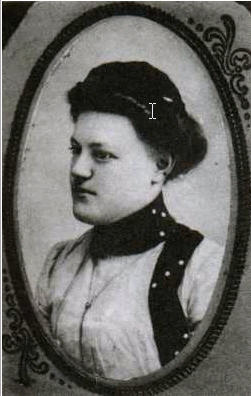
Hyrum S. Winterton in 1900 Sarah Van Wagoner about 1900

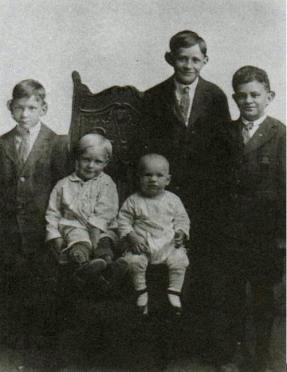
Ed Carlyle and Harold V.
Winterton Ralph Deloy, Omni
Overton, Clair William,
In 1930 Harold
Vernon and Van Delos Winterton
about
1916

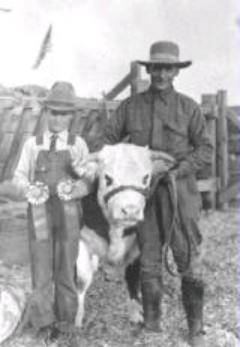
Ruth and DeLoy Winterton Omni
and Harold Winterton

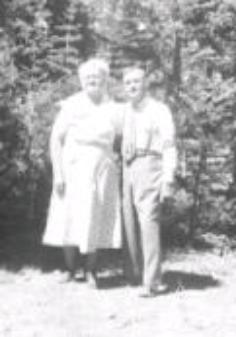
Clair on Old Pete Sarah
Fowers and Hyrum Winterton
Chapter 18
Ralph Staford Winterton
Ralph Stafford Winterton
was born at Charleston, Utah on 27 Sept 1880 the sixth child of William and
Nellie Widdison Winterton and their fourth son.
Ralph Stafford Winterton
was the 18th grandchild of the William Hubbard and Sarah Marriott Winterton
family and their ninth grandson.
Ralph Stafford Winterton’s
maternal grandparents were William and Sarah Stafford Widdison of
Nottinghamshire, England.
W126 Ralph
Stafford Winterton on 2 June 1909 married Ann Louise Ririe born 22 Nov 1881 daughter
of James Boyack Ririe and Elizabeth Ann Morgan. They lived at Magrath, Alberta, Canada, where their children were
born and at 159 N. 4 E., Provo, Utah.
W1261 Zelma
Elizabeth Winterton born 6 Sept 19 10
W1262 Olive
Ellen Winterton born 16 Feb 19 13
W1263 LaPreal
Winterton born 13 July 1915
W1264 Ralph
William Winterton b 4 June 1918
W1265 James
Ririe Winterton b 4 June 1918
W1261 Zelma Elizabeth Winterton
on 18 June 1937 married Ray Charles Colton born 23 March 1907 son of Charles H
Colton and Nellie Hacking. They live at 165 E 7th N, Logan, Utah and are
parents of:
W12611 Craig
Winterton Colton born 6 April 1938
W12612 Kent
Winterton Colton born 2 1 Nov 1943
W12611 Craig
W. Colton married Sharon _________.
W12612 Kent
W. Colton on mission in Australia 1963-64.
W1262 Olive
Ellen Winterton on 18 June 1941 married Phillip James Hart born 7 Sept 1912 son
of Alfred Augustus Hart and Sarah Cecilia Patterson. They live at 843 Ross
Court, Palo Alto, California and are parents of:
W12321 Lynn
W. Hart born 25 Oct 1942
W12622 Roland
Hart born 11 Oct 1944
W12623 Allan
Phillip Hart born 11 Oct 1947
W12624 Sharlene
Hart born 12 Dec 1949
W12625 Nadene
Hart born 29 Jan 1951
W12626 Grant
W. Hart born 19 March 1954
W12627 Diane
Hart born 3 Feb 1956
1263 LaPreal
Winterton on 2 Sept 1942 married Eugene Clarence Larsen born 12 Aug 1911 son of
B. F. Larsen and Geneva Martha Day. They
live at Grand Junction, Colorado and are parents of:
W12631 Neil
W. Larsen born 26 Oct 1946
W12632 Carol
Ann Lar sen born 26 Aug 1948
W12633
Howard Eugene Larsen b 24 April 1950 died 1950
W12634
Jeanene Larsen born 29 Aug 1952
W12635
Robert Brent Larsen b 10 March 1955
W1264 Ralph
William Winterton on 29 May 1942 married Maurine Cook born 8 Oct 19__ daughter of Alfred Lake Cook and Maud OsBorne. They lived in San Francisco, California and
are parents of:
W12641 Patricia
Ann Winterton born 11 March’ 1943
W12642 Richard
Cook Winterton born 25 June 1946
W12643 James
Cook Winterton born 14 May 1948
W12644 Susan
Winterton born 28 Sept 1949
W12645 Lyle
Cook Winterton born 21 March 1953
W12646 Lynn
Cook Winterton born 19 Jan 1956
W12641
Patricia Ann Winterton about 1963married _____________.
W1265 James
Ririe Winterton on 30 Dec 1953 married Josephine Litchfield born 25 March 1926
daughter of Ernest Litchfield and Minnie Burrows. They live at 2154 North
Apache Lane, Provo, Utah and are parents of:
W12651 Gary
L Winterton born 26 Dec 1955
W12652 David
James Winterton born 28 March 1957
W12653 Ruth
Winterton born 24 April 1958
W12654
Richard Ralph Winterton born 11 Nov 1960
Chapter 19
Moroni Winterton
Moroni Winterton was born at
Charleston, Utah on 28 Sept 1882 the seventh child of the William and Nellie
Widdison Winterton family and their fifth son.
Moroni Winterton was the 20th
grandchild of the William Hubbard and Sarah Marriott Winterton family and their
eleventh grandson.
Moroni Winterton’s maternal
grandparents were William and Sarah Stafford Widdison of Nottinghamshire,
England.
W127 Moroni
Winterton on 10 Oct 1910 married Susie Mable Giles born 22 Oct 1886 daughter of
Heber John Giles and Susanna Witt. Susie
Mablels’ paternal grandparents were George Giles and Mary Greenwood of
Lincolnshire, England. They lived at
Charleston, Utah and were parents of:
W1271 Della
Winterton born 2 April 19 13
W1272 Allen
M, Winterton born 31 Jan 1915
W1273
Lucille Winterton born 25 March 1917
W1274 Vera
Winterton born 16 May 1919
W1275 Vernon
Winterton born 16 May 1919
W1276 Beth
Winterton born 15 Feb 192 1
W1277 Baby
Winterton born 29 Oct 1911 died 1911
W1271 Della
Winterton on 5 Sept 1933 married Clyde Alder born 5 Sept 1906 son of Alfred
Lorenzo Alder and Ida Burgener. They lived
at Midway and Heber and were parents of:
W12711
Calvin Clyde Alder born 26 Jan 1935
W12712 Wayne
M. Alder born 19 Nov 1937
W12713 Boyd
Alfred Alder born 26 Aug 1940
W12714
Marilyn Alder born 2 May 1942
W12715 Colleen
Alder born 13 May 1948
W12716 Kathleen
Alder born 5 Oct 1951
W12711
Calvin Clyde Alder on 4 Jan 1956 married Joan Dale Van Wagoner born 24 Jan 1936
or 7 daughter of Arthur Van Wagoner and Winnie Jones. They live at 790 Mt. View
Drive, Midvale, Utah and are parents of:
W127111
Gregory Calvin Alder born 19 March 196 1
W127112
Stephen Douglas Adler born ___ Feb 1963?
W12712 Wayne
M. Alder on 19 June 1961 married Janet Pace daughter of Clarence Pace and Thora
Van Lewan. They live at Logan, Utah and are the parents of:
W127121
Dianne Alder born - June 1963
W1272 Allan
M. Winterton on 17 Sept 1937 married Ava Atwood born 19 July 1918 daughter of
John Leslie Atwood and Hazel Carlisle. They
live at 683 South 400 East Street, Orem, Utah and are parents of:
W12721 Wayne
A. Winterton born 13 Aug 1938
W12722 Joyce
Winterton born 4 Jan 1940
W12723 Ava
Winterton born 29 Dec 1946
W12724
Allene Winterton born 24 May 1953
W12721 Wayne
A. Winterton on ___ June 1963 married Barbara Rae Bush daughter of Mr. & Mrs,
Herschel Bush.
W12722 Joyce
Winterton on ___ Feb 1959 married Lynn J. Stewart son of Mr. & Mrs. Oral Go
Stewart. They are the parents of:
W127221 ________
Stewart born ____ ____ 196?
W1273 Lucille
Winterton on 29 Oct 1937 married Sherman Peterson son of John Peterson and
Margaret Larson. They live at Lehi and 1727 N. 650 E., Provo, Utah and are
parents of:
W12731 Kaye
Peterson born 19 Nov 1939
W12732
Stephen Peterson born 15 Jan 1944
W12733 Linda
Lou Peterson born 24 Feb 1949
W1274 Vera
Winterton on 20 Aug 1937 married Joseph Doyle Thomas born 20 Oct 1916 son of
Harold Thomas and Ida Blanche Huffacker, They live at Heber City, Utah and are
parents of:
W12741 Larry
Vernon Thomas born 25 March 1938
W12742 Joan
Thomas born 24 March 194 1
W12743 Phil
J. Thomas born 25 Dec 1948
W12744
Brenda Thomas born 3 Aug 1953
W1275 Vernon
Winterton on 8 Aug 1941 married Jean McBeth born 5 Aug 1919 daughter of Melvin O.
McBeth and Ann ________. They live at Salt Lake City and are parents of:
W12751 Susan
Winterton born 1 March 1949
W12752 (F)
Kim Winterton born 18 Jan 1954
W1276 Beth
Winterton on 25 Oct 1939 married Harvey J. Crook born 8 March 19 18 son of John
Thomas Crook and Annie Harvey. They
live at Heber City, Utah and are parents of:
W12761
Karlyn Crook born 15 June 1940
W12762 Jean
Crook born 17 March 1943
W12763
Barbara Crook born 21 Aug 1947
W12764 Ralph
H. Crook born 12 Feb 1952
W12765 David
Crook born - May 1957
Chapter 20
Baby Winterton
Baby Winterton was born at
Charleston, Utah on 26 October 1884 the eighth child of the William and Nellie
Widdison Winterton family and their sixth son.
Baby Winterton was the 22nd
grandchild of William Hubbard and Sarah Marriott Winterton family and their
thirteenth grandson.
Baby Winterton’ s maternal
grandparents were William and Sarah Stafford Widdison of Nottinghamshire,
England.
W128 Baby
Winterton died the same day as his birth, living such a short time that no name
was selected for him.
Chapter 21
Thomas Frederick Winterton
Thomas Frederick Winterton
was born at Charleston, Utah on the 14th of August 1886 the ninth
child of the William and Nellie Widdison Winterton family and their seventh
son.
Thomas Frederick Winterton
was the 24th grandchild of the William Hubbard and Sarah Marriott
Winterton family and their fifteenth grandson.
Thomas Frederick Winterton1
s maternal grandparents were William and Sarah Stafford Widdison of
Nottinghamshire, England.
W129 Thomas Frederick
Winterton on 15 Dec 1909 married Sheila Ann Carlile born 5 June 1890 daughter
of George Robert Carlile and Marion R. Neil. Sheila’s paternal grandparents were George Carlile and Laura Ann
Giles, and her maternal grandparents were William Neil and Marion Robertson.
They lived at Charleston, Wasatch County, Utah and were parents of:
W1291 Baby
girl Winterton born 11 April 1913 died 11 April 1913
W1292 Velda
Winterton born 1 Aug 19 14
W1293 Neil
F. Winterton born 10 April 19 16
W1294 Dale
C. Winterton born 4 Jan 1918 died 8 Jan 1927
W1295 Boyd
W. Winterton born 11 Aug 1923
W1296 Wilma
Winterton born 3 Sept 1926
W1292 Velda
winterton on 19 June 1935 married Roy Dean Carlson born 23 April 1913 died 11
July 1957 son of Hyrum B. Carlson and Mary Ellen Wilson. They lived in Heber
and Charleston and are parents of:
W12921 Lynn
W. Carlson born 27 Feb 1936
W12922 Merle
Carlson born 17 Nov 1938
W12923 Nile
D. Carlson born 14 Nov 1940
W12924 Mary
Carlson born 19 July 1951
W12925
Phyllis Carlson born 12 Oct 1953
W12921 Lynn We Cailson on
24 Oct 1963 married Geraldine Gray born 6 Sept 1942 daughter of Owen Charles
Gray and Willa Perkins. They live in Phoenix, Arizona.
W12922 Merle
Carlson on 14 Oct 1960 married Larry Robert Durrant born 17 June 1936 son of
LeRoy Durrant and Vera Deardon. They live
at 2928 Grant Ave., Ogden, Utah and are parents of:
W129221 Gary
Robert Durrant born 24 Sept 1961
W1293 Neil
F. Winterton on 1 June 1940 married Bessie Burles born 1 July 1917 daughter of
George Burles and Emily Choules. They
live at 505 West Sunset Circle, Mesa, Maricopa Co., Arizona and are the parents
of:
W12931 Neil
F. Winterton born 25 Feb 1941
W12932 Joyce
Winterton born 28 April 1942
W12933 Jayne
Winterton born 29 Nov 1944
W12934 Kent
B. Winterton born 5 Jan 1948
W12935 Fred
G. Winterton born 10 April 1950
W12936 Joan
Winterton born 22 Jan 1953 died 5 Sept 1957
W12937 Mark
C. Winterton born 30 Jan 1955
W12938 Julie
Winterton born 16 Dec 1956
W12932 Joyce
Winterton on 22 March 1963 married Sherril W. Tolbert.
W1294 Dale
C. Winterton died age 9 years.
W1295 Boyd
W. Winterton on 15 Aug 1951 married Bonnie Jean Moesser born 22 March 1930 daughter
of Franklin William Moesser and Mae Elza Wolfley. They live at 382 1 S. 3020 E.,
Salt Lake City, Utah and are parents of:
W12951 Vern
Boyd Winterton born 30 Sept 1952
W12952 Ann
Winterton born 16 Jan 1954
W12953 Dale
Moesser Winterton b 16 July 1955
W12954 Reed
Winterton born 4 Sept 1957
W12955 Jean
Winterton born 30 June 1959
W1296 Wilma
Winterton on 22 Feb 1945 married Ned Arden LeSueur born 7 Nov 1925 son of
Charles Taylor LeSueur and Velda Jean Hunsaker. They live at 1101 North Stapley Drive, Mesa, Arizona and are
parents of:
W12961
Charles Thomas LeSueur b 22 Jan 1951
W12962 Ben
Michael LeSueur born 14 Feb 1955
Chapter 22
Alice Malissa Winterton Thomson
Alice Malissa Winterton was
born at Charleston, Utah on 31 July 1888 the tenth child of the William and
Nellie W iddison Winterton family and their third daughter.
Alice Malissa Winterton was
the 26th grandchild of the William Hubbard and Sarah Marriott
Winterton family and their eleventh granddaughter.
Alice Malissa Winterton’s
maternal grandparents were William and Sarah Stafford Widdison of
Nottinghamshire, England.
W12-10- Alice
Malissa Winterton on 27 March 1912 married George Thomson JP. born 9 Sept 1887
son of George Thomson Sr. and Amelia Ann Despain. They lived at Magrath,
Alberta, Canada and were parents of:
W12-10-1
Earl George Thomson b 11 Jan 1913
W12-10-2
Vella Thomson born 15 Jan 1915
W12-10-3
Rulon William Thomson b 7 March 1917
W12-10-4 Mervin
Despain Thomson b 6 July 1919
W12-10-5
Marie Thomson born 28 March 1923
W12-10-6
Norma Thomson born 30 March 1925
W12-10-7
Baby Thomson born 14 Oct 1927 died same day
W12-10-1
Earl George Thomson on 7 March 1934 married LaDean Passey born 19 Oct 1913 daughter
of William Toomer Passey and Ruth Myrtle Norton. They live at Magrath, Alberta,
Canada and are parents of:
W12-10-11
Jolayne Thomson born 22 Dec 1935
W12-10-12 Melvin
Earl Thomson b 18 Aug 1937
W12-10-13 Veldon
Van Thomson b 6 June 1942
W12-10-14
Lenore Thomson born 22 Sept 1944
W12-10-15
Merrill Vern Thomson b 20 Aug 1948
W12-10-11
Jolayne Thomson on 25 July 1957 married Ross Robinson. They live in Canada and are
the parents of:
W12-10-111
Scott Robinson born 28 April 1958
W12-10-112
Barry Robinson born 21 April 1960
W12-10-113
Michelle Robinson born 28 Aug 1961
W12-10-12
Melvin Earl Thomson on 9 March 1960 married Diane Mariette Nilsson born 23 Feb 1941
daughter of Keith Nilsson and Vernice Barton. They live in Canada and are the
parents of:
W12-10-121
Lloyd Thomson born 12 Dec 1960
W12-10-2
Vella Thomson on 11 Nov 1936 married Murray Holt born 8 July 19 13 son of Franklin
Trueman Holt and Sarah Bullock. They live
at Raymond, Alberta, Canada and are parents of:
W12-10-21
Max Thomson Holt born 28 Aug 1937
W12-10-22 Franklin
Robert Holt born 5 Dec 1940
W12-10-23
Bruce Murray Holt born 2 Feb 1943
W12-10-24
Carol Holt born 30 April 1947
W12-10-25
Marie Holt born 13 Oct 1949
W12-10-26
Alan Thomson Holt b 28 July 1951
W12-10-27
Beth Holt born 15 Jan 1957
W12-10-21
Max Thomson Holt on 18 Sept 1961 married Judith Tingey born 12 July 1940. They live at, Raymond; Canada and are
parents of:
W12-10-211
Judy Holt born 8 June 1963
W12-10-22 Franklin
Robert Holt on 8 June 1962 married Helen Margaret Wagstaff.
W12-10-3
Rulon William Thomson on 22 April 1942 married Esther Marguerite Romeril born
20 Jan 1919 daughter of George Henry Romeril and Elma Vera Harvey. They live at
Magrath, Alberta, Canada and are the parents of:
W12-10-31
Rulon Delmont Thomson born 3 1 May 194’7
W12-10-32
Kaye Thomson born 5 Nov 1950
W12-10-33
Barbara Thomson born 11 May 1952
W12-10-34
Donna Thomson born 9 Feb 1955
W12-10-35
Duane George Thomson b 7 Feb 1957
W12-10-4
Mervin Despain Thomson on 25 Dec 1941 married Joyce Doris Duncombe born 1 Oct
1921 daughter of Lowell Bud Duncombe and Nellie Rumble. They live at Magrath, Alberta, Canada and are
parents of:
W12-10-41
Mervin LeRoy Thomson born 22 Jan 1923
W12-10-42
Gary Dean Thomson born 15 Sept 1945
W12-10-43
Richard Lynn Thomson born 28 Sept 1947
W12-10-44
Lowell Don Thomson born 9 June 1949
W12-10-45
Robert George Thomson b 6 Jan 1952
W12-10-46
Jean Thomson born 1 Jan 1954
W12-10-47
Maureen Thomson born 31 Oct 1954
W12-10-48
Laureen Thomson born 31 Oct 1954
W12-10-5
Marie Thomson on 1 Nov 1944 married Fulton Woodruff Bevans born 27 July 1920
son of Franklin Ellsworth Bevans and Erma Adeline Woodruff. They live at Cardston, Alberta, Canada and
are parents of:
W12-10-51
Karen Marie Bevans born 25 Aug 1945
W12-10-52
Fulton Wayne Bevans born 21 Oct 1946
W12-10-53
Gordon Owen Bevans born 29 May 1948
W12-10-54
Sandra Darlene Bevans born 12 July 1949
W12-10-55
Katherine Ann Bevans born 2 April 1952
W12-10-56
Darold LaMonte Bevans born 24 July 1953
W12-10-57
LeGrant T. Bevans born 17 Feb 1956
W12-10-58
Merlin Ray Bevans born 12 Nov 1957
W12-10-59
Verna Jean Bevans born 8 Feb 1959 died 9 Feb 1959
W12-10-5-10- Douglas
Vern Bevans born 19 Sept 1960
W12-10-6 Norma
Thomson on 8 June 1949 married John Ivy Hallmark born 7 Oct 1918 son of Ivy
Aubra Hallmark and Mary Luella Grow. They live at 2036 Madison St., Klamath Falls, Oregon and are
parents of:
W12-10-61
Norma Joan Hallmark born 10 June 1950
W12-10-62
Judy Ann Hallmark born 24 Dec 1951
W12-10-63
William David Hallmark born 21 Aug 1953
W12-10-64
John Thomson Hallmark born 28 Oct 1955
W12-10-65
James Allen Hallmark born 28 April 1960
W12-10-66
Richard Dean Hallmark born 18 Jan 1962
Chapter 23
Carrie Elizabeth Winterton Davis
Carrie Elizabeth Winterton
was born at Charleston on 5 May 1893 the first child of the William and Jane
Steadman Winterton family and their first daughter.
Carrie Elizabeth Winterton
was the 30th grandchild of the William Hubbard and Sarah Marriott
Winterton family and their thirteenth granddaughter.
Carrie Elizabeth Winterton’s
maternal grandparents were George and Ellzabeth Wilkins Steadmar,.
W12-11- Carrie
Elizabeth Winterton on 10 Jan 19 17 married Alexander Mortimer Davis born 11
Sept 1889 son of Edward Garrett Davis and Mary Irene Cobb. They lived at Charleston and were parents of:
W12-11-1
Mary E. Davis born 10 June 1918
W12-11-2
Virginia Davis born 9 Nov 1919
W12-11-3
Barton W. Davis born 6 Jan 1923
W12-11-4
Eleanora Davis born 3 1 Aug 1925
W12-11-1 Mary
E. Davis on 13 Aug 1936 married Harris W. Bethers born 27 Dec 1908 son of
William Bethers and Annie McGuire. They
live at 825 South Main Street, Heber City, Utah and were parents of:
W12-11-11
Mary Ann Bethers born 10 Dec 1939
W12-11-12
Pauline Bethers born 12 April 1944
W12-11-2
Virginia Davis on 25 Nov 1938 married and later divorced Jay O. Haueter then she
married 2nd on 26 June 1947 Edwin Chatwin. They live in Ogden, Utah and are parents of:
W12-11-21 Brent
Chatwin born about 1941
W12-11-22 Karen
Chatwin born about 1943
W12-11-23 Jan
Chatwin born about 1945
W12-11-24 Judy
Chatwin born about 1947
W12-11-25
Rodney Chatwin born about 1949
W12-11-3
Barton W. Davis on 26 June 1947 married Shirley Mair born 18 April 1928
daughter of William A. Mair and LaVora Giles. They live in Heber City, Utah and are parents of:
W12-11-31
Linda Deanne Davis born 3 Oct 1948
W12-11-32
Bruce Davis born 7 May 1952
W12-11-33
baby boy Davis born 24 July 1960 died 24 July 1960
W12-11-4
Eleanora Davis on 1 Dec 1943 married Grant Darwin Casper born 11 Oct 1925 son
of William Glen Casper and Joyce Viola Bell.
They live in Daniels, Utah and are the parents of:
W12-11-41
Darlene Casper born 15 May 1945
W12-11-42
Gerald Grant Casper born 16 May 1949
W12-11-43
Kenneth Darwin Casper born 8 Oct 1960
W12-11-44
Janice Casper born 18 Oct 1961
Chapter 24
Nettie Rachel Winterton Kuhni
Nettie Rachel Winterton was
born at Charleston, Utah on 7 May 1895 the second child of the William and Jane
Steadman Winterton family and their second daughter.
Nettie Rachel Winterton was
the 31st grandchild of the William Hubbard and Sarah Marriott Winterton
family and their fourteenth granddaughter.
Nettie Rachel Winterton’s
maternal grandparents were George and Elizabeth Wilkins Steadman.
W12-12 Nettie
Rachel Winterton on 7 June 1916 married John Hans Kuhni, born 8 Nov 1885 Signan
Canton Berne Switzerland died 20 Feb 1951 at Provo, Utah, USA, son of Samuel
Kuhni and Elizabeth Krahenbull. They
lived at Heber and after 1930 at Provo, Utah. They were the parents of:
W12-12-1 Marie
Kuhni born 13 March 19 17
W12-12-2 Ralph
John Kuhni born 14 July 19 19
W12-12-3 Theron
Valeo Kuhni born 16 July 1921
W12-12-4 Elaine
Kuhni born 5 Jan 1924
W12-12-5 Glade
W. Kuhni born 30 Aug 1926
W12-12-6 Melvin
Reed Kuhni born 11 Sept 1930
W12-12-7 Arlin
Vendell Kuhni born 4 May 1933
W12-12-8 Carol
Kuhni born 26 May 1935
W12-12-1
Marie Kuhni unmarried living in Provo, Utah 1963
W12-12-2 Ralph
John Kuhni on 8 June 1944 married Gloria Christensen born 29 March 1926 daughter
of Andrew M. Christensen and Florence Neillon. They live at 2085 N., 150 E., Provo, Utah and are parents of:
W12-12-21 Claudia
Kuhni born 18 July 1946
W12-12-22
Rose Mary Kuhni borri 21 Feb 1949
W12-12-23
Candace Kuhni born 13 Nov 1952
W12-12-24
Ralph HansKuhni born 9 Aug 1955
W12-12-3
Theron Valeo Kuhni on 29 Oct 1941 married Anne Bray born 29 Jan 1923 daughter of
John Earl Bray and Myrtle Frona Davis. They
live at 572 N 8 E, Provo, Utah and are parents of:
W12-12-31
Diane Kuhni born 6 Sept 1942
W12-12-32
Katherine Kuhni born 5 Nov 1947
W12-12-33
Theron Dallan Kuhni b 30 March 1952
W12-12-31 Diane
Kuhni on 2 June 1960 married Craig Richard Smith, They are parents of:
W12-12-311
Bradley Craig Smith born 18 Nov 1960
W12-12-4
Elaine Kuhni married first on 23 June 1943 Rulon L. Johnson and they were
divorced. They are the parents of:
W12-12-41
Kaylene Johnson born 5 Feb 1946
Elaine Kuhni Johnson on 14
Feb 1953 married 2nd Grant Davis Gray born 26 March 1918 son of
Jesse L. Gray and Zora Davis. They live at 973 E. 420 South, Provo, Utah and
are parents of:
W12-12-42
Patricia Gray born 16 Bug 1953
W12-12-43
Karen Elaine Gray born 1 Dec 1955
W12-12-44
Debra Faye Gray born 3 1 Dec 1958
W12-12-5 Glade
W Kuhni on 16 Feb 1949 married Marilyn Price born 4 Feb 1930 daughter of Victor
H, Price and Mern Lottie Anderson. They
live at 1195 E 820 N, Provo, Utah and are parents of:
W12-12-51 John
Karl Kuhni born 19 Oct 1951
W12-12-52 Kenneth
Glade Kuhni b 13 Sept 1954
W12-12-53 Kristen
Dale Kuhni born 27 Nov 1958
W12-12-6
Melvin Reed Kuhni on 7 April 1954 married Barbara Moore born 4 Feb 1934
daughter of John W Moore and Gertrude Bankhead. They live at 1065 East 420 South, Provo, Utah and are parents of:
W12-12-61
Sheryl Kuhni born 9 Jan 1956
W12-12-62
Kevin John Kuhni born 3 March 1958
W12-12-8
Carol Kuhni on 23 May 1956 married Frederick Orral Huntington born 28 July 1930
son of Orral R Huntington and Golda Buell. They live at Provo, Utah and are parents of:
W12-12-81
Craig Fred Huntington born 1 July 1957
Chapter 25
Edward Marriott Winterton
Edward Marriott Winterton
was born at Charleston, Utah on 16 September 1897 the third child of the
William and Jane Steadman Winterton family and their first son.
Edward Marriott Winterton
was the 32nd grandchild of the William Hubbard and Sarah Marriott
Winterton family and their eighteenth grandson.
Edward Marriott Winterton’s
maternal grandparents were George and Elizabeth Wilkins Steadman.
W12-13 Edward
Marriott died at the age of 23 years unmarried.
Chapter 26
Valeo James Winterton
Valeo James Winterton was
born at Charleston, Utah on the 10th of October 1900 the fourth
child of the William and Jane Steadman Winterton family and their second son.
Valeo James Winterton was
the 33rd grandchild of the William Hubbard and Sarah Marriott Winterton
family and their nineteenth grandson.
Valeo James Winterton’s
maternal grandparents were George and Elizabeth Wilkins Steadman.
W12-14 Valeo
James Winterton on 21 June 1929 married Gladys Barrett born 19 April 1900 daughter
of Arthur Barrett and Edith Ann Manning.
They lived at Charleston, Utah and were parents of:
W12-14-1
Sharron “J” Winterton born 26 March 1938
W12-14-1
Sharron “J” Winterton on 15 June 1956 married Norita Brierley born 18 Jan 1938 daughter
of James Waidkin “Bob” Brierley and Chrjsty Clegg. They live at RFD Heber, Utah and are the parents of:
W12-14-11
Carolyn Winterton born 9 Oct 1958
W12-14-12
Paul James Winterton born 27 Aug 1960
W12-14-13
Kent “B” Winterton born 16 Jan 1963
PART III
John Winterton
18 May 1847
– 19 May 1847
John Winterton, the third
child of the William Hubbard and Sarah Marriott Winterton family, was born at Carlton,
Nottinghamshire, England. He died the following day so his naming was hurriedly
done. Possibly it was only after his
death that the name John was also given to the older surviving brother previously
known as Marriott. Or it may be that this
child was actually the first born and the year of birth was 1843 not 47 as
indicated above and elsewhere in this book. The latter would seem the more logical explanation of there being
two Johns in the family. If he was the
first child and was born prematurely seven months after his parents marriage,
the early death would have a reasonable explanation. Family records conflict on this point probably the result of
someone making an error in copying the date. I believe the correct date of birth is March 18, 1843 (three, not
seven) as shown in William Hubbard Winterton’s journal; the date of death then
is probably 19 March 1843.
PART IV
Ann Winterton Noakes
11 Sept 1849
- 26 Feb 1875
Ann Winterton was born at
Nottingham, Nottinghamshire, England the fourth child and first daughter of
William Hubbard and Sarah Marriott Winterton. At an early age she was put to work in the textile factory near
her home.
Within the year following
her birth her parents joined the Church of Jesus Christ of Latter-day Saints
and when she was about fourteen her father and two older brothers left England
for Utah.
She soon became a skilled
lace maker and was able to save a few pennies a day toward her passage to
America and the Land of Zion in the Tops of the Mountains in Central North
America. It took six long years of
saving before she too could leave England and the unbearable factory surroundings.
Ann had friends who had no
more opportunity for schooling than she but that did not prevent them from
participating in the Nottingham Choir and singing songs and Christmas Carols at
Church and on the public streets and neighbors’ homes. She and Nellie Widdison, who later married
her brother William, were close pals during their teenage years and later after
their marriages lived as neighbors at Charleston for the five short years
before her untimely death.
Ann Winterton arrived in
Salt Lake City in September 1869, the first year that the railroad was
completed and was probably on one of the trips scheduled during its first
summer of operation. Her first stop in Salt Lake was to visit her father and
then she went to Wasatch County to visit her brothers. It was while there that she met and fell in
love with a young man who lived a few miles from her brother’s place. Ann left
England on 28 July 1869 aboard the sailing vessel “Colorado.”
 Ann Winterton
11 Sept 1849 - 26 Feb 1875
Picture unobtainable
as book went to press of
Ann’s husband,
George W. Noakes
born 14 February 1849
died 7 October 1925
Their home was at Charleston, Utah
 Members of
Nottingham Choir, in England The 3
girls on the left are Ann Winterton, Ellen “Nellie” Widdison and Polly Squires. About 1868
Members of
Nottingham Choir, in England The 3
girls on the left are Ann Winterton, Ellen “Nellie” Widdison and Polly Squires. About 1868
It has been said that Ann
and her pal Nellie did not encourage the boys to date them in England but once
in Utah Ann lost no time in obtaining husbands for themselves and wives for her
brothers. Brother John married Emma
Noakes in October 1869 and four months later on 21 Feb 1870 at a double wedding
Nellie married Brother William and Ann married Emma’s brother George Washington
Noakes. They were the parents of three
children and lived at Charleston where Ann died 26 Feb 1875, three weeks after
the birth of her third child.
W14 Ann
Winterton on 21 Feb 1870 married George Washington Noakes born 14 Feb 1849 died
7 Oct 1925 son of George Noakes and Sophia Crowfoot. They lived at Charleston, Utah and were the parents of:
W141 Sarah
Ann Noakes born 9 May 1871 died 25 March 1963
W142 Rosetta
Noakes born 29 April 1873 died 26 Nov 1893
W143 Anna
Noakes born 1 Feb 1875
After Ann’s death George W.
Noakes married 2nd Rosina Haenni 1857 - 1921 of Switzerland daughter
of Christian Haenni and Anna Forster. They were the parents of three children: Mary Elizabeth 1877-1902,
George Wm 1879- 1882, and Emily Samantha born 1881 who married first Wallace
Edward Potter and second Glade Scott. George
and Rosina’s grandchildren born at Fort Duchesne, Uintah County, Utah are shown
in Part IX.
Chapter 27
Sarah Ann Noakes Gill
Sarah Ann Noakes was born
at Charleston, Utah 9 May 187 1 the first child of the Ann Winterton and George
Washington Noake s family and their first daughter.
Sarah Ann Noake s was the
third grandchild of William Hubbard and Sarah Marriott Winterton family and
their second granddaughter.
Sarah Ann Noakes’ paternal
grandparents were George W. (1811-1893) and Sophia Crowfoot (1818-1904) Noakes
who came to Utah in 1852.
W141 Sarah
Ann Noakes on 17 Nov 1890 married Robert Gill born 9 Dec 1864 died 7 Dec 1930
son of Robert Gill and Sarah Millington.
They lived at 415 - 3rd Ave., Salt Lake City and were parents of:
W1411 Mervel
Ann Gill born 28 Aug 1891
W1412
Florence Merrel Gill born 8 Jan 1894
W1413 Robert
Gill born 11 Feb 1896 died 15 Jan 1963
W1414 George
“P” Gill born 22 Aug 1898
W1415 Mahala
Gill born 1 Dec- 1902 died 2 Dec 1902
W1416
Isabella Gill born 22 Feb 1904
W1417 Bessie
Gill born 7 June 1906
W1418 John
Henry Gill born 27 May 1911
W1419 Jessie
Gill born 28 March 1915
W1411 Mervel
Ann Gill on 8 November 1911 married Benjamin Haines Waldron born 6 June 1886
son of Levi Savage Waldron and Devinah Elizabeth Roderick. They lived in Utah, were divorced December
1928 and were the parents of:
W14111 Zoma
Waldron born 4 Oct 1912
W14112 Orson
Pratt Waldron born 11 May 19 14
W14113 Leland
Gill Waldron born 9 April 1916
W14114
Benjamin Waldron born 20 May 1917 died 21 May 1917
W14115 Pearl
Waldron born 12 Feb 1918 died 12 Feb 1918
W14116
George Darold Waldron born 11 March 1919
W14117
Richard Waldron born and died 20 June 1920
W14118 Lloyd
Waldron born and d 18 July 192 1
W14119 Wanda
Waldron born 19 March 1922
W1411-10- Thora
Waldron born 11 May 1924 died 5 Sep 1924
Mervel Ann Gill Waldron
married 2nd on 21 June 1929 William Walter Hall born 25 Feb 1890 son
of Mariam David Hall and Martha Matt. They live at 26 19 South 6th East Street,
Salt Lake City, Utah.
W14111 Zoma
Waldron on 12 June 1929 married William Andrew Justensen born 16 Oct 1895 son of
Rasmus Peter Justensen and Clara Meany Mously. They live at Chester,
California. They are parents of:
W141111 son
Justensen born 27 Aug 1931 died same day
W14112 Orson
Pratt Waldron on 5 Sept 1942 married Erva Christensen born 28 Oct 1920 daughter
of Charles Henry Christensen and Jeanetta Anderson. They live at 713 Southward Drive, South San Francisco, California
and are the parents of:
W141121
Delone Waldron born 16 July 1943
W141122
Dorothy Jean Waldron born 17 July 1945
W141123
Orson Keith Waldron born 28 Aug 1948
W141124
Betty Larea Waldron born 15 Oct 1956
W141121
Delone Waldron about 1962 married _____________. They live at 1772 Denking Way,
Concord, California and are parents of:
W1411211
(son)________ ________ born about 1963
W14113 LeLand
Gill Waldron on 19 June 1941 married Florence Eleanor Williamson born 8 June
1912 daughter of William Joseph Williamson and Celenia M. Plant. They live at 639 Pepper Drive, San Bruno,
California and are parents of:
W141131
Richard Gill Waldron born 16 April 1944
W141132
Laura Denise Waldron born 8 March 1953
W141131
Richard Gill Waldron on 13 Aug 1962 married Merilyn Ann Swift born 14 Feb 1947 daughter
of Mr. & Mrs. Jess Lee Swift. He is
in the U.S. Marines stationed at Camp Pendleton, California (in 1963). They are parents of:
W1411311 Richard
Lee Waldron born 8 April 1963
W14116
George Darold Waldron on 31 May 1941 married Delta Gibbs Howell born 23 Jan
1923 daughter of Thomas Leslie Howell and Margaret Rosella Gibbs. They live in
Salt Lake City and are the parents of:
W141161 Gary
George Waldron born 12 May 1942
W141162
Kenneth Jay Waldron born 25 Dec 1945
W141163
Katherine Ann Waldron born 3 Oct 1948
W14119 Wanda
Waldron married first Paul Eugene Carson. They were the parents of:
W141191
Karen Ann Carson Olsen b 18 March 1951
They were divorced and she
married 2nd Joseph L. Olsen. They were divorced and she married 3rd Robert Adams. They live in (Riverdale) Ogden, Utah.
W1412
Florence Merrel Gill about 1914 married Carl Johnson. They lived at Gardnerville, Nevada and were
the parents of:
W14121 Emma
Johnson born 22 April 19 15
W14122
Bertha Johnson born 24 Jan 1917
W14123
Robert Johnson born 10 Nov 1918
W14124 Frank
Johnson born 3 June 192 1 died 1 Nov 1962
W14125
Donald Johnson born about 1923 d 1945
W14126
Audrey Faye Johnson born 24 Jan 1940
W14121 Emma
Johnson on 1 Oct 1932 married Joseph Morris son of James Morris and Hazel
Hallett. They live at Gardnerville,
Nevada and are parents of:
W141211 Lois
Morris born 29 Sept 1933
W141212 Mary
Lou Morris born 3 July 1935
W141213
Carolyn “Teddy” Morris born 1 Feb 1939
W141211 Lois
Morris on 25 May 1950 married first Anthony Vassilaros and they were the
parents of:
W1412111
Daniel Vassilaros born 15 July 1951
W1412112
Richard Vassilaros born 5 Feb 1953
Lois Morris Vassilaros
married 2nd on 1 April 1961 Don Riddle. They live at Carson City, Nevada and are parents of:
W1412113
Donna Sue Riddle born 7 Oct 1962
W141212 Mary
Lou Morris on 20 Oct 195? married Hugh Hutchison son of Lloyd Hutchison and _________
Smith. They live at Fallon, Nevada.
W141213
Carolyn Morris on 3 Sept 1954 married Raymond Lindsey 18 May 19 son of - Mr.
& Mrs. Dee Lindsey. They live at Carson City, Nevada and are parents of:
W1412131
Joseph Lindsey born 23 Aug 1955
W1412132 Debra
Lindsey born 10 Nov 1956
W1412133
Michael Lindsey born 12 April 1961
W1412134
Rena Lindsey born 21 Aug 1963
W14122
Bertha Johnson on 20 Aug 1935 married Carl Neely son of William Henry Neely and
Sally Darrell. They live at Weed
Heights, Nevada and are parents of:
W141221 James
Neely born 28 Dec 1936
W141222 Audrey
Neely born 24 Jan 1940
W141221
James Neely on 13 July 1963 married Toinette Gill daughter of Mr. & Mrs. Robert
Gill of Fallon, Nevada. He is currently (1963) on active duty in the U.S. Navy.
W141222
Audrey Neely on 1 Feb 1959 married Richard W. Cattedge son of M. E. and Margaret
Cattedge. They live at Fallon, Nevada and
are parents of:
W1412221
Ronald W. Cattedge born 29 May 1960
W1412222
Thomas C. Cattedge born 28 Feb 1962
W14123
Robert Johnson on 15 March 1943 married Dorothy Dowely daughter of Joseph
Dowely and Georgina Merrott. They live at Gardnerville, Nevada and are the
parents of:
W141231
Carolyn Johnson born 30 April 1944
W141232
Georgina Johnson born 25 June 1945
W141233 Donna
Johnson born 23 Nov 1946
W141231
Carolyn Johnson on 10 Aug 1961 married Ronald Eugene Webb son of Mr. & Mrs.
Orville Webb. They live at San Bernardino, California and are the parents of:
W1412311
Ronald E. Webb Jr. born 9 Sept 1962
W141232
Georgina Johnson about 1961 married Harold Wright son of Wayne Wright and Nodia.
They live at Yerington, Nevada and are parents of:
W1412321
Tina Louise Wright born 28 July 1962
W1412322
Wright born 27 Nov 1963
W14124 Frank
Johnson on 29 Feb 1952 married Alma Lee Bramblee daughter of Joseph Bramblee
and Velma Chapin. They were the parents of:
W141241
Charlotte Johnson bdrn 30 Nov 1952
W14P242 Michael
Johnson born 4 Jan 1954
W141243
Jerry Johnson born 17 July 1955
W141244
David Johnson born 3 April 1957
W14125
Donald Johnson unmarried killed in World War II
.
W14126
Audrey Faye Johnson on 24 June 1945 married Lloyd Mc Kay son of James Mc Kay and
Alta M. Fenton. They live at Carson
City, Nevada and are parents of:
W141261 Alta
Faye Mc Kay born 9 Aug 1946
W141262
Donald Mc Kay born 5 June 194?
W141263 Eunice
Ann Mc Kay born Oct 195?
W141264
Nancy Louise Mc Kay born19 Feb 1954
W1413 Robert
Gill about 1923 married first Elda Lewis and they were the parents of:
W14131 Betty
Jean Gill born ___ Feb 1924
W14132 Robert
Gill Jr. born ___ Jan 1926
Robert Gill Sr. married 2nd
Dee Burkhardt. They lived at Fallon,
Nevada and were the parents of:
W14133 Antoinette
Joy Gill born ___ ____ 194?
W14131 Betty
Jean Gill married ________ ________and they are the parents of:
W141311 ________
________ born ___ ____ 19??
W14132 Robert Gill Jr.
married Angela ________. They live in
Fallon, Nevada and are the parents of:
W141321 ________
Gill born ___ ____ 19?
W141322 ________
Gill born ___ ____ 19?
W141323 ________
Gill born ___ ____ 19?
W14133
Antoinette Joy Gill on 13 July 1963 married James Neely born 28 Dec 1936 son of
Carl Neely and Bertha Johnson. (Jim is
on active duty with U.S. Navy in 1963.)
W1414 George
Peter Gill on 25 July 1921 married Wanda Johnson born 6 July 1901 daughter of
Benjamin Albin Johnson and Augusta Pernilla Belnap. They lived at Preston, Idaho and 66 W. 7th N. ,
Bountiful, Utah and were the parents of:
W14141 George
Wayne Gill born 16 March 1922
W14142 Dewey
Johnson Gill born 5 Sept 1924
W14143 Gordon
Lee Gill born 10 Aug 1926
W14141
George Wayne Gill on 10 Oct 1942 married Andrea Fay Phelps born 26 Feb 1925 daughter
of ________ Phelps and Leona ________. They
live in Layton, Utah and are parents of:
W141411
Luanna Gill born 13 Jan 1944
W141412
Linda Gill born 13 Feb 1947
W141413
Christy Lynn Gill born 24 Sept 1952
W141411
Luanna Gill on ___ ____ 1963 married ________ ________. They live in
California.
W14142 Dewey
J. Gill on 20 June 1945 married Wanda Baker born 20 June 1927 daughter of
George Baker and Debra Harrison. They
live in Brigham City, Utah and are parents of:
W141421
Rebecca Gill born 15 July 1946
W141422
Dewey Jay Gill born 5 July 1948
W141423
Debra Jean Gill born 13 April 1954
W141424
Daniel J, Gill born 30 Dec 1959
W141425
Permilla Kay Gill born 25 Sept 1962
W14143
Gordon Lee Gill on 16 October 1957 married Janet Ovard born 16 October 1930 daughter
of Seth Ovard and Helen ________. They live
at Centerville, Utah and are parents of:
W141431
Lauralee Gill born 30 July 1958
W141432
Jennifer Gill born 5 May 1960
W141433
Veronica Gill born 3 Sept 1962
W1415 Mahala
Gill died as a baby
W1416
Isabella Gill about 1929 married Herbert Alder. They lived at Los Angeles, California and were parents of:
W14161 Sally
Ann Alder born 26 July 1930
W14161 Sally
Ann Alder on ___ April 1952 married Roger Peterson. They live at Mexico and are parents of:
W141611
Bruce Peterson born about 1954
W141612 Dale
Peterson born about 1958
W141613 ________ Peterson born ___ March 1963
W1417 Bessie
Gill on 16 July 1935 married William Leland Wahlen born 30 April 1903 son of Jacob
Ashbocker Wahlen and Nancy Elizabeth Thomas. They live at 319 West 3rd North St., Salt Lake City and are the
parents of:
W14171
William Lynn Wahlen born 17 Aug 1954
W1418 John
Henry Gill on 12 July 1934 married Beatrice Webb born 9 Dec 1916 daughter of
Lorenzo Webb and Martha Best. They live
at 530 Butte St., Salt Lake City and are parents of:
W14181
Howard Gill born 7 May 1937
W14182
Kenneth Gill born 8 Feb 1939
W14183
Martha Ann Gill born 15 Jan 1945
W14184 David
Gill born 17 March 1946
W14181 Howard
Gill on 11 May 1961 married Mary Carolyn Ballinger Pope daughter of Mr. & Mrs.
William Ballinger. They live in
Granger, Utah and have adopted two children:
W141811
William Pope Gill born 9 May 1959
W141812 Gill
born ___ Dec 1963
W14182
Kenneth Gill on 6 Feb 1960 married Chrystal Cowan. They live in Salt Lake City, Utah.
W1419 Jessie
Gill married first about 1935 George Aikin and they were the parents of:
W13191
George Jerry Aiken born about 1937
Jessie married second “Sam”
Trubia and they live at Miami, Florida.
W14191
George Jerry Aiken about 1958 married Barbara ________. They lived at Nampa, Idaho and are parents
of:
W141911
Gregory Aiken born about 1959
Chapter 28
Rosetta Noakes
Rosetta Noakes was born at
Charleston, Utah on 29 April 1873 the second child of the Ann Winter ton and
Gaor ge Washington Noake s family and their second daughter.
Rosetta Noakes was the
sixth grandchild of the William Hubbard and Sarah Marrio tt Winterton family
and their fifth granddaughter.
Rosetta Noakes’ paternal
grandparents were George W. (1811-1893) and Sophia Crowfoot (1818-1904) Noakes
who came to Utah in 1852.
W132 Rosetta Noakes about
1891 married Julian Whitmore. She died
in 1893.
Chapter 29
Anna Noakes Barrows
Anna Noakes was born at
Charleston, Utah on 1 February 1875 the third child of the Ann Winterton and
George Washington Noake s family and their third daughter.
Anna Noakes was the ninth
grandchild of the William Hubbard and Sarah Marriott Winterton family and their
seventh granddaughter.
Anna Noakes’ paternal
grandparents were George W. (1811-1893) and Sophia Crowfoot (1818-1904) Noakes
who came to Utah in 1852.
W143 Anna
Noakes married on 28 June 1892 Leonard Ethan Barrows born 17 June 1857 died 17
March 1950 son of Ethan Barrows and Lorena Covey. They lived at Shelley, Idaho
and were the parents of:
W1431 Arilla
Sophia Barrows born 18 Aug 1893 died 2 Nov 1918
W1432
Urzella Annie Barrows born 29 Sept 1895
W1433 Ethan
Leonard Barrows born 6 Sept 1899 died 22 May 1922
W1434 George
Dean Barrows born 1 Aug 1901
W1435 Thelma
Barrows b 1 June 1903 d 1 June 1903
W1436
Francis Leo Barrows born 11 Nov 1904 died 11 Nov 1959
W1437 Bulah
Lorena Barrows born 25 Sept 1906 died 7 June 1908
W1438 Lola
Barrows born 2 March 1912
W1431 Arilla Sophia Barrows
on 5 Nov 1913 married Frank Hiatt son of Mr, & Mrs. Leslie Hiatt. They lived at Shelley, Idaho and were parents
of:
W14311 Waldo
V. Hiatt born 22 Aug 1914
W14312
Maxine Hiatt born 18 March 1917
W14311 Waldo
V. Hiatt on 17 Dec 1939 married Mary Elizabeth DeWeise. They live at 1388
Chaffy Court, Ontario, California and are parents of:
W143111
Richard Vincent Hiatt born 1 Oct 1940
W143112
Norman Waldo Hiatt born 14 Sept 1943
W14312 Maxine Hiatt about
1940 married Hugh Derby Archerd. They
live at 2376 North Allen, Altadena, California and are the parents of:
W143121 ________
Archerd born about 1941
W143122 ________
Archerd born about 1943
W1432
Urzella Annie Barrows on 6 Dec 1923 married George Arthur Nelson born 5 June
1887 died 25 Jan 1962 son of James Peter Nelson and Mary Fransen. They lived at
Shelley, Idaho and were the parents of:
W14321 Zella
Maxine Nelson born 8 Sept 1924
W14322 Enid
Ruth Nelson born 6 March 1926
W14323 Ivy
June Nelson born 20 June 1927
W14324 Anna
May Nelson born 31 Oct 1928
W14325
Marjorie Nelson born 21 Oct 1931
W14326
Jearold Nelson born 4 March 1933
W14321 Zella
Nadine Nelson on 20 Sept 1944 married Manuel M. Morris born 28 Oct 1921 son of
Joseph Morris and Josephine Mora. They
live at 6335 Armstrong Ave. , Fowler, California and are the parents of:
W143211
Barbara Ann Morris born 22 Aug 1945
W143212
Sandra Jean Morris born 28 Feb 1948
W14322 Enid
Ruth Barrows on about 1948 married Gerald Stapleton, They are the parents of:
W143221
JoDee Stapleton born about 1949
W143222
Jerri Kim Stapleton born about 1951
W14323 Ivy
June Nelson about 1946 married Jesse Nielsen. They are the parents of:
W143231
Marjorie Ann Nielsen born 19 April 1947
W143232
Carol Sue Nielsen born 28 March 1948
W143233 Jerry
Clark Nielsen born 18 July 1950
W143234 Michae1
Nielsen born 3 June 1953
W143235
Jeffery Lynn Nielsen born 31 Jan 1957
W143236
Michele Nielsen born 23 Sept 1958
W14324 Anna
May Nelson on 15 March 1946 married Leland Kenneth Jensen born 25 Oct 1924 son
of Kenneth Sern Jensen and Rose Keller. They are the parents of:
W143241
Allen Lee Jensen born 18 Oct 1954
W143242 Lee
Ann Jensen born 19 April 1956
W14325
Marjorie Nelson on 11 Nov 1955 married Buel Brown Phillips born 8 Jan 1924 son
of William Albert Phillips and Amy Lucina Brown. They live on Fowler Ave.,
Fowler, California. No children.
W14326
Jearold Arthur Nelson married Dorothy Kaylene Jensen. They are the parents of:
W143261
Debra Lee Nelson
W143262
Brian Nelson
W143263 David
Corey Nelson
W1433 Ethan
Leonard Barrows died unmarried.
W1434 George
Dean Barrows about 1926 married Ella Boss born 2 July 1905 daughter of Joseph
Boss and Clara Hansen. They were the parents of:
W14341 Duane
LaVar Barrows born 3 1 July 1927
W14342 Robert
Lee Barrows born 7 Feb 1930
W14341 Duane
LaVar Barrows married ________.
W14342
Robert Lee Barrows married ________.
W1336
Francis Leo Barrows on 2 1 Sept 1927 married Vessie Viola Landon born 2 Feb
1909 daughter of Lowell Heber Landon and Minnie Jemia Gardner. They live at Shelley, Idaho and are parents
of:
W14361 Betty
Jean Barrows born 19 Aug 1928
W14362
Lorraine Barrows born 27 June 1930 died 15 Aug 1131
W14363 Ruth
Barrows born 13 April 1932
W14364 Nina
Barrows born 21 Dec 1933
W14365
Francis Jay Barrows born 1 April 1936 died 11 April 1936
W14366
Connie May Barrows born 1 April 1936 died 26 April 1936
W14367 Leon
L. Barrows born 18 Sept 1937
W14368 LaMar
Dee Barrows born 9 Feb 1940
W14369 Gary
Lee Barrows born 1 Sept 1942
W1436-10-
Ronald Max Barrows born 12 Oct 1950
W14361 Betty
Jean Barrows on 11 Sept 1946 married William Columbus Clem born 15 July 1923 son
of Homer Clem and Esther Rebecca Henderson.
They live at Rt. 4, Box 83,
Woodward, Oklahoma and are the parents of:
W143611
Terril Lynn Clem born 4 May 1947
W143612
Kenneth Jay Clem born 18 Nov 1948
W143613 Diane
Marie Clem born 23 Dec 1949
W143614
William Ray Clem born 22 March 1951
W143615
Randall Eugene Clem born 14 Feb 1953
W143616
Homer Francis Clem born 14 July 1954
W14363 Ruth
Barrows on 26 April 1954 married Jake H. Stewart born 1 July 1933 son of Otho
Stewart and Lois V. Lofton. They are
the parents of:
W143631
Richard Lee Stewart born 3 Aug 1955
W143632
Debra Rae Stewart born 13 Aug 1957
W143633
Kathryn Ann Stewart born 12 Feb 1959
W14364 Nina
Barrows on 17 Nov 1951 first married Robert Leroy Mc Cuen born 13 Sept 1929. She married 2nd John Patrilici
and they live at 3234 NE 88th, Seattle, Washington. She is the mother of:
W143641
Kalene Irese Mc Cuen born 6 Dec 1952
W143642
Robert Kevin Mc Cuen born 13 June 1955
W14367 Leon
L. Barrows on 15 March 1957 married Patricia Evelyn Little born 8 Feb 1940 daughter
of Edward Ray Little Jr. and Alice M. Healy. They live at Shelley, Idaho and
are the parents of:
W143671
Debra Leigh Barrows born 27 Sept 1957
W143672
Donette LeAnn Barrows born 14 May 1960
W14368 LaMar
Dee Barrows unmarried 1963.
W1438 Lola
Barrows on 3 Sept 1936 married Alfred Cyril Hainsworth born 9 May 1907 son of Samuel
Hainsworth and Annie Robshaw. They live
at Box 342, Shelley, Idaho and are parents of:
W14381 Don
Alfred Hainsworth born 27 Feb 1937
W14382
Arlene Hainsworth born 12 Oct 1940 died 21 May 1963
W14383 Ross
Hainsworth born 27 Aug 1943
W14384 Carol
Hainsworth born 25 Dec 1945 died 19 June 1947
W14385 Paul
L. Hainsworth born 30 March 1952
W14386 Lou
Ann Hainsworth born 11 Sept 1955
PART V
Thomas Winterton
4 Sept 1851
- 10 June 1918
Thomas Winterton was born at
Nottingham, Nottinghamshire, England the fifth child and fourth son of William
Hubbard and Sarah Marriot Winterton. When he was not quite twelve years old he
witnessed the tearful parting of his parents and saw his father and older
brothers John and William leave for America.
He worked at the textile
mills to help his mother and sisters and to take his brother’s place as best he
could for six long years. He was frugal
and anxious for the time when the family might be reunited in the New World. In 1869 when he was eighteen it was finally
arranged for him and Ann to go to Utah. His mother and twelve year old sister Sarah would stay in England
until there was more money to buy their passage. He sailed from Liverpool Harbor on 28 July 1869 on the vessel
named “Colorado.”
Thomas crossed the plains
on the New Iron Horse and did not have the experience of driving an ox team
freight wagon as his brothers did some six years before. His trip was much quicker as he was in Salt
Lake City by late September.
Thomas Winterton was to
remember and cherish the acquaintance of the LDS Missionary serving his home
area during that last year in England. His name was Sherrill Shurtliff whose name was chosen for one of
brother Wil1iam’s sons. Missionary
Shurtliff was instrumental in making the final arrangements for Tom and Ann to
leave England when they did along with Nellie Widdison and others.
Thomas Winterton settled
and lived at Charleston as his brothers did and when he was thirty-eight years
old married on 19 Nov 1889 Miss Fanny Boardman. The marriage license was issued and the marriage ceremony
performed on the same day at Provo, Utah County, Utah. The record is preserved in Book 1 page 122 of
the Marriage Records of Utah County. Justice of the Peace W. H. Brown performed
the ceremony. Fanny gave her age as 40
years and listed Provo as her residence according to the card file of
Early Church Records at the
Salt Lake Genealogical Library.
 Tom and Fannie Boardman Winterton as they looked about
1890.
Tom and Fannie Boardman Winterton as they looked about
1890.
 Donald Panama 3rd one of the Winterton purebred Champion
Hereford sires.
Donald Panama 3rd one of the Winterton purebred Champion
Hereford sires.
They were living “two miles
out on the Springville Road in Provo” when their nephew Hyrum Shurtliff
Winterton was living with them and attending the B.Y. Academy about 1897-1898.
W15 Thomas
Winterton on 19 Nov 1889 married Fannie R. Boardman born 17 Sept 1849 died 7
May 1924 daughter of Robert Boardman and Mary Green. The obituary notices in
the Salt Lake City Deseret News and Tribune newspapers of 8 May 1924 are on
file in the Church Historian’s Office and on catalogue cards microfilmed at the
Salt Lake Genealogical Library.
Fannie and the Boardman family
were Utah Pioneers of 1861.
Tom and Fannie lived most
of their married lives in or near Charleston in Wasatch County, Utah. Tom
earned their livelihood from agricultural pursuits, raising livestock, hay and grain
on farm land adjoining his brothers places.
No children.
PART VI
Baby Winterton
26 Dec 1853
– 26 Dec 1853
The sixth child (a female)
of William Hubbard and Sarah Marriott Winterton was born dead. It was buried at Carlton, Nottingham,
England. Survivors in addition to the
parents were its siblings John, William, Ann, and Tom Winterton.
PART VII
Hyrum Winterton
30 Dec 1855
- 24 Jan 1856
The seventh child of
William Hubbard and Sarah Marriott Winterton died at Nottingham, England at the
age of 26 days. He was survived by his
parents and siblings John, William, Ann and Tom Winterton.
PART VIII
Sarah Winterton Parker
13 Feb 1857
- 27 Dec 1928
Sarah Winterton was the
eighth and last child born to the William Hubbard and Sarah Marriott Winterton
family. She was their second daughter
and the birthplace was the Nottingham, England home. She was only six years old when her father and two oldest brothers
John and William left home to join the main body of Latter-day Saints at the
Great Salt Lake City in the “Tops of the Mountains” in the Utah Zion of Central
North America beyond the western shores of the Atlantic Ocean.
Sarah was only twelve years
old when her sister Ann and brother Thomas left for the same destination
in.1869. She stayed with her mother and
probably worked with her in the stocking factory for their sustenance and
shelter until her marriage.
Sarah married about 1877
Arthur Parker and became the mother of four children; one of the twins died
shortly after birth and her son John Parker died in England soon after an early
marriage about 1909. Sarah divorced her
husband about 1894 - 95 while still in England.
Sarah Winterton Parker’s
brothers John and William sent the money for her transportation and her two
children’s fares -- Eliza Ann Parker and Fred Parker -- to come to Utah about
1895 or 1896 on the S.S. Anchoria. Sarah
came a year or so later about 1897 or 98.
Her son Fred obtained work
in the Park City mines some 30 miles from Charleston, Utah and married Jennie
Bagley.
Her daughter Eliza Ann
Parker married Joseph Hartle and was the mother of six children. They made
their home in Salt Lake City during the early part of the twentieth century.
 Sarah Winterton Parker and David Cluff her second husband.
Sarah’s picture was taken in Nottingham England about 1890. David’s picture taken in 1872.
No picture of Arthur Parker, Sarah’s first husband, was available.
Sarah Winterton Parker and David Cluff her second husband.
Sarah’s picture was taken in Nottingham England about 1890. David’s picture taken in 1872.
No picture of Arthur Parker, Sarah’s first husband, was available.
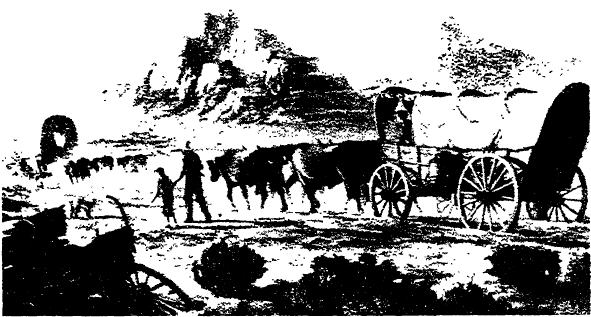
Sarah Winterton Parker
lived at her brother William‘s home in Charleston, Utah until about 1906 or 1907.
Then she married David Cluff born about
1850 died about 1925 at Provo, Utah. After
about ten or twelve years they separated and she returned to her brothers home
to live for the last dozen or so years of her life.
Sarah Winterton Parker
Cluff died 27 December 1928 at the home of her brother William and is buried in
the Charleston, Wasatch County, Utah cemetery.
W18 Sarah
Winterton on 24 December 1876 at St. Nichlas Church in Nottingham married Arthur
Parker born about 1850 died about 1910.
They lived at Nottingham, England and their children were born there. They were divorced about 1895.
W181 Twin
Parker b 8 Feb 1878 died same day
W182 John
William Parker born 8 Feb 1878 died 8 Sept 1909
W183 Eliza
Ann Parker born 30 Dec 1879 died 21 Feb 1957
W184
Frederick Parker born 3 Nov 1884 died 6 April 1944
Chapter 30
Twin Parker
Twin Parker was born at
Nottingham, England on 8 Feb 1878 the first (twin) child of the Sarah Winterton
and Arthur Parker family and their first son.
Twin Parker was the 10th
grandchild of the William Hubbard and Sarah Marriott Winterton family and their
third grandson.
W181 Twin
Parker died the same day he was born living such a short time that no name was
selected for him.
Chapter 31
John William Parker
John William Parker was
born at Nottingham, England on 8 Feb 1878, the second (twin) child of the Sarah
Winterton and Arthur Parker family and their second son.
John William Parker was the
1lth grandchild of the William Hubbard and Sarah Marriott Winterton family and
their fourth grandson.
W182 John
William Parker married about 1900 ________ ________ and died shortly afterwards
8 Sept 1909 at Nottingham, England. They
were the parents of:
W1821
Gertrude Parker born about 1902
My limited research failed
to determine whether Gertrude married and has progeny now living in England or
if she died as a child.
Chapter 32
Eliza Ann Parker Hartle
Eliza Ann Parker was born
on 30 December 1879 the third child of the Sarah Winterton and Arthur Parker
family and their first daughter.
Eliza Ann Parker was the 16th
grandchild of the William Hubbard and Sarah Marriott Winterton family and their
ninth granddaughter.
She emigrated to
Charleston, Utah, USA about 1895 or 1896 with her brother on the S.S. Anchoria.
Eliza Ann Parker at the age
of 17 when applying for a marriage license at Provo, .Utah County, Utah gave
her place of residence as that city. The
license was issued and the marriage ceremony performed the same day 31 May
1897. Eliza Ann and Joseph Hartle were
united in matrimony by Justice of the Peace A. Saxey. The record is preserved in Book 3 page 41 of the Marriage Record
of Utah County. Joseph Hartle was 22
and living at Charleston according to the card file of Early Church Records in
the Salt Lake Genealogical Library.
W183 Eliza
Ann Parker on 31 May 1897 married Joseph A. Hartle born 27 July 1875 at Charleston
died 24 July 1930 son of John Hartle 1832-191? and Harriet Javison 1833-1912 of
England. Joe’s paternal grandparents
were Joseph and Sarah ________. Joe’s
maternal grandparents were John Javison and Sarah Gillette of England. Eliza and Joseph lived in Park City in 1902
and in Charleston in 1899 and at 2595 South 3rd East Street, Salt
Lake City and were parents of:
W1831 Harold
Joseph Hartle born 18 Feb 1899 died 3 Nov 1926
W1832 Hazel
Barbara Hartle born 1900?
W1833 Ada Lavenia
Hartle born 1901?
W1834 Lloyd
Hartle born 2 April 1902 died 28 July 1902
W1835
Winifred Hartle born 15 Dec 1903
W1836 Alton
Hartle born 6 Nov 1905 died ___ Jan 1954
W1831 Harold
Joseph Hartle died unmarried.
W1832 Hazel
Barbara Hartle on 16 Feb 1923 married Dr. King Hendricks, Professor at Utah State
University. They live at 687 Canyon
Road, Logan, Utah and are parents of:
W18321 Rebecca
Barbara Hendricks born 16 Aug 1924
W18321
Rebecca Barbara Hendricks on 10 June 1946 married Major Thomas M. Madden of the
U. S. Army. They live at 1319 Monroe
St., Walla Walla, Washington and are parents of:
W183211
Michael Thomas Madden born 8 Jan 1955
W183212 Ann
Elizabeth Madden born 1 Aug 1956
W1833 Ada
Lavenia Hartle on 8 April 1914 married first Harold Emmett Booth born about 1898
son of Hyrum Edward Booth and Rebecca McMurrin. They were parents of:
W18331 Ada
Lucille Booth born about 19 15
W18332 W.
Lenore Booth born about 1916
W18333
Harold Booth born about 1917
Ada married 2nd on
12 Jan 1924 Grover C. Evans and 3rd 11 March 1928 Robert E. Adelman
born 26 Oct 1897 died 14 Nov 1963 son of Ernest Rudolph Adelman and Marie
Craig. They lived at 133 Maryland
Parkway, Las Vegas, Nevada. No
children.
W18331 Ada Lucille Booth
married first Paul Padget who died a few years later. They were the parents of:
W183311
Dennis Padget born about 1937
Lucille married 2nd
John Catana. No children.
W18332 W.
Lenore Booth married Paul Todd. They
were the parents of a daughter born at Los Angeles, California.
W183321 Sharon
Lee Todd born 29 Oct 1934
W183321
Sharon Lee Todd about 1953 married Lester Watson. They live in Washington and are the parents of:
W1833211
(daughter) ________ Watson born about 1954
W1833212
Charles Watson born about 1956
W1833213
Paul Todd Watson born about 1958
W18333
Harold Booth on 7 Oct 1945 married Marjorie Ruth Julia Kangus. They are the
parents of:
W183331 James
Booth born 17 Dec 1946
W1834 Lloyd
Hartle died at four months of age.
W1835
Winifred Hartle on 20 June 1923 married Patrick Frederick Bruce born 27 April 1901
at Palmers Green, a suburb of London, England son of William Gordon Bruce and
Jane Thompson. They live at 10745
Victoria Ave., Candlewood Park, Whittier, California and are parents of:
W18351
Ronald Frederick Bruce born 29 May 1925
W18351
Ronald Frederick Bruce on 28 June married Doris Mae Pflughaupt born 25 Dec daughter
of Louis Pflughaupt and Hilma Rinn. They
live at 2001 Yucca St., Fullerton, California and are parents of:
W185211
Stephen Frederick Bruce born 28 Jan 1946
W183512
Karen Diane Bruce born 5 April 1947
W1836 Alton
Hartle about 1931 married Emma Laurel Addy born 23 Feb 1909 daughter of Alfred
Addy and Olivia . They lived at 2595
South 3rd East St., Salt Lake City, Utah and were the parents of:
W18361
Joseph Alfred Hartle born 13 March 1932
W18362 Beth
Hartle born 25 Feb 1934
W18361
Joseph Alfred Hartle on 10 Jan 1952 married Charlotte Ann Ashcraft born 15 July
1931 daughter of James Horace Ashcraft and Mildred
Ann Durham of Arkansas. They live at 162 East 4th North,
American Fork and are parents of:
W183611
JoAnn Hartle born 28 Sept 1963
W18362 Beth
Hartle on 17 March 1954 married Gerald O. Vieweg born 14 April 1931 son of Mr.
& Mrs. Oswald A. Vieweg of Germany.
They live at 4160 South 15th East, Salt Lake City, Utah and
are the parents of:
W183621
Robert Vieweg born 28 Oct 1954
W183622 Paul
Vieweg born 21 Nov 1955
W183623
Catherine Vieweg born 8 June 1957
W183624
Bruce Vieweg born 29 Oct 1960
W183625
Michael Joseph Vieweg born 2 June 1962
Chapter 33
Frederick Parker
Fred Parker was born at St.
Ann’s, Nottingham, England on 3 Nov 1884 the fourth child of the Sarah
Winterton and Arthur Parker family and their third son.
Fred Parker was the 14th
grandchild of the William Hubbard and Sarah Marriott Winterton family and their
sixth grandson.
Fred Parker emigrated to
Charleston, Utah, USA about 1895 or 1896 with his sister. He worked in the mines in Park City, Utah for
a number of years, then lived in American Fork and moved to California where he
lived for some years before his death.
Fred Parker died 7 April
1944 at Orlando, California according to the obituary notice in the Salt Lake
City Deseret News and Tribune newspapers of 11 April 1944 on file at the
Genealogical Society.
W184 Fred
Parker on 21 December 1904 married Jennie Ahvilda Bagley born 4 September 1886
daughter of Joseph Smith Bagley and Hannah Jenson. At the time of the 1914 LDS Church census they lived in the Burton
Ward at 242 East 21st South St. 9 Salt Lake City and were the parents
of:
W1841 Afton
Parker born 23 Sept 1905 died 14 Oct 1956
W1842
Frederick Lorraine Parker born 25 April 1908 died 27 Jan 1909
W1843
DeWayne John Parker born 17 July 19 10
W1844 Marvin
Bagley Parker born 9 Dec 1912
W1845 Dale
Arthur Parker born 23 Dec 1915 died 29 July 1927
After Fred’s death Jennie
lived at Rt. 2, Box 14A Orlando, California.
W1841 Afton
Parker on 7 Sept 1927 married Stephen Robert Angus. They
lived at Rt. 2, Box 15 Orlando,
California and were the parents of:
W18411
Robert Dale Angus born ___ ____ l928?
W1843
DeWayne John Parker on 23 October 1932 married Sarah May Christensen born 1 May
1910 daughter of Eli Lachonius Christensen and Inez Dick. They live at 701 Ave I, Boulder City, Nevada
and are parents of:
W18431
Carole May Parker born 8 Dec 1935
W18432 Sharon
Kaye Parker born 9 Aug 1944
W18433 John
Wayne Parker born 30 June 1950
W18431
Carole May Parker about 1957 married Sheldon Mahlon Edwards born 12 July 1933.
They are the parents of:
W184311
Sheldon Clay Edwards born 9 Jan 1958
W184312
Donna Rae Edwards born 15 Oct 1960
W18432
Sharon Kaye Parker about 1963 married Harold Lee Barrel1 born 17 Aug 1943.
PART IX
John and Ann Winterton’s In-Laws
The George & Sophia Noakes Family
Earlier in the book the
marriage of John Marriott Winterton and Emma Inkpen Noakes has been described,
so also has the marriage of his sister Ann to Emma’s brother George Washington Noakes
been noted. It is because of this
special interest this “double-cousinship” of the two families progeny that it
was decided to include a brief account of the Noakes pioneer family in the Winterton
book.
George W. Noakes Sr. (and
his father’s family) left England some 35 years before the Wintertons having
lived in Ohio and other states before coming to Utah in 1852. He lived at Salt Lake,
Cottonwood and Alpine, Utah before settling in 1859-60 on land in the Provo
River Valley at Noakes Springs just south of Charleston - an area now covered
by waters of the Deer Creek Reservoir.
In order to have a family
coding system comparable to the Wintertons, “N” will stand for the Noakes name
and “N1” will stand for George W. Noakes Sr. the father of Emma and George Jr. who
married into the Winterton family. N15
as the following family group presentation shows is the family code number of George
Washington Noakes Jr., husband of Ann Winterton W14; likewise, “N18” is the
number of Emma Inkpen Noakes, wife of W11 John Marriott Winterton.
George W. Noakes Sr. was
born on 4 Sept 1811 at Udimore, Sussex, England, died 11 Sept 1893 at
Charleston, Utah. He was the son of Thomas
Noakes 1791-1871 and Emma Inkpen 1789-1851 who are buried in the Salt Lake Cemetery.
He was the grandson of
William Noakes and Elizabeth Honice. He
was the great grandson of Thomas Richard Noakes and Mary Susans. He is thought to be the great great grandson
of Zebulon Noakes and Elizabeth Ketchley of Sussex County, England who were
married about 1720.
About January of 1838 at
Commerce, Illinois, (later Nauvoo) George Noakes married Sophia Crowfoot
1818-1904 daughter of Benjamin Gideon
Crowfoot and Samantha
Sackett. Sophia joined the LDS Church
within a few years after its organization in 1830 having heard its originator
Joseph Smith Junior discuss its principles in her Ohio home.
George Noakes was
apparently not baptized a member of the Mormon Church until 1849. He was a ward teacher, Superintendent of
Sunday School, a Seventy and acted in other Church capacities. George and Sophia were parents of twelve
children:
N11 Mary
Noakes born 17 Sept 1839
N12 Cornelia
Noakes born 19 Dec 1840
N13 Rosarner
Noakes born 1 Jan 1843
N14 Eliza
Noakes born 25 Nov 1846
N15 George
Washington Noakes Jr. born 14 Feb 1849
N16 William
Henry Noakes born 25 Sept 1850
N17 Thomas
Nephi Noakes born 10 Sept 1852
N18 Emma
Inkpen Noakes born 3 Dec 1854
N19 Mary
Elizabeth Noakes born 3 Oct 1857
N1-10- John
Hubbard Noakes born 19 March 1859
N1-11- David
Edward Noakes born 9 Sept 1860
N1-12-
Robert Avery Noakes born 5 Sept 1862
The first four children N11 Mary, N12 Cornelia, N13
Rosamer and N14 Eliza are believed
to have died young and before marriage.
N15 The
marriage of George Washington Noakes Jr. to Ann Winterton is noted earlier in the
book as Part IV and their children’s progeny are listed in Chapters 27, 28 and
29 so will not be repeated here.
His second marriage about
1876 after Ann’s death was to Rosina Haenni born 26 Dec 1857 in Switzerland
died 8 Aug 1921 at Charleston, Utah daughter of Christian Haenni and Anna
Forster. They lived at Charleston, Utah
and were the parents of:
N154 Mary
Elizabeth Noakes born 5 Sept 1877 died 28 July 1902
N155 George
William Noakes born 8 April 1879 died 7 Dec 1882
N156 Emily
Samantha Noakes born 14 Aug 1881 living 1963
N156 Emily
S. Noakes on 2 1 Sept 1897 married Wallace Edward Potter Junior born 24 Aug 1874
died 2 Sept 1923 son of Wallace Edward Potter Senior and Harriet S. Kempton. They lived at Charleston, Fort Duchesne and
Salt Lake. They were the parents of:
N1561 Ina
Murriel Potter born 8 Jan 1899 died as child
N1562 “Ted”
George Edwin Potter born 28 April1900 father of Bernell, Merl and June.
N1563
William A Potter born about 1901 father of Billie, Nancy, Tiny and Linda.
N1564 Ethel
Potter born about 1904 died young
N1565 Frank
Potter born about 1906 died young
N1566 Bessie
Potter born about 1908 married Mr. Lloyd parents of seven children
N1567 Arvil
Fay Potter born about 19 11 married Marcella Woolsey-parents of Claudia &
Karen
N1568 Helma
Rose Potter born about 1914 married Earl Bridge -parents of Barbara, Earl,
Carol
Nl569
Clarence Potter born about 1916 married twice father of Clarence, Betty Jean,
Barbara
N156-10-
Melvin W Potter born about 1918 married Alice. They live at 175 Paxton Ave., SLC, Utah and are the parents of:
Mary Alice,Wallace, Ina, Scott, Vera, Shirley, Emily and Susan.
N156-11- Harold
Potter born about 1921 married Lucille Lee-parents of Cloyd, Gary and Bonnie. After Mr. Potter’s death Aunt Emily married
second 11 Dec 1930 Glade Lee Scott. She
is still (Jan 1964) keeping house at 1418 Blair St., Salt Lake City, Utah.
N16 William
Henry Noakes died as a small child probably in Iowa before his parents started their
trip across the plains to Utah in 1852.
N17 Thomas
Nephi Noakes about 1875 married Frances Cornelia Carter born 4 May 1861 died 26
June 1927 daughter of John Russell Carter and Eliza Mae Powell. They lived at
Salina, Utah and were the parents of:
N171 Thomas
Levi Noakes born 8 Nov 1876 died 1878. He died as child
N172 George
Harvey Noakes born 11 May 1877 died 1910.
He married Violet Bruce
N173 Eliza
Sophia Noakes born 24 July 1879 died 1963
N174
Susannah Noakes born 18 May 1881 died 1897
N175 John
Russell Noakes born 8 Feb 1883 died 1934
N173 Eliza
Sophia Noakes on 26 July 1895 married Frederick Hyrum Levie born 8 Jan 1867 died
17 March 1948 son of Joseph Hyrum Levie and Sarah Jane Flake. They lived at Salina, Utah and were parents
of:
N1731 Clara
Jane Levie born 18 July 1896 married Louis Rasmussen on 15 June 19 11. They live
at Orem, Utah
N1732 Harvey
Frederick Levie born 4 July 1897 died 5 June 1958 married on 14 Feb 1918 Ida
Meriam Carson-parents of six children lived at 305 Los Angeles Street,
Montebello, California.
N1733 Joseph
Lester Levie born 14 Oct 1898 married 12 Feb 1919 Gilia Ione Thurston. They live at Long Beach, California.
N1734 Sarah
Mable Levie born 17 June 1900 married Leo Amasa Kenney on 31 March 1919
N1735 Hazel
Fern Levie born 6 March 1902 married Don S. Anderton on Nov 1917 and they live
at Elsinore, California
N1736 Velma
Marie Levie born 24 May 1904 died 6 March 1906
N1737
Clarence Eugene Levie born 18 March 1906 and married Emma Laura Miller on 3
March 1926. They lived at Parma, Idaho.
N1738
Delbert Raymond Levie born 6 Dec 1907 and married Clara Hattie Larsen on 24 Aug
1927. They lived at 1344 Milon Place,
Monterey Park, California.
N1739 Ernest
LeRoy Levie born 15 Oct 1910 died 22 Oct 1910
N173-10-
Thelma Gladys Levie born 17 Oct 191l married first Bernard Laturner and second Vaughn.
They live at Pasadena, Calif.
N173-11-
Arnold J. Levie born 29 April 1913 marriedMytrle James and they live at
Belvedere, California.
N173-12-
Elmer Thomas Levie born 8 Jan 1916 and married Lona J. Baker on 24 Jan
1934. They live at Montebello,
California.
N173-13-
Theral Dean Levie born 27 May 1923 and married Dorothy Birrell. They live at Montebello, California.
N173-14-
Roseanne Levie born 11 Oct 1892 daughter of Mr. F. H. Levie’s first wife
Roseanne Mills 1875-1892. She married 3
June 1908 Samuel S. Hunt and they live at Price, Utah.
N174
Susannah Noakes about 1908 married William Thomas Mills born 10 Aug 1873. Thay lived at Joseph and Salt Lake City,
Utah and were the parents of:
N1741
Leonard Mills born 1 June 1909
N1742 Melvin
Lee Mills born 19 May 1912
N1743 Maude
Mills born 8 April 1916
N1744
Richard LaVere Mills born 12 May 1918
N175 John
Russell Noakes about 1910 married Mattie Heckie born 29 June 1890. They lived at Jerome, Idaho and were parents
of:
N1751 Irven
Thomas Noakes born 5 Aug 1911
N1752
Laurence Glen Noakes born 5 July 1914
N1753 James
Harold Noakes born 22 March 1916
N1754
Josephine Noakes born 10 June 1918
N1755 Frank
Wayne Noakes born 26 Sept 1923
N18 The
marriage of Emma Inkpen Noakes and John Marriott Winterton is recorded in Part
I of this book and their twelve
childrens’ descendants are listed in chapters one through twelve so will not be
repeated.
N19 Mary
Elizabeth Noakes died unmarried in October 1857.
N1-10- John
Hubbard Noakes on 15 May 1889 married Margaret Priscilla Casper born 4 June
1872 died 11 July 1941 daughter of William Nephi Casper and Agnes Mc
Farland. They lived at Charleston and
Park City, Utah and were parents of:
N1-10-1 Mary
Jane Noakes born 12 June 1890 died 1926
N1-10-2
David Avery Noakes born 25 Sept 1891 died 1948
N1-10-3
Mabel Sophie Noakes born 1 Nov 1893
N1-10-4 Gertrude
Louisa Noakes born 9 Oct 1895 died 1946
N1-10-5
William Reuben Noakes born 13 Feb 1897 died 1898
N1-10-6
Wallace Nephi Noakes born 4 April 1899
N1-10-7 Erving
Arthur Noakes born 23 Nov 1900
N1-10-8 Beatrice
Verga Noakes born 29-Nov 1902 died 17 Dec 1902
N1-10-9 Vida
Luella Noakes born 10 March 1904 died 24 March 1904
N1-10-10- Reva
Agnes Noakes born 8 June 1906
N1-10-11- Margaret
Marie Noakes born 17 July 1908
N1-10-12-
Casper Derbin Noakes born 4 Feb 1913 died 15 April 1924
Nl-10-1-
Mary Jane Noakes on 9 March 1910 married John Jennings Gordon born 30 April
1881 died 14 Dec 1930 son of Eli Gordon and Elizabeth Nelson. They lived at
Charleston, Utah and were the parents of Lynn, Dwayne, Doyle, Wanda, Wilma,
Farrell, Dial, Wendel and a baby who died at birth in 1926.
Nl-10-2
David Avery Noakes about 1915 married Ada Pearl Adamson born 13 Nov 1893 died
25 July 1948 daughter of Henry T. Adamson and Mary Ann Sheppard. They lived at
Park City and American Fork, Utah and Portland, Oregon. They were the parents
of William, John, Ada, Wilmer, Norma, Jack, Ruth, Thelma and Mary Ann.
N1-10-3
Mabel Sophia Noakes about 1911 married Frederick Howarth born 17 Feb 1884 died
5 Dec 1929 son of John Howarth and Ann Kirkham. They lived at Park City and were the parents of Jennie, Reba, and
Margaret Howarth.
N1-10-4
Gertrude Louisa Noakes about 1913 married Jesse Nelson Gordon born 29 March
1879 died 193? They lived in Park City,
Utah and were the parents of Levette, Neil, Boyd, Jesse, Leah, and Nola Gordon.
N1-10-6
Wallace Nephi Noakes on 20 July 1922 married Inez Jerusha Jensen born 12 Nov 1904
daughter of Joseph Arthur Jensen and Jerusha Jones. They live at Portland, Oregon and are parents of Leta, Wallace and
Nola Noakes.
N1-10-7
Erving Arthur Noakes about 1922 married first Norma Beck born 11 June 1900 and they
were the parents of Donna, Phillip and Helen.
He married second on 20 May 1936 Byrl Smith born 1 Aug 1907 daughter of
Joseph H. Smith and Saraban Butler. They
live at Portland, Oregon and are the parents of Karma and Addalie Noakes. Norma Beck Noakes married second Lionel C. Going
and they lived at Phoenix, Arizona.
N1-10-10-
Reva Agnes Noakes on 24 Dec 1924 married William Wallace Richardson born 4 March
1904. They live at Park City, Utah and are
the parents of William, Robert, Clark and Don.
N1-10-11-
Margaret Marie Noakes on 3 July 1924 married Oren Joseph Anderson born 26 June 1896.
They live at Park City, Utah and are
the parents of John, Oran, Maurine, Ray and Rita.
N1-11 David
Edward Noakes believed to have died unmarried.
N1-12 Robert Avery Noakes
believed to have died unmarried.
A book entitled “Noakes
Pioneers of Utah” is planned for an early publishing date possibly by 1965. It will contain a more detailed historical, biographical
and genealogikal account of the progenitors and descendants of the Thomas
Noakes family who emigrated from England in 1828, and from the Ohio Valley in
the 1840 decade to be among the earliest of the Utah Pioneers. The book will be organized in two sections,
one for the George and Sophia Crowfoot Noakes family of Charleston, Utah and
the second section for his younger brother John Hubbard and Susan Childs Noakes
family of Springville, Utah. A separate
chapter will be devoted to each of George and Hubbard Noakes’ twenty-three
children. If interested, inquire of the
author of this book – see fly page for address.
PART X
Conclusion
A busy Winterton mother was
overheard to say to a neighbor, “I could be such a good parent if I wasn’t so
darned busy raising kids.”
How should a family history
book, intended as a memorial to our pioneer great grandparents, end? Just where or when can we really say “it’s finished’’?
Is there anyone, any place who has a satisfactory
answer to these questions?
I haven’t found the answer
and yet I know that both space and financial limitations impose a restriction
as to what may be written! Neither have
I been able to trace all of the descendants of William Hubbard Winterton and
Sarah Marriott. The present whereabouts
of several of their great grandchildren and possibly great great grandchildren as
well as these progenies’ names is unknown to me.
Much as I regret not being
able to include their names and other biographical and genealogical data to
make a more complete record, it seems necessary to proceed to print the data
that is available.
It is quite possible that
my research was inadequate or faulty and that some of the incomplete family
lines of the Winterton descendants will feel slighted to learn their names and
records are less inclusive than they might have been. My apologies -- I can only say that I tried
to find you.
Several other Winterton
cousins either failed to acknowledge my correspondence, or I was unable to
secure a correct current address.
The question has been asked
“doesn’t anyone know for sure who our ancestors were back in the 15th
or 16th centuries”? My
answer is in the negative, at least, I am not aware of a source of such
information. This book contains all the
information of the progenitors of William Hubbard and Sarah Marriott Winterton
that I could find – as you have noted it is of uncertain substance even as early
as the middle of the seventeenth century.
Did William H. or Sarah or
their parents have any idea when they married in England in the 1840 decade to
what numbers their progeny would reach by this 100th anniversary of
their arrival in Utah? Possibly they
didn’t even discuss the subject being too busy with the day to day, yes even hour
to hour struggle to feed their stomachs and find a small measure of shelter
against the night and the storm.
Surely the United States of
America, a young country on a new continent, had a need for such as they who
had an appreciation for “life, liberty and the pursuit of happiness.” Such restless spirits were needed to pioneer
and colonize in the mountains and valleys of the West -- needed to cross an ocean, plains and rivers
to find their homes and cease to be strangers to these shores.
Several years ago when I
stood in New York City Harbor and looked at the Statue of Liberty and read the inscription
written by Emma Lazarus, I thought how aptly it applied to the William Hubbard
and Sarah Marriott Winterton family in England as well as to the thousands of
other American immigrants.
“Give me your tired, your
poor,
Your huddle masses yearning
to be free,
The wretched refuse of your
teeming shore.
Send the homeless
tempest-tossed to me,
I lift my hand beside the
golden door. “
The William Hubbard
Winterton family was part of the 5 million European immigrant group arriving in
the United States between 1850 and 1880 that helped offset the high civil war
mortality rate. Their descendants are
taking part in the population boom of the past decade which has been triggered by
the introduction and discovery of life saving drugs, antibiotics, surgical techniques
and unprecedented economic prosperity. Every
10 or eleven seconds during the past year our nation’s population gained one
more person. Here in Utah and in nearby
states the Winterton descendants were likewise growing in numbers.
I believe William Hubbard
Winterton and Sarah Marriott would have been amazed to see this listing of
several thousand of their descendants. Yet
this family’s growth is not any more phenomenal than many another pioneers of
the same time and place. Population
estimates place some 300,000,000 people on earth at the time of our Savior’s
birth and 1700 years later the estimate doubles to 600,000, 000 people. Now 1963 years later the figure is ten times
as great and the estimate is thought to be a quite accurate figure of three billion
(3,000,000,000). What a small drop in
the bucket we Wintertons are when viewed in comparison to these numbers.
Utah had a population of
890,000 people in 1960 where 113 years before there were just a few small
roving bands of nomadic “Yuta” Indians.
While this account shows some dispersion from Utah to other states on
the part of William Hubbard Winterton’s descendants, I think it safe to
estimate at least eighty percent of them still live within our borders. Would it be boasting to say that 1/6 of one
per cent of Utah’s present (1963) population is composed of William Hubbard and
Sarah Marriott’s progeny?
The Winterton descendants
are interesting and important people; it is to be hoped this family history
will preserve a permanent and lasting record of these several thousand persons
even though they do represent less than 1% of the State of Utah’s present
population and an even more infinitesimal portion of the Nation’s and earth’s population.
The Winterton descendants have included
among them men and women of almost every kind of occupation or profession.
There have been cattle
breeders, government and Church officials, educators, farmers, miners, livestock
raisers, businessmen and storekeepers, soldiers, sailors and airmen, laborers and
workers in factories and on construction projects -- they have been
missionaries, nurses, cooks, waitresses, janitors and teachers. Some have traveled only within the state--to
the next county; others have gone to other states and still other Wintertons
have traveled extensively about the earth going to other nations and
continents.
But most of the descendants
of our Utah pioneer ancestors who still bear the family name remain in Utah. They reside in the Valleys in the Tops of the
Mountains of Zion to use the poetic phrase. They live in Salt Lake, Utah, Wasatch and other counties of Utah
USA to use a more prosaic wording.
To be still more exact and
comparative in my statements I referred to the telephone directories of a
number of communities across the width and length of our nation. Here is what I found. These are the numbers of Winterton names
with telephone service in the respective cities. Salt Lake, Utah, 9; Provo, Utah, 6; Charleston (and Heber Valley),
Utah, 6; Roosevelt, Utah, 4; other Utah communities, 4; total in Utah, 29.
Metropolitan Los Angeles,
California, with five separate telephone directories listed only four Wintertons.
Seattle, Kansas City, Boston and Dallas
had one each. Chicago had two. Cleveland, Washington D.C., Pittsburg,
Minneapolis, Miami, Brooklyn, Manhattan, Baltimore, Detroit and San Francisco
listed none. LaGrande, Oregon and Sand
Point, Idaho directories were not available to me but I know at least one
Winterton family in each of those places who has a phone. Total 12 Winterton phones in selected cities
in other states.
Let us be honest with
ourselves and those that will read this record at some later date. A few of us are just a little bit less than
perfect. I was pleased to read that
experienced genealogical researchers admit that even the noblest and most royal
of ancient families sometimes have a confused ancestry with a mysterious family
skeleton or two hid in a closet. Why
should the Wintertons be any different?
Can’t we be lenient in our
judgments and tolerant of such marital misfeasance or malfeasance we might
think to have discovered in ancestral family or collateral lines? It could be, you know, that some amateur
researcher or typist has erred -- not a Winterton ancestor or cousin.
Please don’t be chagrined
if the exploration into the past and present reveals a Winterton family tree
with an embarrassing twig or two -- even a rotten limb might show up. Just remember it1 s what you and I do that
counts, not what our ancestors did or didn’t do.
While on this subject I’d
like to repeat that old sagacious saying: “There are no delinquent or
illegitimate children -- it is their parents who are responsible.”
An anonymous writer has
described the birth and death of the several generations of a family in the
following words: “Aye thus it is, one generation comes, another goes and
mingles in the dust; and thus we come and go, and come and go, each, for a
little moment filling up some little place, and then we disappear in quick
succession, and thus it shall be so until time, in one vast perpetuity, is
swallowed up everlastingly.”
We must bring the writing
of this book to a close but the story of the William Hubbard and Sarah Marriott
Winterton family and their descendants goes on indefinitely. It would be interesting to know about the
children and other progeny of our great grandparents’ collateral ancestors.
Possibly some Winterton or
other family descendant will someday feel urged to make such a compilation. What an interesting research activity it should
be! Consider a1so the many thousands
more names that will be added to William Hubbard Winterton’s progeny in the
next 100 years.
What an immense volume it
would take to contain the names of the posterity of William Hubbard Winterton’s
great grandchildren if it were to be written in 2063 A. D.! Perhaps some yet unborn family member will
undertake the project in another hundred years.